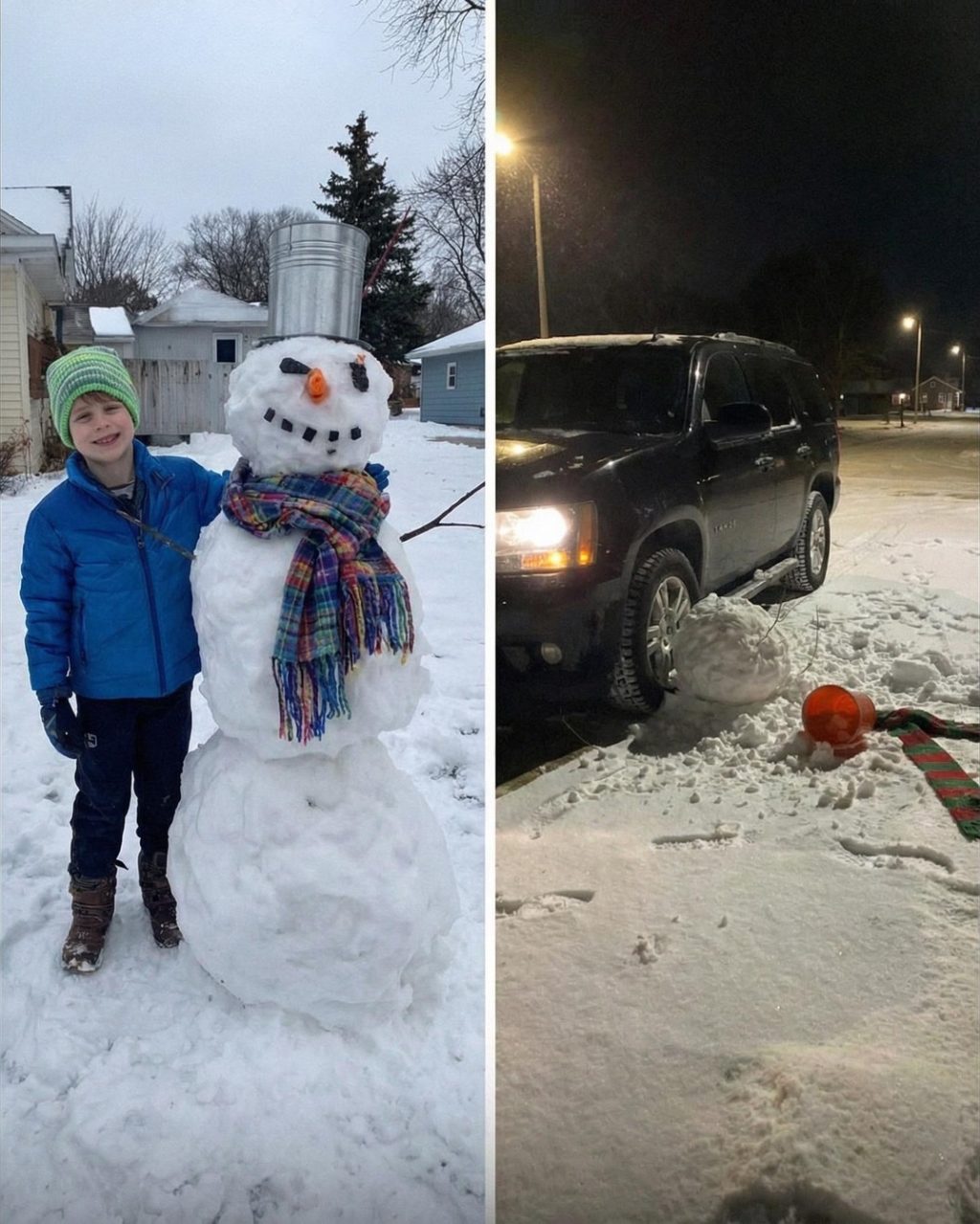
My son Nick is eight years old, and this winter he fell headfirst into what I can only describe as a full-blown snowman phase.
Not the casual, roll-a-ball-and-move-on kind. This was serious business.
Every afternoon after school, he’d burst through the front door, drop his backpack wherever it landed, and immediately start pulling on snow pants and gloves. He had a system. Snow pants first. Then boots. Then the scarf his grandmother knitted, even if it wasn’t that cold.
“Snowman weather doesn’t care about temperature,” he told me once, very seriously.
He always built them in the same spot: the corner of our lawn near the driveway. It wasn’t random. He liked that corner because it had the best snow—undisturbed, packed just right, and close enough that he could run back inside to warm his hands without abandoning his project.
Each snowman got a name. Not Frosty or silly things like that—real names. Harold. Simon. One memorable one was named Steve, for reasons I never fully understood.
They had stick arms, pebble eyes, and a scarf Nick insisted made them “official citizens.” That was his phrase. Official citizens.
And almost every time, they were gone by morning.
At first, I assumed it was kids messing around late at night or maybe the snow just collapsing after a freeze. Snowmen aren’t exactly built to last. But then I started noticing something else.
Tire tracks.
They cut right across the edge of our lawn, shallow but unmistakable. Always in the same place. Always right where Nick built his snowmen.
Our neighbor, Mr. Streeter, has a habit of cutting the corner when he pulls into his driveway. His house sits just a little higher than ours, and instead of making a clean turn, he angles across our grass to save himself a few seconds.
I’d noticed it before, but it hadn’t seemed worth starting a feud over. Grass grows back. Snow melts.
Then one evening, Nick came home quieter than usual.
He didn’t burst through the door. He didn’t talk about school. He just slipped off his boots, leaving little wet puddles on the mat, and stood there with his head down.
“Mom,” he said softly.
I looked up from the stove. “Hey, bud. What’s wrong?”
“He did it again.”
I already knew who “he” was.
“Did what again?” I asked gently, even though my chest was tightening.
Nick swallowed. “Mr. Streeter drove onto the lawn. He smashed him.”
I turned off the burner and pulled him into a hug. His gloves were damp, snow clinging to the seams.
“I’m sorry,” I said. “I know you worked hard on that one.”
“It was Simon,” he murmured. “He was my best one yet.”
This wasn’t the first time. I’d already spoken to Mr. Streeter twice. The first time, he’d laughed a little and said he didn’t realize it mattered. The second time, he’d been less patient.
“It’s just snow,” he’d said, shrugging. “It’ll melt anyway.”
Still, I promised Nick I’d talk to him again.
Nick shook his head before I even finished the sentence.
“It’s okay, Mom,” he said. “You don’t have to.”
I looked down at him. “What do you mean?”
He hesitated, then leaned closer, lowering his voice like we were sharing state secrets.
“I have a plan.”
That immediately set off alarm bells.
“What kind of plan, sweetheart?” I asked.
He smiled—not a mischievous grin, not the kind kids get when they know they’re about to do something wrong. This was calm. Confident.
“It’s a secret,” he said.
I should have pressed him. I should have insisted on details. But something about his tone stopped me. He didn’t sound angry. He didn’t sound vengeful.
He sounded… certain.
The next afternoon, Nick went out like usual. I watched from the kitchen window as he worked, rolling snow, patting it smooth, humming to himself. This one was bigger than the others. Wider base. Taller torso. No face yet.
When I asked him why, he said, “I’m waiting.”
I didn’t know what that meant, and before I could ask, he was already back outside.
Early evening rolled around, the sky dimming into that bluish winter twilight. I was folding laundry when I heard a sharp, sudden noise outside.
Not a crash exactly—more like a loud crunch followed by a metallic bang.
Then shouting.
My heart jumped into my throat.
I ran to the living room window just in time to see Mr. Streeter standing next to his car, hands in the air, staring down at his front tire.
Nick was right beside me, pressed to the glass, laughing so hard he had to lean on the window for support.
“Nick,” I said, horrified. “What did you do?”
“Nothing,” he said between giggles. “I didn’t do anything.”
I threw on my coat and boots and rushed outside.
The snowman—or what was left of it—stood exactly where Nick always built them. But this one was different.
Embedded deep in the base, completely hidden beneath packed snow, was a large, flat rock.
Mr. Streeter’s front tire was hissing loudly, already sinking.
He turned when he saw me. “Your kid put a rock in the snow!”
Nick stepped forward before I could speak.
“It’s our lawn,” he said calmly.
I froze.
Mr. Streeter stared at him. “What?”
Nick pointed at the edge of the driveway. “That’s where your driveway ends. This is our yard. You keep driving here.”
There was no yelling in his voice. No disrespect. Just fact.
“You broke my tire,” Mr. Streeter snapped.
Nick nodded. “You broke my snowmen.”
For a moment, no one spoke. The only sound was the tire slowly deflating.
I expected Mr. Streeter to explode. To threaten, to yell, to blame me.
Instead, he let out a long breath and rubbed his forehead.
“I didn’t see it,” he muttered.
“You never do,” Nick said quietly.
That landed harder than any insult could have.
I stepped in then, my heart pounding. “Nick, go inside.”
He hesitated, then nodded and walked back toward the house, boots crunching in the snow.
Mr. Streeter looked embarrassed now. Tired. Smaller somehow.
“I wasn’t trying to be a jerk,” he said. “I just… I cut the corner. Habit.”
“I talked to you,” I said. “Twice.”
“I know,” he admitted. “I didn’t think it mattered.”
He glanced at the flattened snowman again. “Guess it did.”
He paid for the tire himself. Didn’t ask us for anything. And the next morning, something unexpected appeared along the edge of our lawn.
Small orange survey flags. A clear line marking the boundary between his driveway and our grass.
Nick noticed them immediately.
“They’re like tiny borders,” he said, delighted.
From that day on, the snowmen survived. One lasted almost two weeks, slowly shrinking but never crushed. Mr. Streeter adjusted his turns, even when it meant backing up and trying again.
A few days later, he knocked on our door.
“I owe you both an apology,” he said. Then, awkwardly, he handed Nick a small carrot. “For the next one.”
Nick beamed.
Watching it all, I realized something important: my son hadn’t just protected his snowmen. He’d defended something bigger. Respect. Boundaries. The idea that small things matter, especially to people who put their hearts into them.
And he did it without shouting. Without cruelty. Without me stepping in to fight his battles.
Sometimes, the clearest lessons come from the smallest voices—standing their ground in the snow.