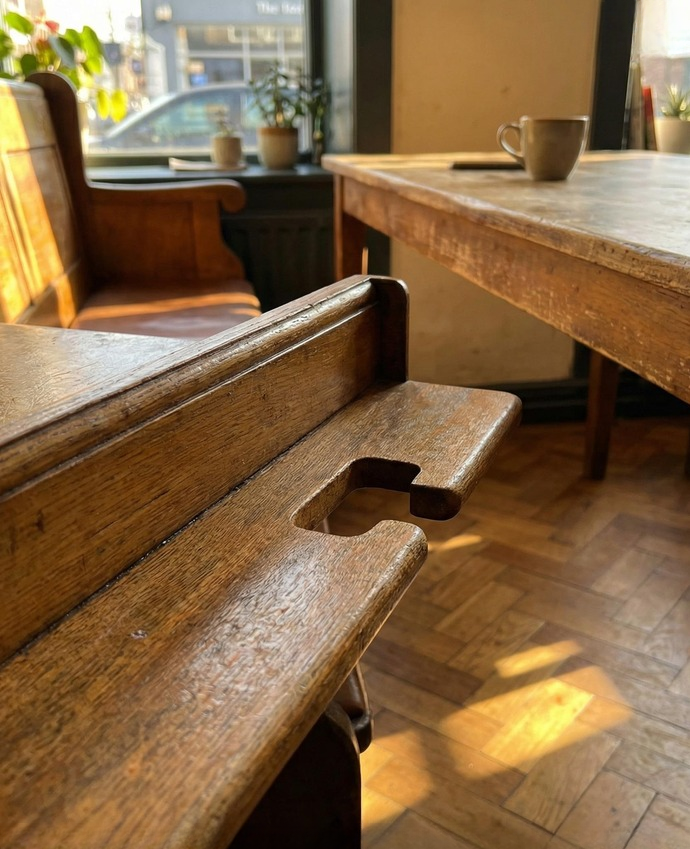
The Curious Cut-Out in the Pew: A Small Detail with a Quiet Purpose
If you’ve ever sat in an old Catholic cathedral and let your eyes wander instead of focusing on the homily, you may have noticed something peculiar.
Along the back edge of many wooden pews, there’s a small carved slot — a simple cut-out shape, often centered or placed at intervals. It’s not decorative. It’s not random. And once you notice it, you can’t unsee it.
So what is it for?
The answer is wonderfully practical — and deeply rooted in tradition.
A Place for the Faithful’s Essentials
That small carved opening is designed to hold a walking stick or cane.
In centuries past — and even today in many parts of the world — parishioners walked to church. Not just a block or two, but sometimes miles. Rural communities in particular depended on sturdy walking sticks for balance on uneven paths, muddy roads, and cobbled streets.
When they arrived at Mass, they needed somewhere to place those canes without them clattering to the floor or sliding down the smooth wood of the pew.
The solution was simple: carve a slot.
That small cut-out cradles the shaft of a cane upright, keeping it secure and out of the aisle. It’s subtle engineering — functional, unobtrusive, and built right into the structure of communal worship.
Designed for Dignity
There’s something deeply thoughtful about it.
Church architecture has always been about more than grandeur and stained glass. It’s about people — especially the elderly, the infirm, the faithful who show up week after week despite aching joints and slow steps.
These pew slots quietly say:
We expect you. We planned for you. You belong here.
Instead of forcing someone to lean their cane awkwardly against a pew (where it might fall during kneeling or standing), the slot keeps it steady. No noise. No fuss. No embarrassment.
In a space meant for reflection, silence matters.
A Feature You’ll Find in Older Churches
You’re more likely to see these carved slots in historic European cathedrals or older North American churches built in the 18th and 19th centuries.
Modern churches sometimes solve the same problem differently — with wider aisles, designated seating, or built-in cane hooks — but the carved slot remains a charming relic of thoughtful craftsmanship.
It also reflects a time when furniture was custom-built by local artisans. Every groove and curve had a purpose. Even the smallest detail carried intention.
Not for Books — And Not for Decoration
Some people assume the slot is meant for hymnals or prayer books.
It’s not.
Hymnals are typically stored in racks attached to the back of pews. The slot’s shape — narrow and open at the top — wouldn’t support a book properly. It’s perfectly sized, however, for the round shaft of a walking stick.
Others think it might be decorative — a stylistic flourish or a design quirk.
But church carpenters rarely wasted wood or labor on purely ornamental cut-outs in load-bearing structures. The placement and shape are too purposeful.
It’s utility, plain and simple.
A Small Window into the Past
What makes this detail so fascinating is how it captures everyday life from another era.
Before cars. Before paved parking lots. Before accessibility regulations were written into building codes.
People walked. They leaned on canes. They gathered.
And someone, long ago, noticed the quiet problem of sticks tipping over during Mass — and solved it with a chisel.
That’s the beauty of old architecture. It doesn’t just tell us about faith. It tells us about habits. Movement. Community. Consideration.
The Poetry of Practical Design
There’s something almost poetic about the way sacred spaces blend the spiritual and the practical.
Grand arches lift your gaze toward heaven.
Stone columns speak of permanence.
And a small wooden slot holds a tired parishioner’s cane.
One feature inspires awe.
The other prevents a trip hazard.
Both matter.
Next time you find yourself in an old cathedral, take a moment to look down instead of up. Run your hand along the wood polished by generations. Notice the little details — the ones no one points out in guidebooks.
Sometimes the smallest carvings hold the biggest stories.