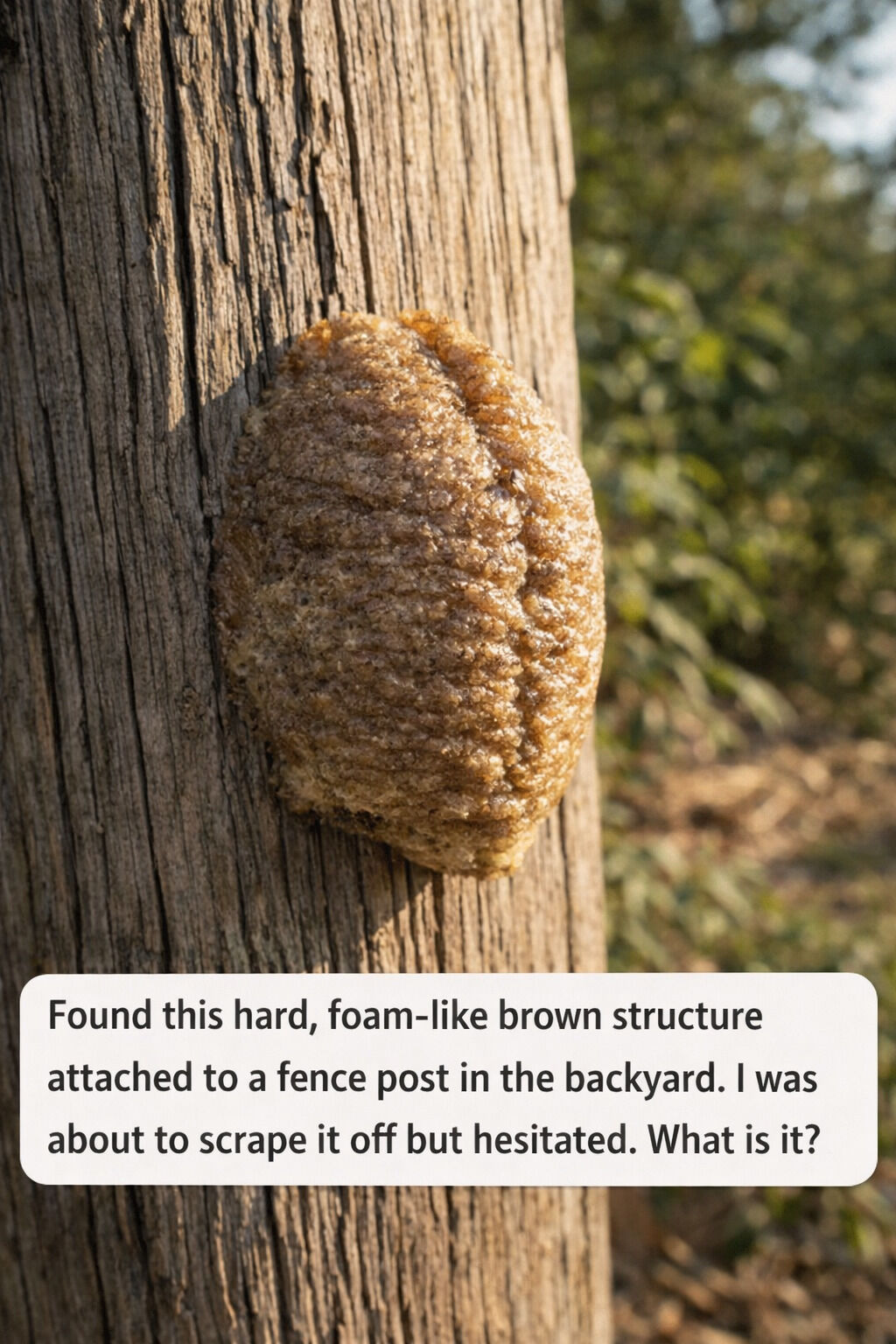
I was walking through the backyard, doing my usual casual scan for weeds and fallen branches, when something on the fence post caught my eye.
It was brown. Hard. Kind of foamy-looking.
At first, I assumed it was just some strange sap buildup or maybe a chunk of old insulation that had somehow ended up stuck there. I even grabbed a tool and started to scrape at it — but something made me pause.
It didn’t look random.
It looked… intentional.
So instead of knocking it loose, I snapped a photo and went inside to figure out what on earth I was looking at.
And I’m really glad I hesitated.
Because what I found out surprised me — and honestly changed the way I look at little discoveries like this.
That Weird “Foam” on Your Fence Might Be Something Special
If you’ve ever found a hard, tan-to-brown lump stuck to a fence, tree, wall, or even outdoor furniture, you’re not alone. A lot of people stumble across these strange structures and immediately assume they’re mold, fungus, or some kind of insect nest that needs to go.
That was my first instinct too.
But here’s the truth:
That odd-looking blob is almost certainly an egg case.
More specifically, it’s likely an ootheca — a protective casing created by a praying mantis to hold her eggs safely through winter.
Yes. Really.
Inside that compact little shell can be dozens — sometimes over a hundred — tiny mantis eggs, all waiting patiently for warmer weather.
Suddenly, that weird brown lump doesn’t feel so gross anymore.
It feels kind of magical.
Why They Look So Strange
When the mantis lays her eggs, she secretes a foamy substance that hardens when exposed to air. That foam becomes a tough, weather-resistant shell designed to protect the developing babies from cold, rain, predators, and time itself.
Once it dries, it takes on that wrinkled, layered appearance — almost like expanding foam insulation or hardened caramel.
Nature isn’t always pretty.
But it is brilliant.
This casing acts like a tiny fortress, keeping everything inside safe until spring.
What Happens If You Leave It Alone
If you let it stay right where it is, here’s what will likely happen:
When temperatures rise, dozens of tiny mantis nymphs will hatch and scatter into your yard.
And that’s actually great news.
Praying mantises are natural pest control experts. They feast on aphids, flies, beetles, mosquitoes, and other insects that love destroying gardens. Having them around means fewer chemicals, fewer bugs, and a healthier outdoor ecosystem.
They don’t harm plants.
They don’t bother people.
They just quietly do their job.
Think of them as tiny backyard guardians.
I Almost Destroyed It — And That’s What Stuck With Me
What hit me hardest was realizing how close I came to wiping out an entire generation of beneficial insects without even knowing it.
One quick scrape.
Gone.
It made me think about how often we remove things simply because they look unfamiliar or inconvenient.
But sometimes, those strange little discoveries are part of something bigger.
Something alive.
Something purposeful.
Now, every time I walk past that fence post, I feel oddly protective of that small brown bundle. I catch myself checking on it, wondering when the babies will arrive.
It’s funny how one pause can change everything.
Should You Remove It?
If it’s in a spot where it truly can’t stay — like right on your front door or somewhere high-traffic — you can gently relocate it to a tree or shrub using gloves. Just be careful not to crush it.
But if it’s tucked away in a quiet corner of your yard?
My advice is simple:
Let it be.
Spring will bring a tiny miracle.
A Little Reminder from the Backyard
Finding that egg case reminded me of something important: not everything strange needs fixing. Sometimes, it just needs understanding.
Our yards are full of hidden stories — tiny ecosystems quietly doing their thing while we rush past with lawn tools and to-do lists.
That foam-like lump?
It’s not trash.
It’s tomorrow’s pest patrol.
And I’m really glad I didn’t scrape it off.