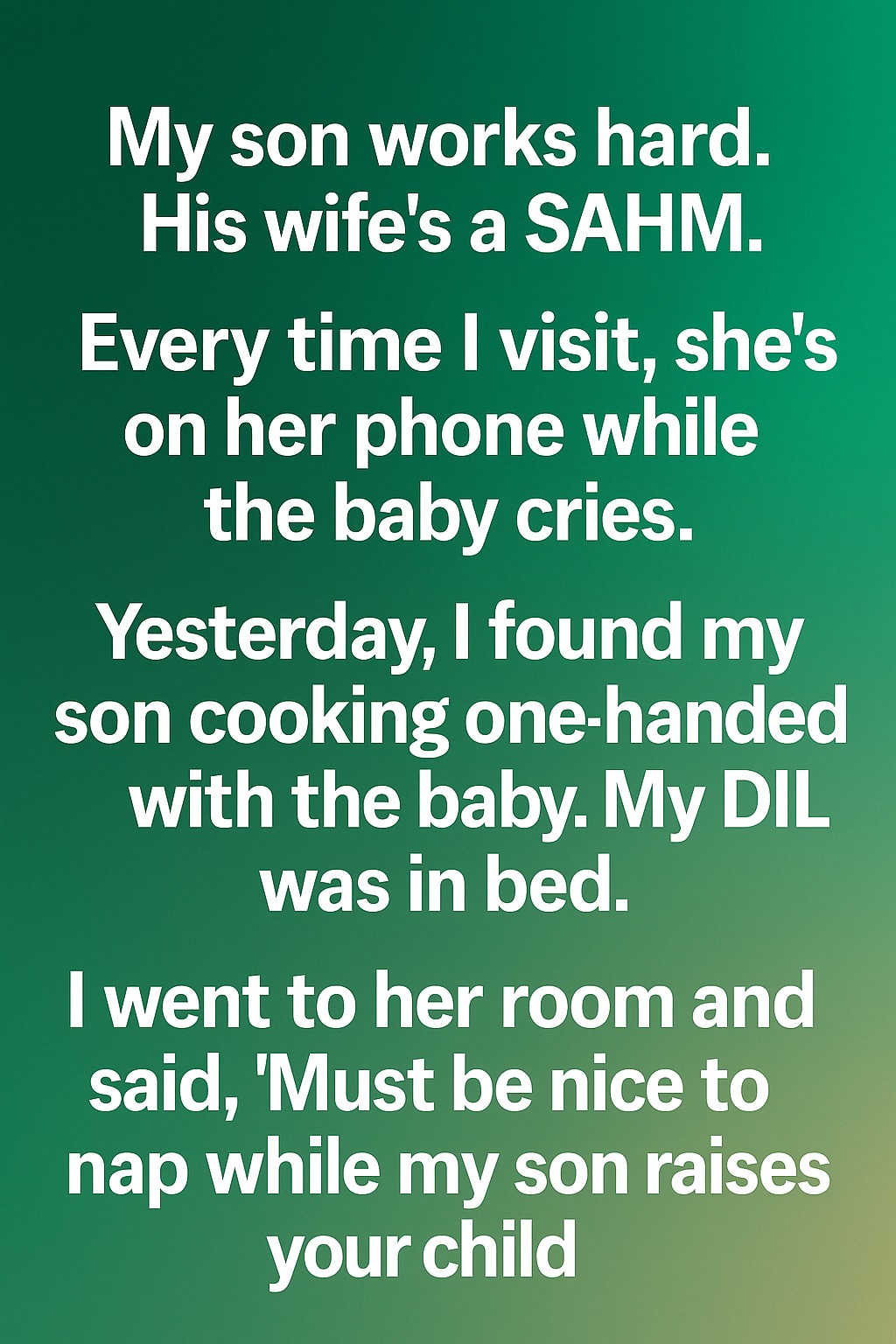
My son works hard. Long hours, early mornings, the kind of job that leaves him exhausted by the time he walks through the door. His wife is a stay-at-home mom.
And if I’m being honest, every time I visited, it rubbed me the wrong way.
She always seemed to be on her phone. The baby would be crying, and there she was—scrolling, tapping, barely reacting. At least, that’s how it looked to me. I grew up in a different time. When babies cried, you picked them up. You didn’t stare at a screen.
So I kept quiet, but the judgment sat heavy in my chest.
Then yesterday happened.
I came over unannounced, like I sometimes do. The house was quiet except for the sound of the baby fussing. I walked into the kitchen and stopped short.
There was my son, holding the baby against his chest with one arm, gently bouncing while stirring something on the stove with the other. He looked tired—really tired. Dark circles under his eyes, shoulders slumped, moving on muscle memory more than energy.
“Hey, Mom,” he said, trying to smile.
I glanced around. “Where’s your wife?”
He nodded toward the bedroom. “She’s resting.”
Resting.
I felt something tighten inside me.
A few minutes later, I walked down the hall and pushed open the bedroom door. She was lying in bed, eyes closed, phone on the nightstand. She looked peaceful.
And before I could stop myself, the words came out.
“Must be nice,” I said sharply, “to nap while my son raises your child.”
Her eyes opened slowly. She didn’t look startled. She didn’t look guilty. She just looked… exhausted.
For a moment, she said nothing.
Then she sat up.
“Can I tell you something?” she asked quietly.
I crossed my arms, already defensive. “Go ahead.”
She took a breath. “I’ve been up since 2 a.m. The baby wouldn’t sleep. I fed him, changed him, walked him around the house for hours. At 6, your son woke up and insisted I lie down for a bit.”
I didn’t respond.
She continued, her voice steady but tired. “This is the first time I’ve closed my eyes today.”
Something in her tone made me uncomfortable—not angry, not dramatic. Just honest.
“I’m not on my phone because I don’t care,” she said. “I’m on it because sometimes it’s the only way I stay awake. Or sane. Or connected to adults.”
I opened my mouth to reply, but nothing came out.
She swung her legs over the side of the bed and stood up. As she passed me, she added, “You see five minutes. I live the other twenty-three hours.”
She walked down the hall toward the kitchen.
I stayed frozen in the doorway.
From the kitchen, I heard her say softly, “Give him to me,” and the baby’s cries quieted almost instantly.
I stood there longer than I meant to.
Later, I sat at the table while they moved around the kitchen together—wordless, practiced, clearly a team. She took the baby. My son leaned against the counter, rubbing his eyes.
“You okay?” she asked him.
“Yeah,” he said. “Just tired.”
She smiled gently. “Me too.”
That’s when something hit me.
I’d been keeping score without knowing the rules.
I saw her resting and assumed laziness. I saw her on her phone and assumed indifference. I saw my son helping and assumed imbalance.
What I didn’t see were the nights she handled alone. The mental load. The constant vigilance. The fact that being home with a baby isn’t rest—it’s relentless.
Later, my son pulled me aside.
“Mom,” he said carefully, “she’s an amazing mother. I don’t need you defending me from her.”
That stung. But he was right.
On my way out, I stopped by her again.
“I owe you an apology,” I said. “I spoke out of judgment, not understanding.”
She looked surprised, then nodded. “Thank you.”
I hesitated. “I didn’t know.”
She gave a tired smile. “Most people don’t.”
Driving home, I replayed everything in my head.
I thought about how easily we judge what we don’t live. How quickly we assign value to visible effort and ignore invisible exhaustion. How different motherhood looks now—and how hard it still is.
I learned something that day.
Being tired doesn’t always look like hard work.
And rest doesn’t always mean you’re doing nothing.
Sometimes, it means you’ve already given everything you had.