The judge nodded.
When the video started, the entire courtroom fell silent.
My husband filed for divorce the way someone files a police report.
No therapy.
No conversation.
No warning.
Just a neatly stacked packet of documents left at my office reception desk, clipped together and placed beside my name. On top was a pale yellow sticky note that read:
Please don’t make this difficult.
That was Caleb—always polite when he wanted to be cruel.
He wanted full custody of our ten-year-old daughter, Harper. In his filing, he described me as unstable, financially irresponsible, and emotionally volatile. He painted himself as the calm, dependable parent—the one who cooked dinners, helped with homework, and maintained structure.
And because he wore a clean suit and spoke softly, people believed him.
In court, he barely held my gaze for two seconds before looking away, as if I were something unpleasant he’d already disposed of.
Harper sat beside my lawyer and me on the first day of the hearing. Her feet didn’t reach the floor, and her hands were folded in her lap so carefully it broke my heart.
I didn’t want her there.
But Caleb insisted.
He said she would “help the judge see the reality.”
Apparently, the reality was a child watching her parents dismantle each other in public.
Caleb’s lawyer spoke first.
“Mr. Dawson has been the primary caregiver,” she said calmly. “He provides structure and emotional consistency. Meanwhile, Ms. Dawson has displayed unpredictable mood swings and has exposed the child to inappropriate conflict.”
Inappropriate conflict.
I wanted to laugh, but my throat burned instead.
I had proof—texts, bank statements, the nights Caleb didn’t come home, the way he siphoned money into an account I didn’t even know existed. I had screenshots of messages sent at 2 a.m., excuses that never matched, apologies that never lasted.
But my lawyer told me to stay calm. To wait. To let the evidence be introduced properly.
Even so, the judge’s face remained neutral.
That kind of neutrality that makes you feel invisible.
Then, just as Caleb’s lawyer finished speaking, Harper shifted in her seat.
She raised her hand.
Small. Steady.
Everyone turned.
My heart stopped.
“Harper…” I whispered, instinctively reaching for her arm.
But she stood anyway.
She looked up at the bench, her shoulders straight, her eyes far too serious for a ten-year-old.
“Your Honor,” she said clearly, her voice trembling but brave, “can I show you something Mommy doesn’t know?”
The courtroom went completely silent.
Caleb’s head snapped toward her.
For the first time that day, his composure cracked.
“Harper,” he said sharply, “sit down.”
She didn’t.
The judge leaned forward slightly. “What would you like to show me?” he asked gently.
Harper swallowed. “A video,” she said. “It’s on my tablet. I kept it because I didn’t know who to tell.”
My stomach dropped.
A video?
Caleb’s lawyer stood up immediately. “Your Honor, we object—”
The judge raised his hand. “I’ll allow a brief review in chambers,” he said, then looked back at Harper. “But tell me this first. Why doesn’t your mother know?”
Harper’s chin trembled.
“Because Dad told me not to,” she whispered.
Caleb went pale.
My hands shook so badly I had to grip the edge of the table to steady myself.
The judge’s voice remained calm, but something in his eyes changed. “Marshal,” he said, “please bring the child’s device.”
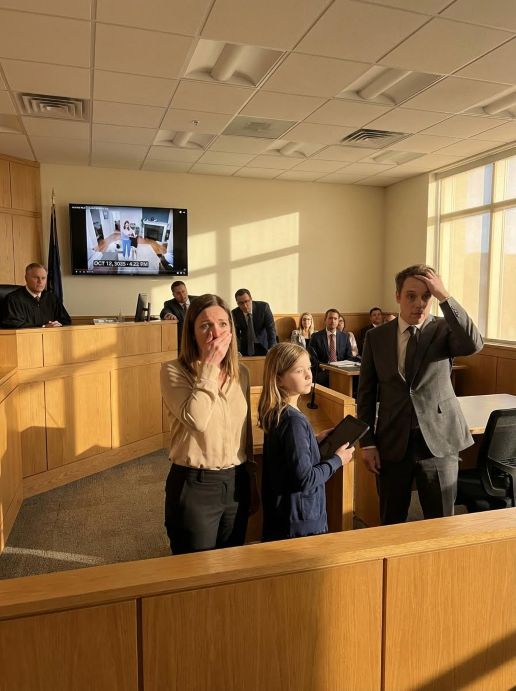
Harper walked forward, small in that enormous room, and handed her tablet to the court officer with both hands—like she was surrendering something precious.
When the judge signaled for the courtroom screen to turn on, my heart was pounding so hard my ears rang.
The screen flickered.
And the first image froze the entire room.
It was Caleb.
Standing in our kitchen.
The timestamp glowed in the corner of the screen—11:47 p.m., three months earlier. A night he had told me he was “working late.”
He was yelling.
Not the controlled, quiet man everyone else knew—but loud, sharp, unfiltered.
“You think I don’t know what you’re doing?” he shouted at someone off-camera.
Then the camera angle shifted.
It was Harper holding the tablet. Her breathing was shaky.
“I’m scared,” her small voice said.
Caleb spun toward her.
His face changed instantly.
Not concern.
Not regret.
Anger.
“Turn that off,” he snapped. “Don’t record me.”
The courtroom was motionless.
Then the video continued.
Another clip.
Caleb pacing the living room, phone pressed to his ear.
“She’s useless,” he said, laughing coldly. “I’ll take everything. The house. The kid. I’ll make her look crazy. Judges eat that up.”
A murmur rippled through the courtroom.
I felt like I couldn’t breathe.
Another clip.
Caleb crouching in front of Harper.
“If you tell Mommy any of this,” he said quietly, dangerously calm, “she’ll lose you. Do you understand?”
Harper nodded in the video.
Tears streamed down my face.
The screen went black.
No one spoke.
Not Caleb.
Not his lawyer.
Not even the judge—at least, not right away.
Then the judge slowly stood.
“Mr. Dawson,” he said, his voice firm and controlled, “you will remain seated.”
Caleb looked like he might collapse.
The judge turned to me. “Ms. Dawson, did you have any knowledge of these recordings?”
I shook my head. “No, Your Honor.”
He nodded once, then looked at Harper.
“You were very brave,” he said gently. “But you should never have been put in that position.”
Harper finally sat down, curling into herself like she’d been holding her breath for months and could finally let it go.
The ruling didn’t come that day.
But when it did, it was clear.
Full custody was denied to Caleb.
An investigation was ordered.
Supervised visitation only—pending further review.
As for me?
The judge looked directly at me before adjourning.
“Your daughter told the truth when no one else could,” he said. “That speaks volumes about the environment she needs.”
Outside the courthouse, Harper slipped her hand into mine.
“I didn’t want to keep secrets anymore,” she said softly.
I knelt and hugged her tightly.
Neither of us looked back.
And for the first time since that sticky note appeared on my desk, I felt something I hadn’t felt in a long time.
Safe.