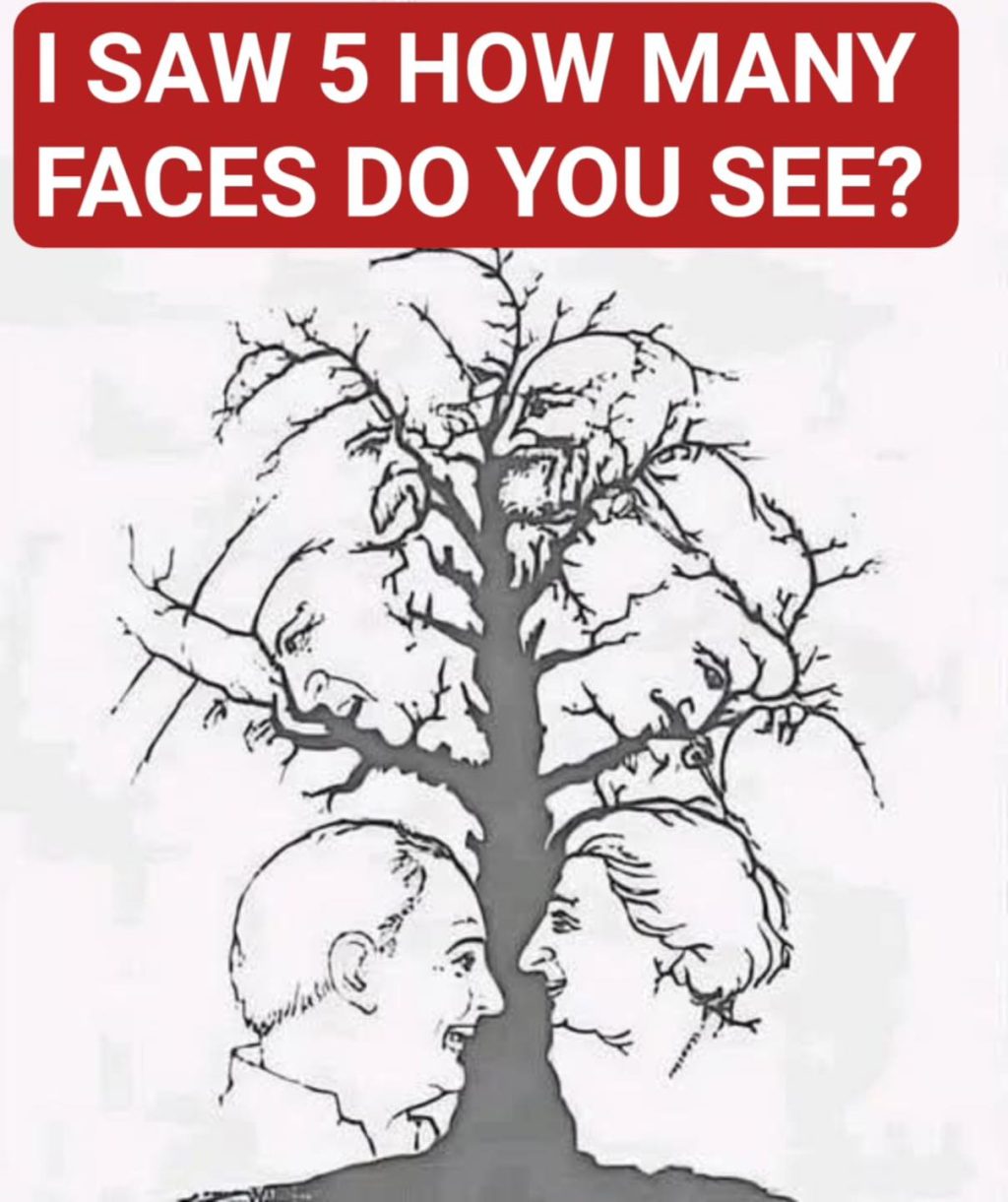
At first glance, this image seems simple: a tree standing between an older couple facing each other. Nothing unusual, right?
But look again.
This classic optical illusion has been circulating for decades, quietly challenging people’s perception, attention to detail, and visual flexibility. And here’s the kicker: most people don’t see all the faces—at least not right away.
The challenge is simple.
Find all the hidden faces in under 10 seconds.
Ready?
What Most People See First
Nearly everyone spots the same two faces immediately:
an elderly man and woman looking at each other at the base of the tree. That’s the obvious layer—the one your brain locks onto instantly.
Your mind loves familiar patterns, especially faces. Once it finds one, it tends to stop searching. This is called perceptual anchoring, and it’s exactly what makes this illusion so tricky.
If you stopped at two, don’t worry. You’re in very good company.
The Faces Hidden in Plain Sight
The real magic of this image lives in the branches.
As you shift your focus upward, the tree’s limbs begin to transform. What once looked like random lines suddenly take on new meaning: profiles, noses, foreheads, lips—entire faces hiding in the negative space.
Some appear sideways.
Some are upside down.
Some only emerge when you stop trying so hard to see them.
That’s the key.
This illusion isn’t about sharp eyesight. It’s about mental flexibility—your ability to let go of the first interpretation and allow new ones to surface.
So… How Many Faces Are There?
The headline gives a hint: five.
Two are obvious.
Three are cleverly embedded in the tree’s branches and contours.
If you found all five in under 10 seconds, that puts you in a very small group. Not because you’re “smarter” in the traditional sense—but because your brain is comfortable switching perspectives quickly.
What This Says About Your Brain
Optical illusions like this one reveal something fascinating about how we process the world:
- People who spot multiple faces quickly tend to be strong at pattern recognition
- They’re often good at seeing connections others miss
- They’re more comfortable with ambiguity and layered information
In everyday life, this can show up as creativity, intuition, or the ability to read between the lines.
And if you didn’t see all five right away? That doesn’t mean anything negative. It just means your brain prefers clarity and stability first—and there’s real strength in that too.
Why This Illusion Never Gets Old
What makes this image so powerful is that it changes depending on how you look at it. The illusion doesn’t move—but your perception does.
That’s why people can stare at it for minutes, suddenly spotting a new face they swear wasn’t there before. The image stays the same. The viewer doesn’t.
Try This Before You Scroll Away
Cover the bottom half of the image and focus only on the branches.
Then flip your screen upside down.
Then relax your eyes and stop actively searching.
Chances are, another face will pop out when you least expect it.
That’s the beauty of optical illusions—they remind us that seeing isn’t just about the eyes. It’s about the mind.
So, how many did you spot before reading the answer? 👀