Three days after my hysterectomy, when I could barely get out of bed without wincing, I shuffled into the kitchen, clutching the counter for balance. Every small movement reminded me how fragile I was, how much my body had been through.
I expected to see a cup of tea waiting for me.
Maybe a sticky note with “Rest today” or “I love you.”
Instead, there was a single sheet of paper taped to the fridge.
At first, I thought it was a grocery list.
But when I leaned closer, my heart stopped.
It was a bill.
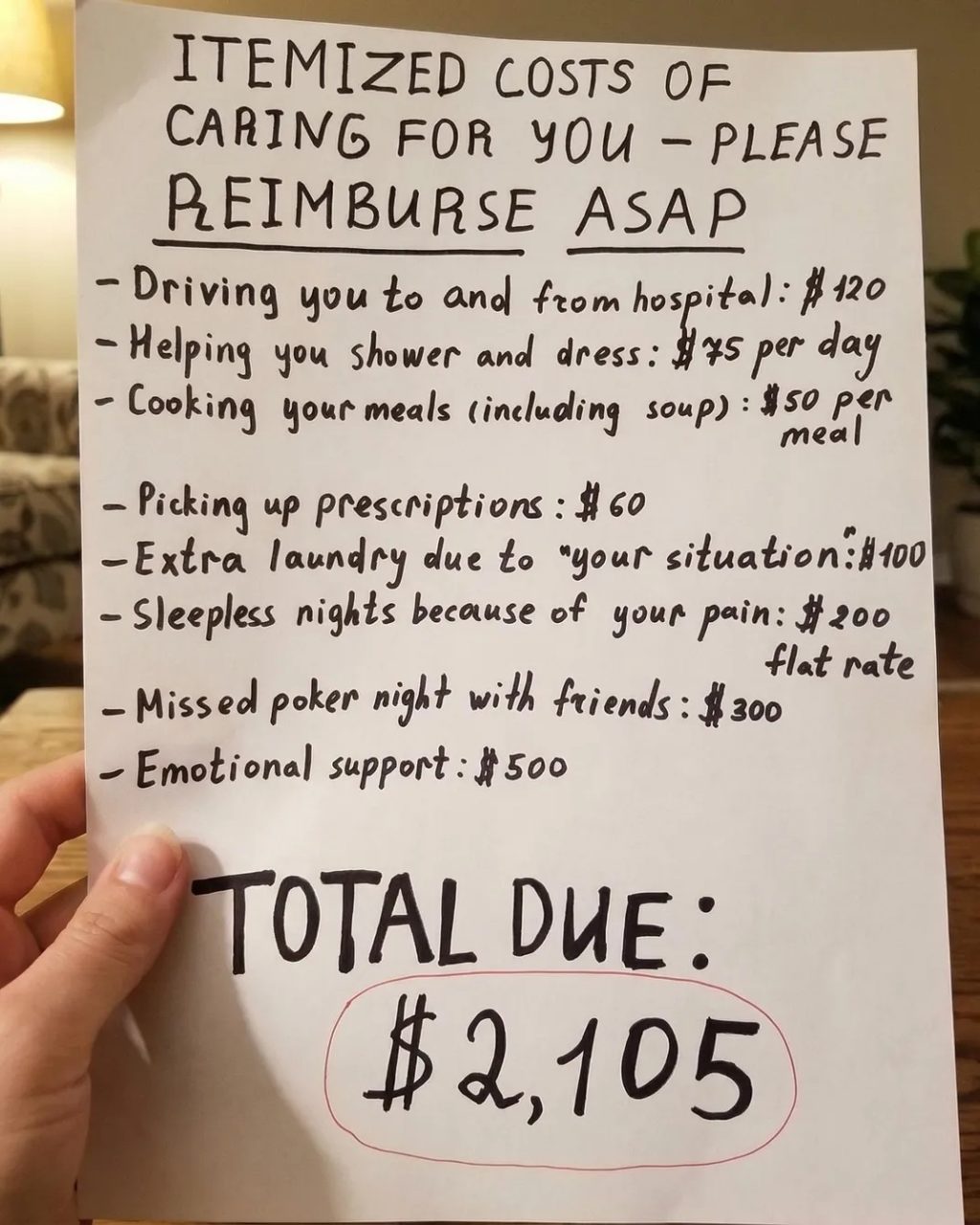
“ITEMIZED COSTS OF CARING FOR YOU — PLEASE REIMBURSE ASAP.”
Written in my husband’s neat block letters, it looked like something pulled from an accountant’s office—not from the man I’d been married to for seven years.
My eyes blurred as I read it line by line.
- Driving you to and from the hospital: $120
- Helping you shower and dress: $75 per day
- Cooking your meals (including soup): $50 per meal
- Picking up prescriptions: $60
- Extra laundry due to “your situation”: $100
- Sleepless nights because of your pain: $200 flat rate
- Missed poker night with friends: $300
- Emotional support: $500
At the bottom, circled in red:
TOTAL DUE: $2,105
My knees nearly buckled. I grabbed the fridge handle just to stay upright.
This wasn’t a joke.
Not a prank.
Not sarcasm.
It was his handwriting. His voice echoed in my head—cool, practical, transactional—tallying up the cost of my pain.
I had trusted this man with my body, my future, my health.
I had trusted him when he squeezed my hand before surgery and whispered, “I’ve got you.”
And now, stitched together and barely able to stand, I was being treated like an invoice.
I stood there for a long time, staring at that paper, until the shock faded into something colder.
Clarity.
My husband, Mark, came home that evening cheerful and relaxed, carrying takeout and humming like nothing was wrong.
“Hey,” he said. “How are you feeling?”
I didn’t answer right away.
I handed him the paper.
His smile barely flickered.
“Oh. That,” he said casually. “Yeah, I figured we should be fair about it.”
“Fair?” My voice was quiet. Dangerous.
“Well,” he shrugged, “I’ve been doing a lot extra. I missed work hours. Poker night. It adds up.”
I stared at him.
“You charged me for emotional support,” I said.
He laughed lightly. “I mean… that one’s kind of a joke.”
Nothing about his face suggested it was.
“I just think,” he continued, “that if the roles were reversed, you’d understand.”
That’s when something inside me hardened.
I nodded slowly.
“You’re right,” I said. “You’re absolutely right.”
He looked relieved. “See? I knew you’d get it.”
“Oh, I do,” I said softly. “Completely.”
That night, while he slept peacefully beside me, I opened my laptop.
And I started working.
The next morning, Mark woke up to find a new sheet of paper taped to the fridge—right next to his.
Mine was longer.
Neater.
Detailed.
“RETROACTIVE INVOICE: UNPAID LABOR & SACRIFICES DURING OUR MARRIAGE.”
He squinted. “What’s this?”
“I thought we were being fair,” I said, sipping my tea.
His eyebrows lifted as he read.
- Carrying and giving birth to our child before my miscarriage: $25,000
- Emotional labor of managing family schedules for 7 years: $15,000
- Cooking meals you ‘didn’t feel like making’: $18,200
- Cleaning bathrooms you ‘forgot about’: $9,100
- Being your emotional support through job stress and family drama: $20,000
- Putting my career on hold for your promotions: $30,000
- Pain, blood loss, and permanent bodily changes from surgery: PRICELESS
At the bottom:
TOTAL DUE: $117,300
His face drained of color.
“You can’t be serious,” he said.
I smiled gently.
“Oh, but I am. I even gave you a discount. Market rates would be higher.”
“That’s ridiculous,” he snapped. “Marriage doesn’t work like that!”
I tilted my head.
“Exactly.”
Silence stretched between us.
For the first time since my surgery, he looked uncomfortable.
“You made me feel like a burden,” I continued quietly. “Like my pain was an inconvenience you deserved compensation for.”
“That’s not—”
“You itemized my suffering,” I said. “So I thought I’d return the favor.”
He swallowed.
“I didn’t realize…” His voice faltered. “I didn’t think it would hurt you like that.”
I met his eyes.
“That’s the problem. You didn’t think at all.”
That afternoon, Mark tore his bill off the fridge and threw it away.
Then he sat down beside me and cried.
Not loudly. Not dramatically.
Just quietly, ashamed.
“I’m sorry,” he said. “I failed you when you needed me most.”
I didn’t forgive him immediately.
Respect doesn’t grow back overnight.
But things changed after that.
He started helping without keeping score.
Started listening without defensiveness.
Started understanding that love isn’t transactional.
And I learned something too.
That strength doesn’t always look like endurance.
Sometimes, it looks like standing up—slowly, painfully—and refusing to be reduced to a line item.
Because love is not a service rendered.
And respect should never come with a price tag.