The waitress slapped my card down on the table so hard it made my wife flinch.
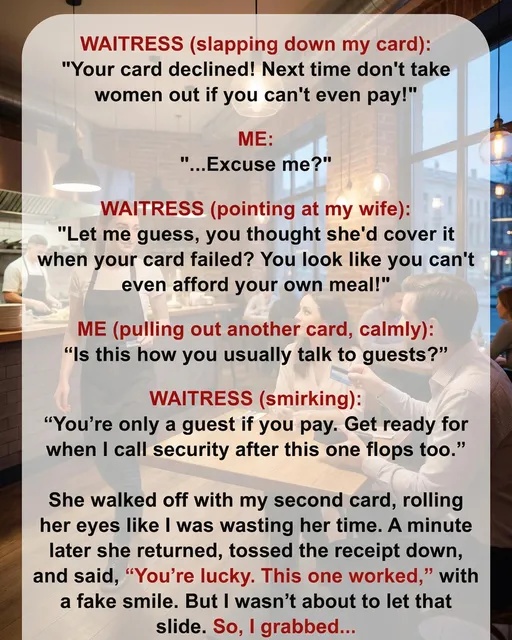
“Your card declined,” she said loudly. “Next time, don’t take women out if you can’t even pay.”
The surrounding tables went quiet. Forks paused midair. I felt every pair of eyes turn toward us.
“…Excuse me?” I said calmly, though my chest was tight.
She pointed at my wife like she was an exhibit.
“Let me guess,” she sneered. “You thought she’d cover it when your card failed? You look like you can’t even afford your own meal.”
My wife’s face turned red. She reached for her purse, but I gently stopped her.
I pulled out another card and placed it on the table, my voice steady.
“Is this how you usually talk to your guests?”
The waitress smirked.
“You’re only a guest if you pay. Get ready—I’ll call security when this one flops too.”
She snatched the second card and walked off, rolling her eyes as if I were wasting her time.
The restaurant felt painfully quiet. I could hear my wife’s breathing beside me, shallow and embarrassed.
“I’m sorry,” she whispered. “We can just leave.”
I squeezed her hand.
“No,” I said quietly. “We’re not going anywhere.”
A minute later, the waitress returned. She tossed the receipt onto the table and forced a tight smile.
“You’re lucky. This one worked.”
She turned to walk away.
But I wasn’t about to let that slide.
“So,” I said, loud enough for her to hear, “what was the problem with the first card?”
She shrugged. “Machine glitch. Happens.”
“No apology?” I asked.
She leaned in slightly, lowering her voice with mock sweetness.
“You got your food. You paid. Don’t push your luck.”
She walked away.
My wife looked at me, eyes glossy. “Let’s just eat.”
But my appetite was gone.
I looked around the restaurant—linen tablecloths, dim lighting, expensive décor. This place prided itself on “class.”
And yet, I had just been humiliated in front of a room full of strangers.
Not because my card declined.
But because she decided I didn’t belong.
I asked to see the manager.
She didn’t return with him.
Instead, ten minutes passed.
Then fifteen.
Our food arrived cold.
The waitress avoided our table completely.
Finally, a man in a tailored suit approached, clipboard in hand.
“I’m the manager,” he said politely. “Is there a problem?”
I nodded calmly.
“Yes. A serious one.”
I explained everything. Slowly. Clearly. Without raising my voice.
The slamming of the card.
The comments about my wife.
The threat of security.
The refusal to apologize.
The manager’s face tightened with every sentence.
“I’m very sorry,” he said. “That’s not how we treat guests.”
“I’d like to show you something,” I replied.
I handed him my first card.
He glanced at it—and froze.
Then he looked at me again, this time really looking.
“I see,” he said quietly.
He swallowed.
“Please excuse me for a moment.”
He walked briskly toward the back.
Five minutes later, the restaurant owner emerged.
His smile vanished the moment he saw me.
“Sir,” he said nervously, “I had no idea you were dining with us tonight.”
I stood.
“I wasn’t planning to announce myself,” I said evenly. “I just wanted dinner with my wife.”
The owner nodded quickly.
“I understand. And I assure you, this will be handled.”
He turned sharply toward the waitress, who had gone pale.
“Office. Now.”
She tried to laugh it off. “What? I didn’t do anything—”
“Now,” he snapped.
The entire restaurant watched as she followed him, shoulders slumped.
The owner turned back to us.
“Dinner is on the house,” he said. “And I offer my deepest apologies.”
I nodded.
“That won’t be necessary,” I said. “But I will leave feedback.”
We finished our meal in silence.
When the bill came, it read: $0.00.
As we stood to leave, the owner stopped me.
“Sir… thank you for bringing this to my attention.”
I met his eyes.
“Respect isn’t about money,” I said. “It’s about humanity.”
He nodded.
Outside, my wife exhaled shakily.
“I felt so small,” she said. “Like I’d done something wrong just by being there.”
I wrapped an arm around her.
“You didn’t,” I said. “And neither did I.”
She looked up at me. “Why did that card matter so much to them?”
I smiled faintly.
“Because it’s tied to the company that owns this building.”
Her eyes widened.
“Oh.”
The next week, I received an email.
The waitress had been terminated.
Mandatory retraining was issued.
Policies were rewritten.
Not because I demanded it.
But because respect should never be optional.
That night reminded me of something important:
People will judge you by what they think you’re worth.
But dignity?
That’s something no card can buy—and no one has the right to take away.