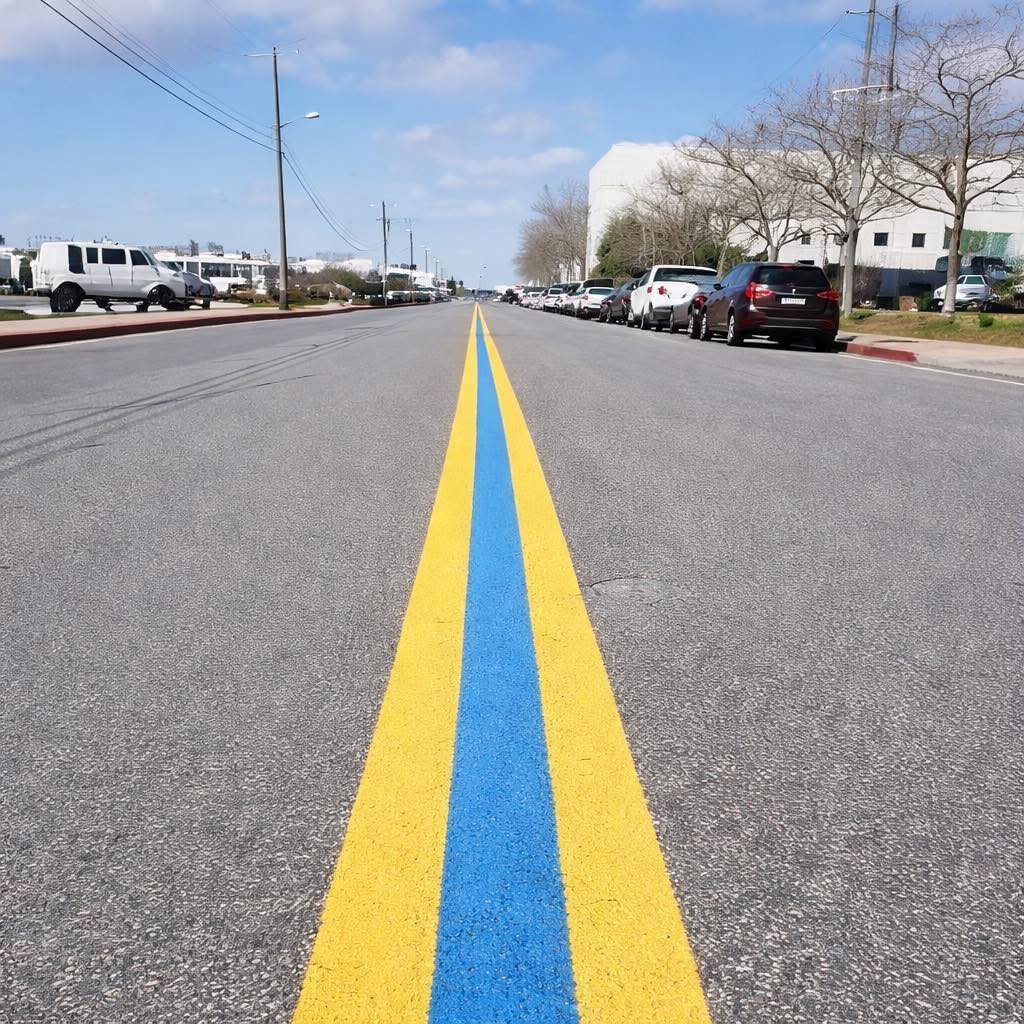
You’re driving through a quiet neighborhood or an industrial area, minding your own business, when something catches your eye: a thin blue line painted right down the middle of the road. Not a bike lane. Not a construction mark. Just… blue.
If you’ve ever wondered what that blue line is doing there, you’re not alone. It looks unusual because, unlike white or yellow road markings, blue isn’t typically used for traffic control. And that’s exactly the clue.
The blue line isn’t meant for drivers at all.
It’s there for firefighters.
The Hidden Language of Street Markings
Roads are full of quiet signals most of us never think about. Yellow lines divide traffic directions. White lines guide lanes and crossings. Red curbs warn you not to park. All of these are designed with drivers in mind.
Blue lines serve a very different audience.
In many cities and municipalities, a blue line painted along or near the center of a street is used to mark the location of underground water mains—specifically, the pipes firefighters rely on during emergencies.
The line acts as a visual map, telling fire crews exactly where to find a water source when seconds matter.
Why Firefighters Need It
When a fire breaks out, firefighters don’t just hook a hose to the nearest hydrant and hope for the best. They need to know where the main water lines run underground so they can:
- Locate the strongest water supply
- Connect quickly in low-visibility conditions
- Avoid damaging critical infrastructure
- Save valuable time during an emergency
In smoke, darkness, or chaotic conditions, a clearly painted blue line on the pavement can be the difference between hesitation and immediate action.
It’s especially useful in areas where hydrants are spaced far apart, hidden, or partially obscured by parked cars, snow, or vegetation.
Why Blue?
Color coding is a universal system in construction and emergency planning:
- Blue = potable (drinkable) water
- Red = electricity
- Yellow = gas
- Green = sewer
- Orange = communication lines
Blue stands out against asphalt and doesn’t conflict with standard traffic markings. It’s recognizable, consistent, and easy to spot—even at night or through smoke.
Where You’re Most Likely to See It
Blue road lines are more common in certain areas, including:
- Industrial zones
- Warehouse districts
- Newly developed neighborhoods
- Cities with strong fire safety infrastructure
- Areas prone to wildfires or large structural fires
Not every city uses them, which is why they often surprise people when they appear.
What It Doesn’t Mean
The blue line is not:
- A bike lane
- A parking restriction
- A traffic lane
- A decorative feature
- A secret code for drivers
You don’t need to change how you drive, park, or behave because of it. It’s informational, not instructional—for emergency services only.
A Quiet Safety Feature Most People Never Notice
What makes the blue line fascinating is how invisible it is to everyday life. Thousands of cars pass over it daily, and most drivers never give it a second thought. Yet in an emergency, that simple strip of paint becomes critically important.
It’s a reminder that cities are layered systems. Beneath the pavement are networks of water, power, gas, and communication—each carefully mapped and marked, even if we don’t see it.
So the next time you spot a blue line stretching down a street, you’ll know: it’s not random, and it’s not decorative.
It’s there to help save lives.
When a Blue Line Leads to a Police Station
In several cities and countries, a blue line painted on the roadway is a wayfinding tool designed to guide people directly to a police station or police facility.
This system is often used to help:
- Visitors or tourists who don’t know the area
- People in distress who may not have GPS access
- Drivers who need urgent police assistance
- Emergency responders navigating unfamiliar streets
Instead of relying on signs alone, the road itself becomes the guide. You simply follow the blue line until it ends — usually right at the entrance of a police station.
This practice has been documented in parts of:
- Europe
- South America
- Some Asian cities
- Older urban districts with limited signage
In these cases, the blue line is intentional, directional, and symbolic — blue being strongly associated with law enforcement worldwide.
How This Is Different From Firefighter Blue Lines
Here’s where people mix them up.
There are two very different uses of blue lines on streets:
🔹 Police Wayfinding Blue Lines
- Purpose: Guide people to a police station
- Appearance: Often a single solid blue line
- Placement: May run continuously through multiple streets
- Audience: The general public
- Meaning: “Follow this to the police”
🔹 Fire Infrastructure Blue Lines
- Purpose: Mark underground water mains
- Appearance: Thin blue stripe, often near yellow lines
- Placement: Along the center or side of the road
- Audience: Firefighters and emergency crews
- Meaning: “Water supply runs here”
They can look similar — but their intent is completely different.
How to Tell Which One You’re Seeing
Ask yourself a few quick questions:
- Does the line continue through intersections, turning with the road?
→ Likely police wayfinding. - Does it end abruptly, stay perfectly straight, or align with hydrants?
→ Likely a water main marker. - Is there a police station nearby or at the end of the route?
→ That’s your answer. - Are there small police symbols, arrows, or signs along the way?
→ Definitely police-related.
Why Cities Use This System
Painted guidance lines are:
- Cheap to install
- Easy to follow
- Language-independent
- Visible in bad weather
- Helpful when technology fails
In emergencies, simplicity matters. A blue line on asphalt can be more effective than a dozen street signs.
So… Who’s Right?
Both explanations are correct — just in different places.
In some cities, blue lines help firefighters.
In others, they quietly guide people to the police.
And unless you know the local context, it’s easy to assume one when it’s actually the other.
That’s what makes these markings so interesting:
they’re part of a hidden language most of us were never taught.
And now, next time you see one, you’ll know exactly what to look for.