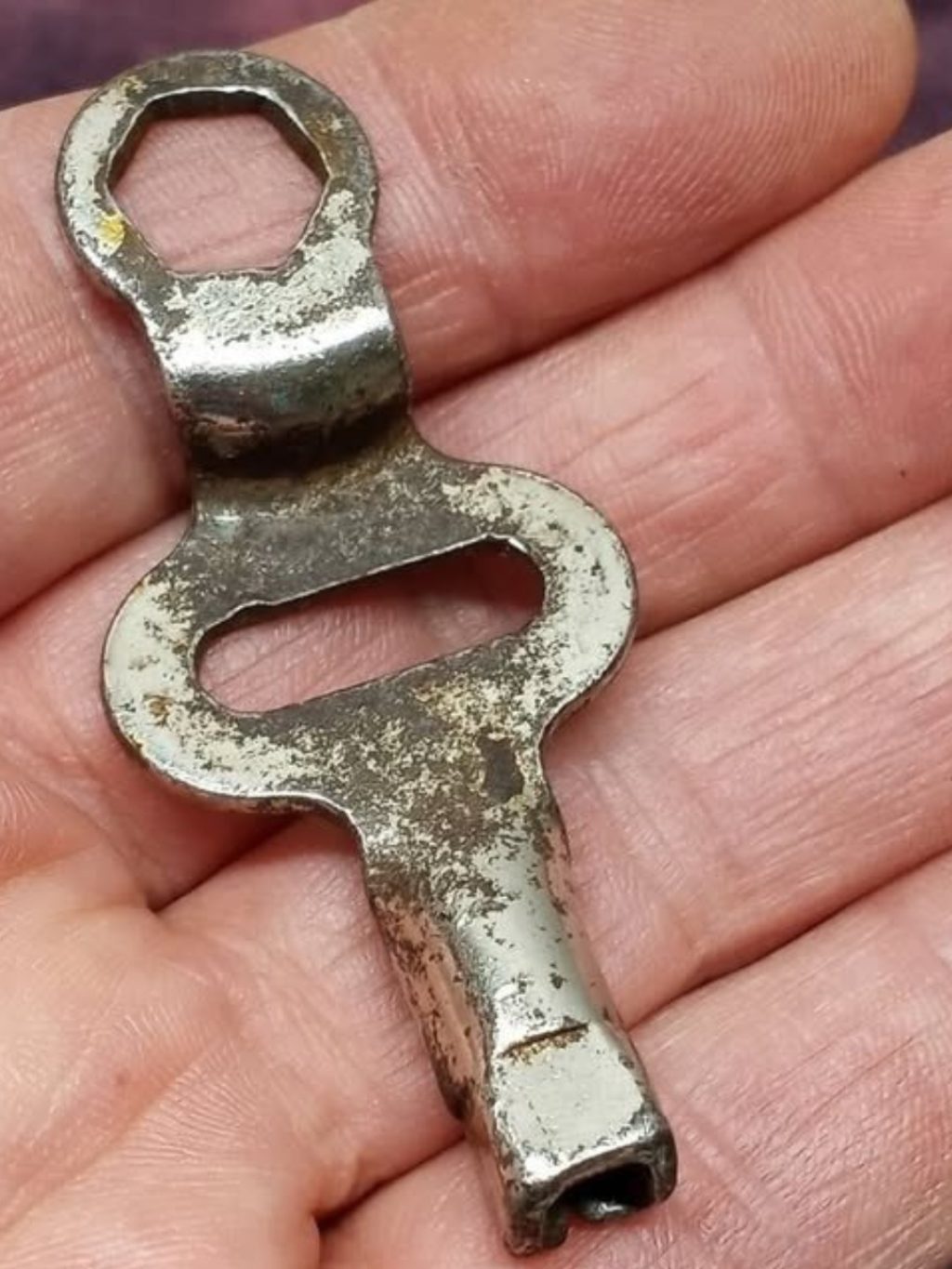
When my husband was sorting through boxes in his grandparents’ old house, he came across a small metal object tucked into a drawer. At first glance, it looked like a key — old, solid, clearly used. The kind of thing that feels like it should belong to something important.
Naturally, we tried it on every door, cabinet, trunk, and lock in the house.
Nothing.
It didn’t fit anywhere. It didn’t turn. And yet, it felt too intentional to be random. Too well-made. Too worn to be meaningless.
So what was it?
It’s Not a Door Key — and That’s the Clue
The first thing to notice is the shape. Unlike a standard door key, this piece has a hollow, squared end rather than teeth. There’s also an elongated slot in the middle and a loop-like opening at the top.
That design rules out doors entirely — but it perfectly matches something else many homes used to have.
The Most Likely Answer: A Clock Winding Key
This isn’t a key for opening something.
It’s a clock winding key.
Before battery-powered clocks became common, most household clocks — especially mantel clocks, wall clocks, and grandfather clocks — had to be wound by hand. That was usually done once a day or once a week using a small metal key just like this one.
The square opening at the end fits onto the winding arbor inside the clock. Turning it slowly would tighten the spring that powered the clock’s movement.
Why It Doesn’t Match Any Clock in the House
That part trips a lot of people up.
Clock keys weren’t always stored with the clock itself. They were often kept in drawers, sewing boxes, or small tins — wherever someone wouldn’t misplace them. Over time, clocks break, get sold, or are passed on… but the key stays behind.
It’s very possible that:
- The original clock is long gone
- The clock mechanism was removed or replaced
- The key belonged to a clock that stopped working decades ago
What remains is this small, forgotten tool.
The Wear Tells a Story
If you look closely, the metal is smoothed down in places, especially around the edges. That kind of wear doesn’t happen from sitting untouched. It comes from years of regular use — someone winding a clock again and again, likely at the same time every day.
It’s a quiet reminder of a slower routine:
Morning coffee.
A hand reaching for the key.
A clock ticking steadily through the house.
Could It Be Anything Else?
There are a few less common possibilities — antique toy keys, early machinery winders, or specialty cabinet tools — but the shape, size, and wear pattern overwhelmingly point to a clock key.
Collectors and antique dealers see these all the time, especially in older family homes.
A Small Object with a Long Memory
What I love most about this find is how ordinary it once was — and how mysterious it feels now.
This wasn’t something meant to be special. It was a tool. A daily habit. A background detail of someone’s life. And yet, decades later, it’s the thing that stops you mid-cleanup and makes you wonder who last held it — and why.
Even if the clock it belonged to is gone, the story isn’t.
Sometimes history doesn’t announce itself loudly.
Sometimes it fits quietly in the palm of your hand.