I wasn’t looking for my first love. At my age, that chapter felt safely sealed, tucked away with other things I no longer expected to revisit. But life has a strange way of circling back when you least expect it—sometimes through the smallest, most ordinary moments.
I’m 62 years old, and I teach literature at a public high school. My days are predictable in the best and worst ways: early mornings, familiar hallways, the soft rustle of pages turning, mugs of tea that grow cold while I grade essays long past midnight. I’ve learned not to expect surprises. Predictability feels earned.
Every December, my students get the same holiday assignment: Interview an older adult about their most meaningful holiday memory. Most of them go straight to grandparents, aunts, or kind neighbors who bake too much and love to talk. I never imagined I’d be part of the project.
But this year, one of my quieter students, Emily, lingered after class. She shifted her backpack from one shoulder to the other and asked, a little nervously, if she could interview me instead.
I laughed. “My holiday memories are boring, sweetheart. Trust me.”
She smiled but didn’t back down. She said she wanted a different perspective—someone who loved books, someone who’d lived a full life. Her sincerity disarmed me, and before I could overthink it, I agreed.
We sat in the empty classroom one afternoon, the winter light slanting through the windows. Emily asked thoughtful, gentle questions about traditions, family, and how the holidays felt when you’d lived through more of them. It was easy, almost comforting.
Then, halfway through, she paused and asked casually, as if it had just occurred to her:
“Did you ever have a love story around Christmas? Someone special?”
The question landed harder than I expected.
I hadn’t thought about him in years—not properly. Not the way you think about something that still has weight. But suddenly, there he was.
His name was Daniel. Dan, to everyone who knew him. We were seventeen, hopelessly inseparable, the kind of young and foolish that feels eternal when you’re in it. We planned everything together—college, travel, a life that felt just within reach. We even talked about running away after graduation, as if the world couldn’t possibly stop us.
Then one day, it did.
His family disappeared almost overnight after a financial scandal involving his father. No warning. No forwarding address. No goodbye. One week he was there; the next, his house was empty, the windows dark. I waited for a letter. A call. Anything.
Nothing ever came.
That unfinished sentence—the life we never got to live—stayed with me longer than I ever admitted. It followed me into adulthood, into marriages and divorces, into quiet nights when I wondered what might have been.
I told Emily a softened version of the story. Just enough for her assignment. I didn’t mention how long it took to stop looking for him in crowds or how every December used to feel slightly heavier than the rest.
The interview ended. Life went on.
Or so I thought.
The following week, Emily burst into my classroom before the bell rang, her face flushed, her phone clutched tightly in her hand.
“Mrs. Harper,” she said, almost breathless, “I think I found him.”
I remember the way my body went still. Completely still.
“That’s not possible,” I said automatically.
But she stepped closer and held up her phone. On the screen was a post from a local community forum. A man was searching for someone he’d loved decades ago.
“She had a blue coat and a chipped front tooth,” the post read. “I’ve checked every school in the county for decades—no luck. If anyone knows where she is, please help me before Christmas. I have something important to return to her.”
Emily swallowed. “Mrs. Harper… he even posted a picture. Is this really you?”
My heart stopped.
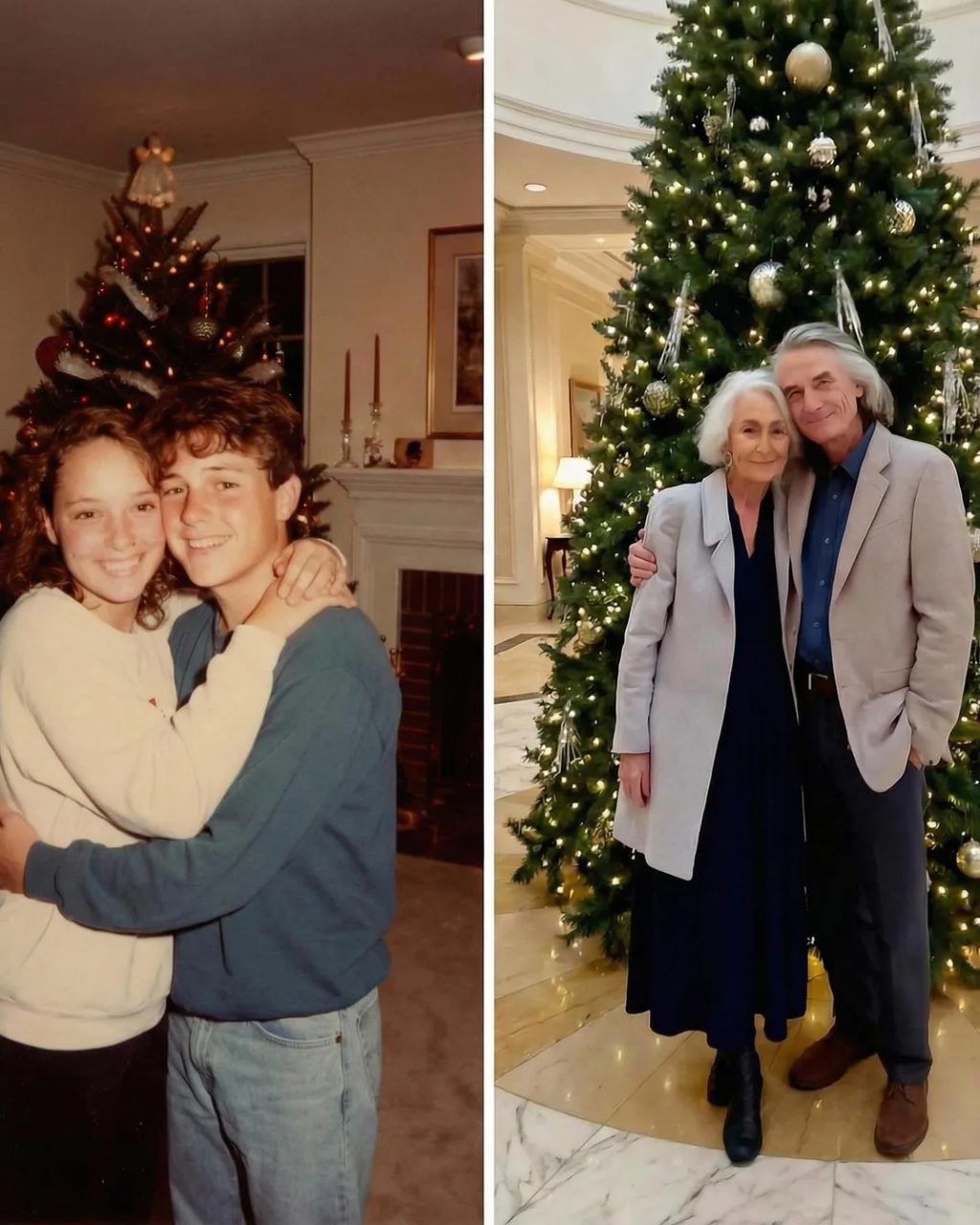
Because there we were—Dan and me at seventeen, smiling into the camera like the future was already ours. A moment I thought had been erased, somehow preserved.
“Yes,” I whispered. “That’s me.”
Emily’s voice softened. “Do you want me to write to him? Should I tell him where you are?”
I didn’t answer right away.
For forty years, I’d lived with the idea that some doors were meant to stay closed. That longing was something you outgrew, like an old coat that no longer fit. Sitting there, staring at that photo, I realized how wrong I’d been.
I nodded.
She sent the message that afternoon.
Three days later, I received an email.
It was from Daniel.
He wrote carefully, as if afraid the words might vanish if he moved too quickly. He explained how his family had been forced to leave, how letters he sent were returned unopened, how he searched for me every few years, convinced one day he’d find the right trail. He apologized for the silence he never chose.
At the end of the message, he asked if I would meet him—for coffee, nothing more—before Christmas.
We met in a small café halfway between our towns. When he walked in, older and grayer but unmistakably himself, I felt something loosen inside me that I didn’t know was still tight.
He reached into his coat pocket and placed something on the table between us.
It was a folded piece of paper. A letter.
“I wrote this the week we left,” he said quietly. “I never got to give it to you.”
I didn’t open it right away. I didn’t need to. The weight of it—the proof that I hadn’t imagined us—was enough.
We talked for hours. About the lives we lived, the ones we didn’t, and the strange, winding paths that brought us back to the same table. There was no bitterness. Just understanding.
We didn’t promise anything dramatic. No grand declarations. But when we stood to leave, he asked if we could meet again.
I said yes.
This Christmas, my life looks much the same from the outside. I still teach. I still drink too much tea. I still grade papers late into the night.
But something inside me has shifted.
I’ve learned that some love stories don’t end—they pause. And sometimes, if you’re lucky, they find their way back to you when you least expect it.