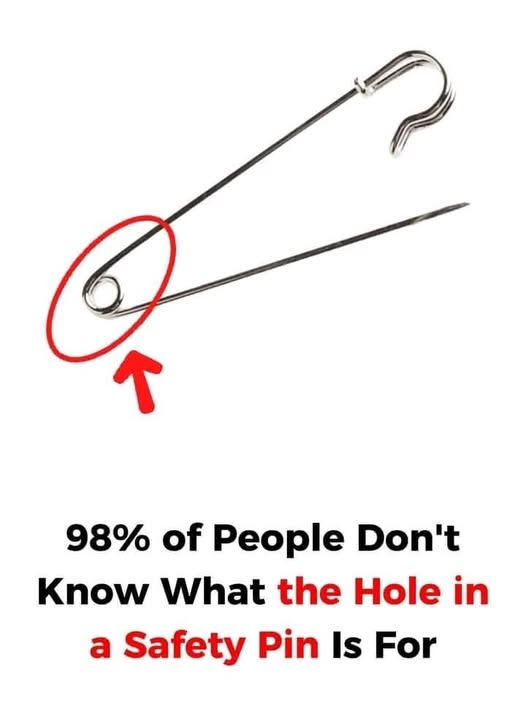
At first glance, a safety pin seems like one of the simplest tools ever invented. A thin piece of metal, a clasp, a sharp point—nothing complicated. Most of us have used one to fix a torn shirt, fasten a diaper, or save an outfit during an emergency. But hidden in plain sight is a tiny detail most people overlook entirely: the small hole at the bottom of the pin.
That little hole isn’t decorative. It isn’t a manufacturing mistake. And it definitely isn’t useless.
In fact, it plays several important roles—some practical, some clever, and some surprisingly historical.
The Original Purpose: Stability and Strength
The primary function of the hole is structural stability.
When the safety pin is closed, the pointed end locks into the clasp. The hole allows the metal to coil evenly, distributing pressure across the pin. This design helps prevent the pin from popping open unexpectedly, especially when it’s under tension.
Without that hole and coil system:
- The pin would bend more easily
- The clasp would loosen faster
- The sharp end could slip out and cause injury
In short, the hole is what helps make a safety pin truly safe.
A Smart Solution for Threading Elastic
One of the most practical—and lesser-known—uses of the hole is for threading elastic or string through fabric.
Sewers and tailors often thread elastic through the hole, then push the pin through a waistband, sleeve, or drawstring channel. The hole keeps the elastic from slipping off, making the process smoother and far less frustrating.
That’s why safety pins are still a go-to tool in sewing kits, even in the age of modern gadgets.
Pressure Control and Flexibility
The hole also allows the pin to flex under pressure without snapping.
When weight or tension is applied—such as when holding thick fabric—the coil created by the hole acts like a spring. This gives the pin elasticity, helping it maintain its shape and strength over time.
This tiny design detail is the reason safety pins last longer than paper clips or straight pins.
A Historical Design Choice
The safety pin was invented in 1849 by Walter Hunt. Interestingly, the hole and coil weren’t afterthoughts—they were part of the original patent.
Hunt designed the pin to:
- Protect users from the sharp point
- Be reusable and durable
- Hold fabric securely without tearing it
The hole was essential to achieving all three goals.
Unexpected Modern Uses
Beyond clothing and sewing, people have found creative uses for the hole, including:
- Attaching charms or tags
- Hanging lightweight objects
- Using it as a temporary key ring
- Fishing line threading
- Emergency zipper repair
That tiny hole turns a simple pin into a surprisingly versatile tool.
Why Most People Never Notice
The reason 98% of people don’t know what the hole is for is simple: it just works.
Good design doesn’t demand attention. It quietly solves problems without explanation. The safety pin does its job so well that most of us never stop to ask why it works the way it does.
Until now.
A Reminder That Small Details Matter
The hole in a safety pin is proof that even the most ordinary objects often carry thoughtful engineering behind them. What looks insignificant can be essential. What’s overlooked can be brilliant.
So the next time you grab a safety pin, take a second look.
That tiny hole?
It’s doing more work than you ever realized.