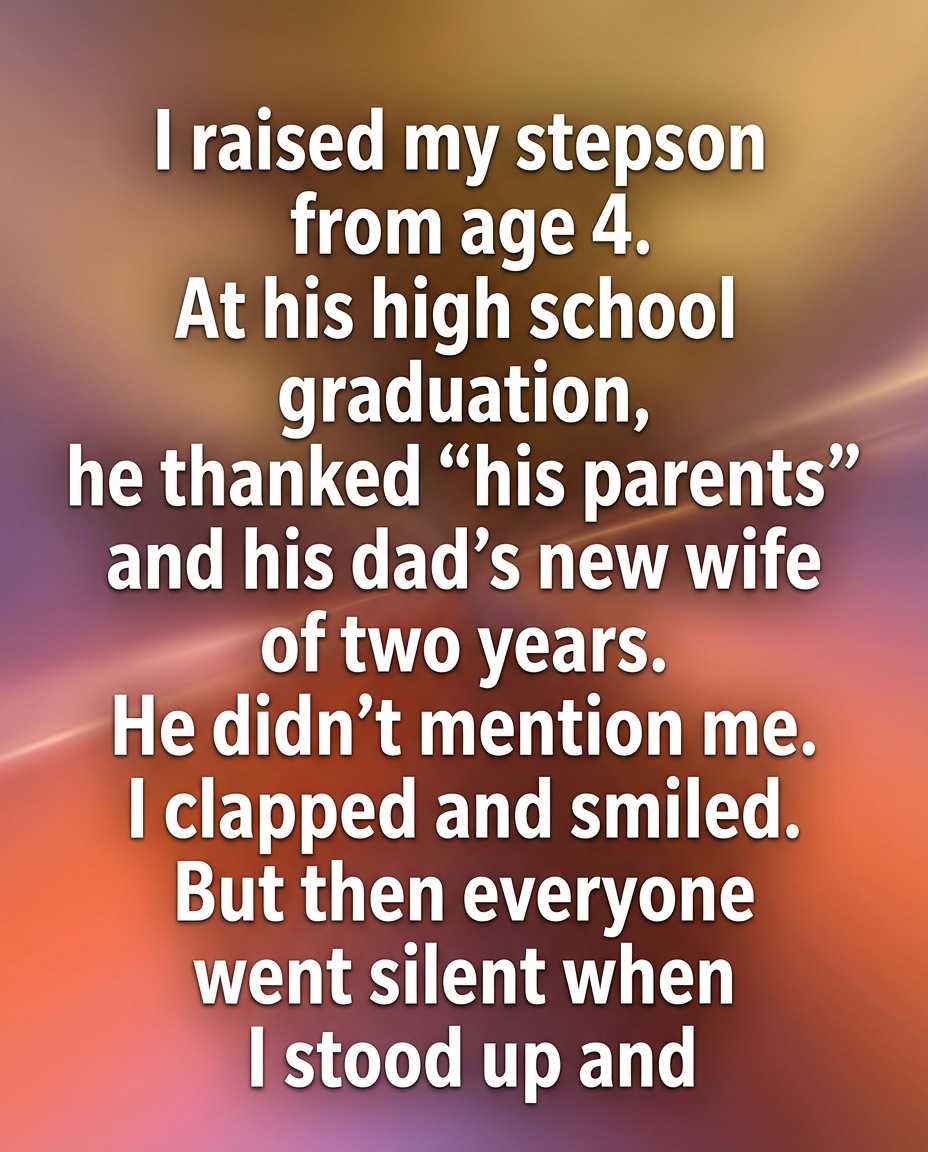
I raised my stepson from the age of four.
I was the one who packed his lunches, helped with homework, stayed up during fevers, and sat in the front row of every school play. I learned how he liked his eggs, how he struggled with math but loved history, and how he used humor to hide his fears.
I never tried to replace his mother. I just tried to be there.
At his high school graduation, he stood at the podium in his cap and gown, hands shaking slightly as he thanked “his parents.”
Then he thanked his dad’s new wife—someone who had been in his life for only two years.
He didn’t mention me.
I clapped.
I smiled.
And I told myself it didn’t matter.
But then everyone went silent when I stood up.
The Moment No One Expected
I hadn’t planned to stand.
My legs moved before my heart caught up, and suddenly I was on my feet in the middle of the auditorium. I felt hundreds of eyes turn toward me, felt the air shift with confusion and discomfort.
I wasn’t angry.
I wasn’t dramatic.
I was tired.
I cleared my throat, my voice steadier than I felt.
“I won’t take much time,” I said quietly.
My stepson looked at me then—really looked at me—and for the first time that night, he seemed unsure.
What I Needed to Say
“I didn’t expect to be thanked today,” I continued. “And I don’t need applause. I didn’t raise you for recognition.”
A murmur rippled through the room.
“I just want to say this,” I said, turning toward him. “I am proud of the man you are becoming. I’ve been proud of you since the day you learned to tie your shoes. Since the first time you called me at work because you forgot your lunch. Since every scraped knee, every bad grade, every small victory.”
My voice wavered, but I didn’t stop.
“I loved you when it was easy. And I loved you when it wasn’t.”
The room was completely silent.
The Look on His Face
My stepson’s eyes filled with tears.
Not polite tears.
Not performative ones.
The kind you don’t expect and don’t know how to stop.
He swallowed hard and nodded at me, just once.
I sat back down.
The applause that followed wasn’t loud or explosive. It was slow, respectful, and heavy with understanding.
But the real moment came later.
After the Ceremony
He found me in the hallway while families took photos and laughed and hugged.
“Why didn’t you tell me?” he asked, his voice cracking.
I frowned. “Tell you what?”
“That you felt invisible,” he said. “That I hurt you.”
I took a deep breath. “Because I didn’t raise you to carry my pain. I raised you to walk forward.”
He broke down then.
Right there in the hallway.
And I held him like I had when he was small.
The Truth He Finally Shared
“I didn’t thank you because I was scared,” he admitted. “I thought… I thought if I said your name, it would make things complicated. I didn’t want to upset anyone.”
“Who?” I asked gently.
He hesitated. “My dad. And his wife.”
And suddenly, so many things made sense.
The Years Between Us
His father and I had divorced years earlier. It wasn’t explosive, but it wasn’t kind either. Over time, I learned to be careful—to show up without stepping on toes, to love without demanding space.
And somewhere along the way, my stepson learned the same careful balance.
He learned silence.
He learned gratitude with limits.
He learned how to survive divided loyalties.
What Love Looks Like Without Credit
“I never needed you to choose me,” I told him. “I just needed you to know I chose you. Every day.”
He nodded through tears.
“I know now,” he said. “I just didn’t realize how much it mattered to say it out loud.”
The Letter He Wrote Me
Two weeks later, a letter arrived in the mail.
Inside was a single page, handwritten.
It said:
You didn’t give birth to me, but you gave me stability. You didn’t have to stay, but you did. You taught me what love looks like when no one is watching. I’m sorry I didn’t say your name when it mattered most. Please know it’s written on my heart.
I cried longer than I want to admit.
What I Learned That Day
Being a parent—especially a stepparent—often means loving without guarantees.
It means showing up when you might not be acknowledged.
It means choosing grace over bitterness, patience over pride.
And sometimes, it means standing up—not to demand credit—but to speak truth with kindness.
Where We Are Now
He calls me every Sunday.
Sometimes just to talk. Sometimes to ask advice. Sometimes to say nothing at all.
He introduces me now as “my mom.”
Not because I asked.
But because he finally understands.
And that is more than enough.