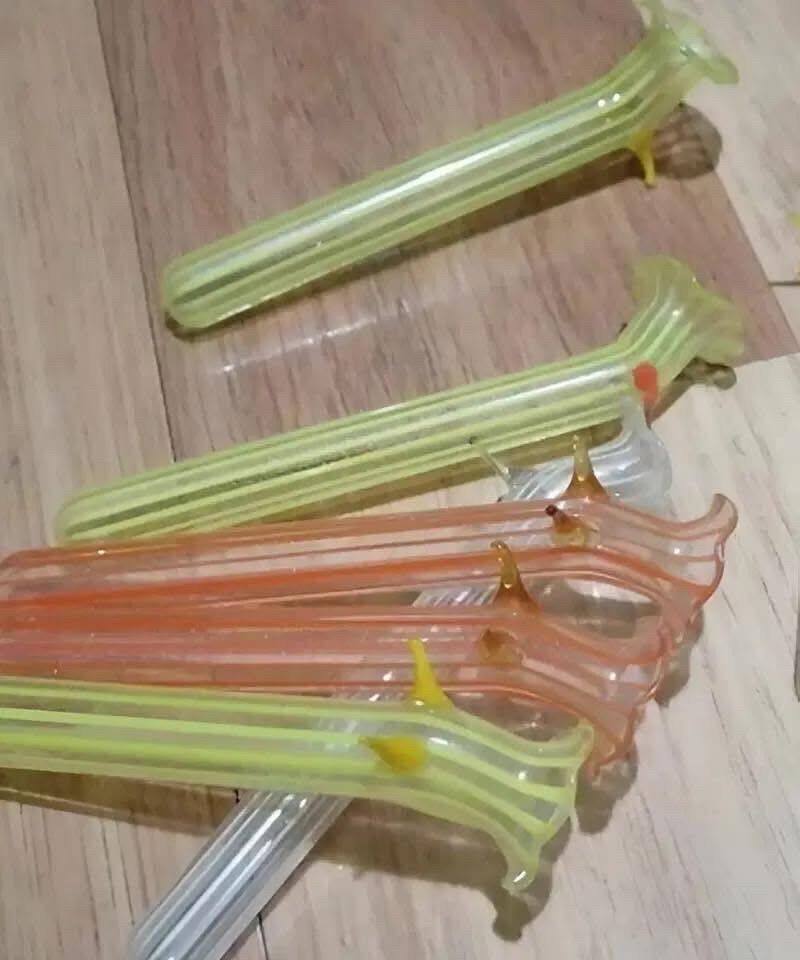
When I opened my grandmother’s old crockery cupboard, I expected the usual things: mismatched teacups, chipped saucers, maybe a forgotten gravy boat from another era. What I did not expect was a small bundle of strange, colorful objects tucked carefully in the back.
At first glance, they looked like plastic bars—maybe cocktail accessories, decorative swizzle sticks, or parts of an old Christmas ornament. But the moment I picked one up, I knew that wasn’t right.
They were glass.
Light. Fragile. Carefully made.
Each one had thin, elegant ridges running along its length, translucent hues of green, amber, orange, and yellow catching the light. And then there was that odd detail: a small rounded “bump” or nub along the side, placed deliberately, as if it served a purpose.
I turned one over in my hand, completely puzzled.
What were these things?
The First Clues: Material and Design
A closer look revealed a few important details:
- They were hand-blown glass, not molded plastic
- All were nearly identical in shape and size
- The colors varied, but the design was consistent
- They showed signs of age, but no damage—suggesting they were stored carefully
This wasn’t junk. These objects were tools.
And they weren’t decorative.
The Answer: Vintage Glass Drink Stirrers (with a Twist)
After some digging—and a few conversations with people who know their antiques—the mystery finally unraveled.
These are vintage glass cocktail stirrers, most commonly used in the mid-20th century.
But not just any stirrers.
The small side “bump” is the key.
What Is the Little Bump For?
That tiny protrusion isn’t decorative—it’s functional.
It’s designed to:
- Rest against the rim of a glass
- Prevent the stirrer from slipping completely into the drink
- Keep the stirring end suspended at the right depth
In other words, it’s an early ergonomic design—simple, clever, and elegant.
Before disposable plastic swizzle sticks took over, glass stirrers like these were considered refined, reusable barware. They were often part of a matched set, used during dinner parties, holidays, or special occasions.
Why Were They in a Crockery Cupboard?
That part actually makes perfect sense.
In many households—especially decades ago—barware wasn’t kept in a “bar.” It lived alongside fine china, crystal glasses, and serving pieces. These stirrers were likely used when guests came over for:
- Aperitifs
- Digestifs
- Coffee liqueurs
- Cocktails served after dinner
Your grandmother probably brought them out only on special occasions—which explains why they survived so well.
A Glimpse Into Another Era
Holding one of these glass stirrers feels like holding a piece of everyday history.
They come from a time when:
- Objects were made to last
- Even small tools were thoughtfully designed
- Entertaining at home was an art
No logos. No branding. Just craftsmanship.
Are They Valuable?
Monetarily, they’re usually not worth a fortune—but sentimentally and historically, they’re priceless.
Collectors of vintage barware do seek them out, especially:
- Complete matching sets
- Unique colors or hand-blown variations
- Pieces from the 1940s–1960s
More importantly, they’re a reminder of how much care once went into even the simplest household items.
Final Thoughts
What started as a confusing discovery turned into a quiet moment of connection across generations.
Those strange little glass bars weren’t random at all. They were part of your grandmother’s life—her dinners, her guests, her celebrations.
Sometimes, the most mysterious objects aren’t strange at all.
They’re just waiting for us to remember how they were once used. 🕰️✨