My mom died when I was ten.
Dad held it together for a few years, doing the best he could with packed lunches, bedtime stories, and quiet tears he thought I didn’t notice. But when I was fourteen, he married Cheryl.
She was the kind of woman who smiled too wide when people were watching and snapped too fast when they weren’t.
She never raised a hand to me.
She never had to.
Every reminder came in small, precise cuts — the way she called me “your son” instead of my name, the way my chores doubled while hers disappeared, the way she’d say, “You should be grateful I let you stay here,” in a house my great-grandfather built.
Dad tried to keep the peace. I think he thought love meant compromise.
Five years later, Dad died of a sudden heart attack.
I was nineteen.
The shock hollowed me out. One minute he was laughing at something on TV, the next he was gone. Just like that.
Cheryl cried loudly at the hospital. Clung to people. Played the grieving widow perfectly.
But she didn’t wait for the funeral flowers to wilt.
Two days later, she stood at the top of the stairs with her arms crossed and said, flat and cold:
“You’re not family anymore. Get out.”
No sympathy.
No warmth.
Just ice.
I packed a duffel bag. Grabbed my guitar. Left behind my childhood bedroom, my dad’s old tools, and every photo I wasn’t fast enough to save.
That night, I slept on my best friend’s couch, staring at the ceiling, wondering how grief could burn and freeze at the same time.
The next morning, I decided to go back.
Not to argue. Not to beg.
Just to get a few more things — my dad’s watch, some documents, maybe the framed picture of us fishing when I was twelve.
But when I turned onto the street where I’d grown up, my stomach dropped.
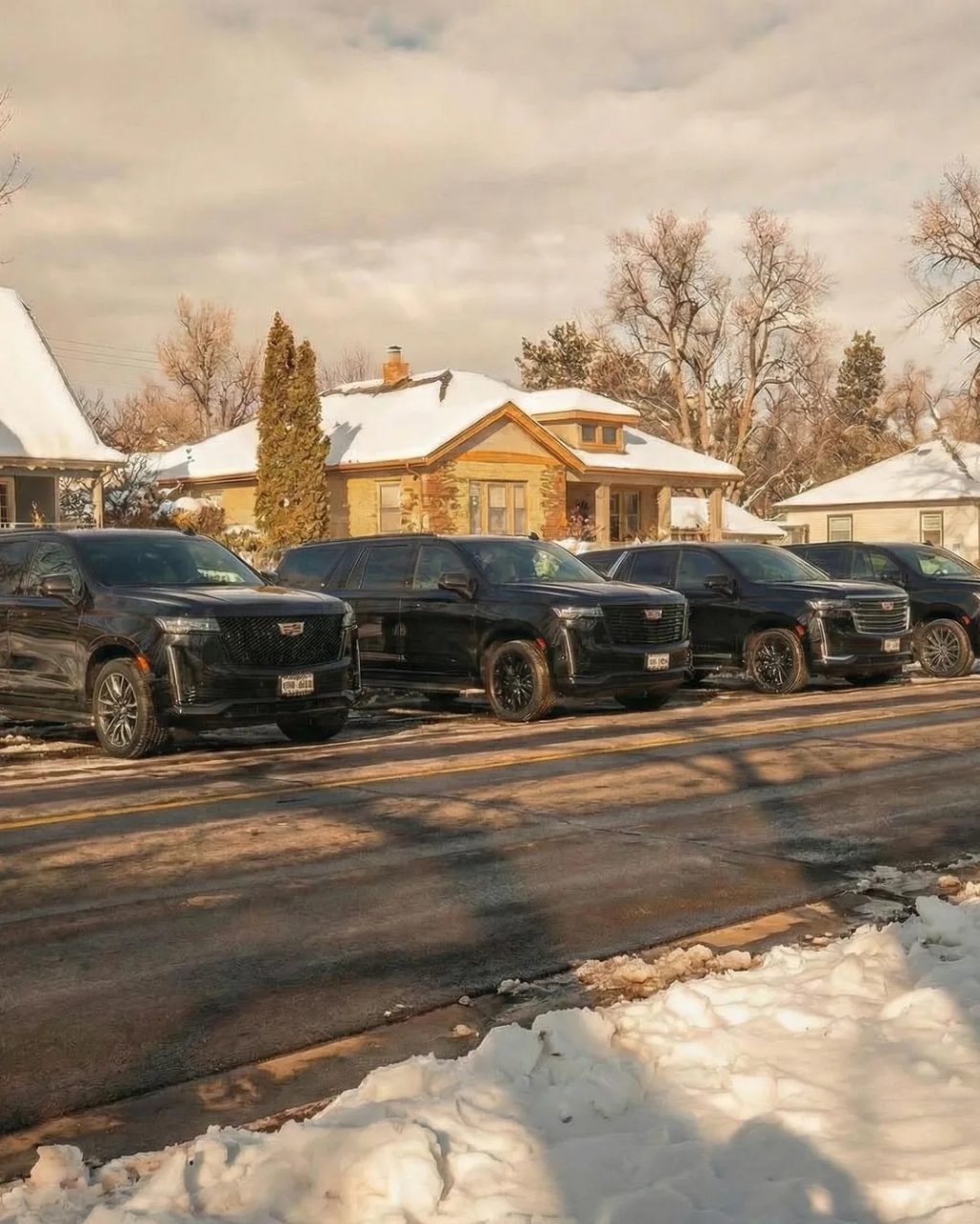
Five black SUVs were parked in front of the house.
Clean. Polished. Expensive.
For a second, I thought Cheryl had hired security to keep me away.
My hands shook as I walked up to the door.
I rang the bell.
The door creaked open.
Cheryl stood there, pale as a sheet.
“Oh! You’re here!” she said, her voice suddenly syrupy. “I was just… just about to call you, sweetheart.”
Sweetheart.
She hadn’t called me that in five years.
I blinked. “What’s going on?”
Before she could answer, a man in a tailored suit stepped forward.
“Are you Daniel?” he asked.
I nodded.
“My name is Mr. Caldwell,” he said. “I’m the executor of your father’s estate.”
Cheryl’s smile twitched.
We all sat in the living room — the same one where Dad used to nap on Sundays.
Two lawyers. A financial advisor. A man from a private bank.
Cheryl sat stiffly, fingers digging into the arm of the chair.
Mr. Caldwell cleared his throat.
“Your father updated his will six months ago,” he said, looking directly at me.
Cheryl’s head snapped toward him.
“He what?”
Mr. Caldwell continued calmly. “Your father left the house, the land, and the family business to his son.”
The room went dead silent.
Cheryl laughed sharply. “That’s not possible. I’m his wife.”
“You were,” Mr. Caldwell said gently. “But the property predates the marriage and was held in a family trust.”
He slid a folder across the table toward me.
“Additionally,” he added, “your father left you several accounts set up in your name, as well as full ownership of the workshop.”
Cheryl’s face drained of color.
“No,” she said. “No, no, no. He wouldn’t do that. He promised me security.”
Mr. Caldwell nodded. “He did. You’ll receive a stipend for twelve months, as outlined in the prenuptial agreement.”
Her voice rose. “This is ridiculous! He wouldn’t shut me out like this!”
I finally spoke.
“He didn’t,” I said quietly. “You shut me out.”
Cheryl turned on me, eyes blazing.
“You ungrateful little—”
Mr. Caldwell cut her off.
“Ms. Cheryl,” he said firmly, “you are required to vacate the property within thirty days.”
Her mouth opened. Closed.
She looked around the room like it might save her.
It didn’t.
When the SUVs left, Cheryl didn’t say a word to me.
She just sat there, staring at the walls like they were betraying her.
I walked upstairs.
Into my room.
It still smelled faintly like old books and dust — like home.
I sat on the bed and cried for the first time since Dad died.
Not from pain.
From relief.
Cheryl moved out three weeks later.
She took her clothes. Her furniture. Her bitterness.
I stayed.
I fixed the workshop. Learned the business Dad loved. Played my guitar in the evenings, just like he used to ask me to.
Sometimes I imagine him standing in the doorway, arms crossed, smiling that quiet smile.
He knew.
He always knew.
And even after death, he made sure I was never truly alone again.