I was forty-five when Christmas stopped feeling like a celebration and started feeling like something I just had to survive.
My daughter, Hannah, disappeared seven years ago. She was nineteen. One evening, she didn’t come home—and that was it. No body. No answers. Just a bedroom frozen in time and a phone that never rang again.
People told me I should move on. That hope was cruel. That I needed closure.
But how do you close something that was never finished?
That morning, I stopped at a small coffee shop near the train station. It was warm and crowded, the air thick with cinnamon and espresso. Christmas music played too loudly, almost aggressively cheerful. People laughed. Cups clinked. Life moved on around me.
I ordered a latte I didn’t even want and stood near the counter, staring at the lights strung across the window, trying not to think about how Hannah used to love this time of year.
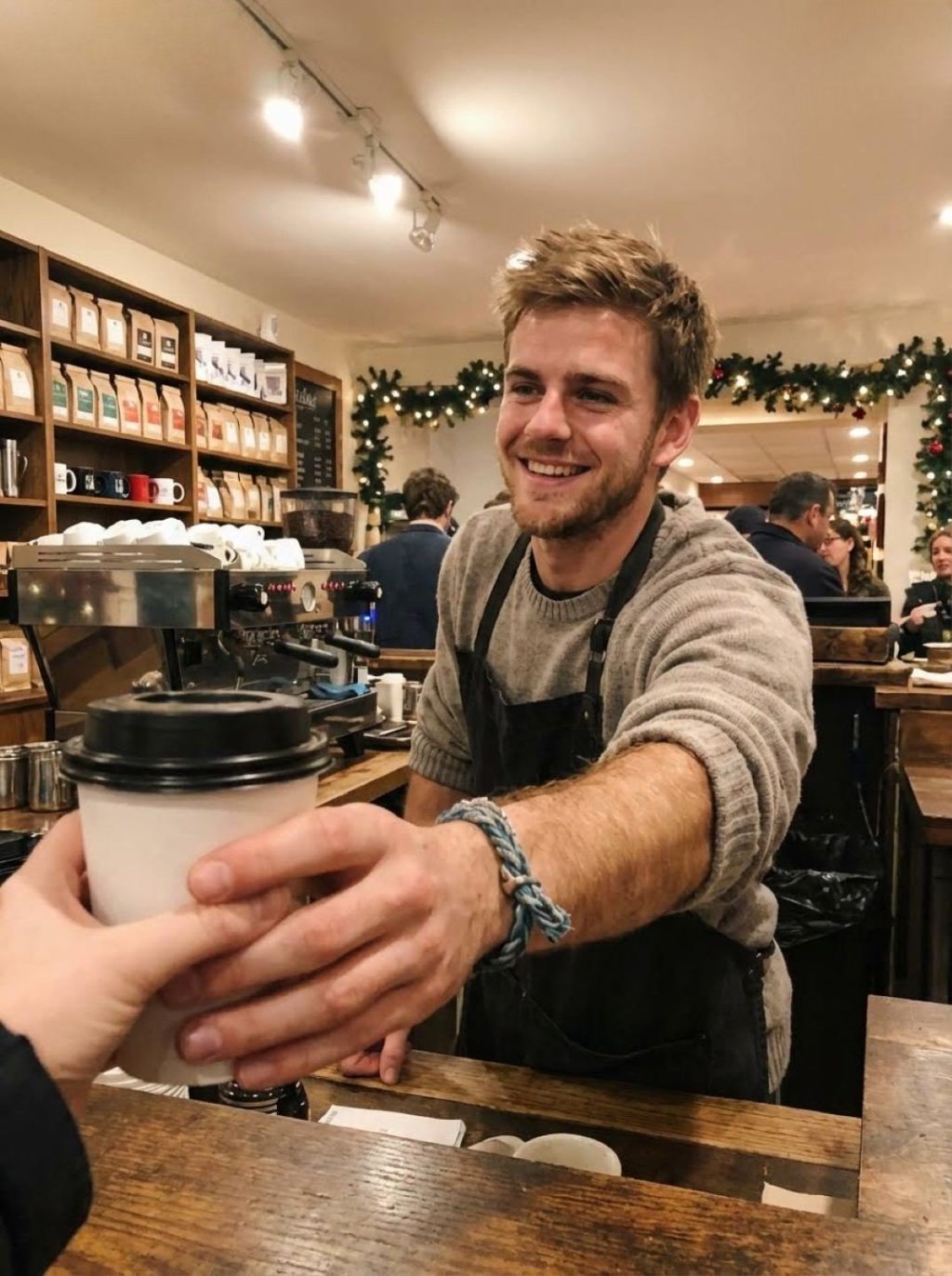
Then the barista handed me my cup.
And my hand froze.
On his wrist was a thick braided bracelet—faded blue and gray threads, tied with a tiny knot instead of a clasp.
I knew it instantly.
My heart slammed so hard I thought I might faint.
We had made that bracelet together when Hannah was eleven, one quiet winter afternoon at our kitchen table. She’d laughed when the knot came out crooked and said it didn’t matter—that it made it special.
She wore it for years.
Every day.
Even the night she disappeared.
The cup shook in my hand as I stared at the bracelet like it might vanish if I blinked.
“Excuse me,” I said, my voice barely steady. “That bracelet… where did you get it?”
The barista—mid-twenties, dark hair, kind eyes—looked down at his wrist, then back at me.
“Oh. This?” he said casually. “I found it. Years ago.”
Found it.
My knees went weak.
“Where?” I whispered.
He hesitated, studying my face. “Are you okay?”
“Please,” I said. “Just tell me where.”
He leaned closer, lowering his voice. “Near the river. By the old bus terminal. It was tangled in some weeds.”
My breath caught painfully in my chest.
That area had been searched. Thoroughly. Dogs. Volunteers. Police.
Nothing had ever been found.
“Did… did you give it to someone?” he asked gently.
I shook my head, tears blurring my vision. “No. I made it with my daughter. She went missing.”
His face drained of color.
“I’m so sorry,” he said quickly. “I didn’t know. I swear, I didn’t steal it. I just—when I found it, I was homeless. It felt… grounding. Like someone had loved it.”
I nodded numbly. I believed him.
But something didn’t sit right.
“Can you tell me exactly when you found it?” I asked.
He thought for a moment. “About seven years ago. Winter. I remember because it was freezing. I’d just come to the city.”
My heart skipped.
“That’s when my daughter disappeared.”
The shop felt too small. Too loud.
“I need you to tell me everything,” I said. “Please.”
He took his break early.
We sat at a small table near the back while customers came and went, oblivious to the fact that my entire life had just cracked open.
He told me his name was Leo.
That night, seven years ago, he’d been sleeping near the river when he heard shouting. A man and a girl arguing. She was crying. The man sounded furious.
Leo said he didn’t intervene—he was scared, young, and had learned the hard way that trouble could get you killed.
By morning, the bracelet was there.
Just the bracelet.
“I should’ve gone to the police,” he said, guilt thick in his voice. “I didn’t think… I didn’t know.”
My hands clenched together.
“You can still help,” I said. “Please.”
He nodded immediately. “Whatever you need.”
That afternoon, I went to the police station for the first time in years.
This time, I had something new.
A witness.
A location.
A bracelet.
The investigation reopened.
The river area was searched again, deeper this time. Records were reexamined. People were re-interviewed.
Three weeks later, they found something buried beneath debris not far from where Leo had described.
Not Hannah.
But her backpack.
Inside it—her phone.
And one message saved as a draft, never sent.
Mom. I’m scared. If you get this, please know I tried to come home.
I screamed when I read it.
Seven years of not knowing collapsed into one unbearable moment.
The man from that night was eventually identified.
He was Hannah’s ex-boyfriend. Violent. Controlling. He’d moved away shortly after her disappearance.
He was arrested.
He never admitted everything.
But there was enough.
I never got my daughter back.
But I got the truth.
And somehow, that bracelet—something small and imperfect—had survived long enough to find its way back to me.
On Christmas Eve, Leo returned the bracelet.
“I think it belongs with you now,” he said softly.
I wrapped it around my wrist, tears streaming freely.
“It brought me back to her,” I said. “Thank you.”
That Christmas, I lit a candle for Hannah.
For the girl she was.
For the woman she never got to be.
And for the strange, fragile way love sometimes finds its way home—even after years of darkness.
Hope didn’t erase the pain.
But it finally had a place to land.