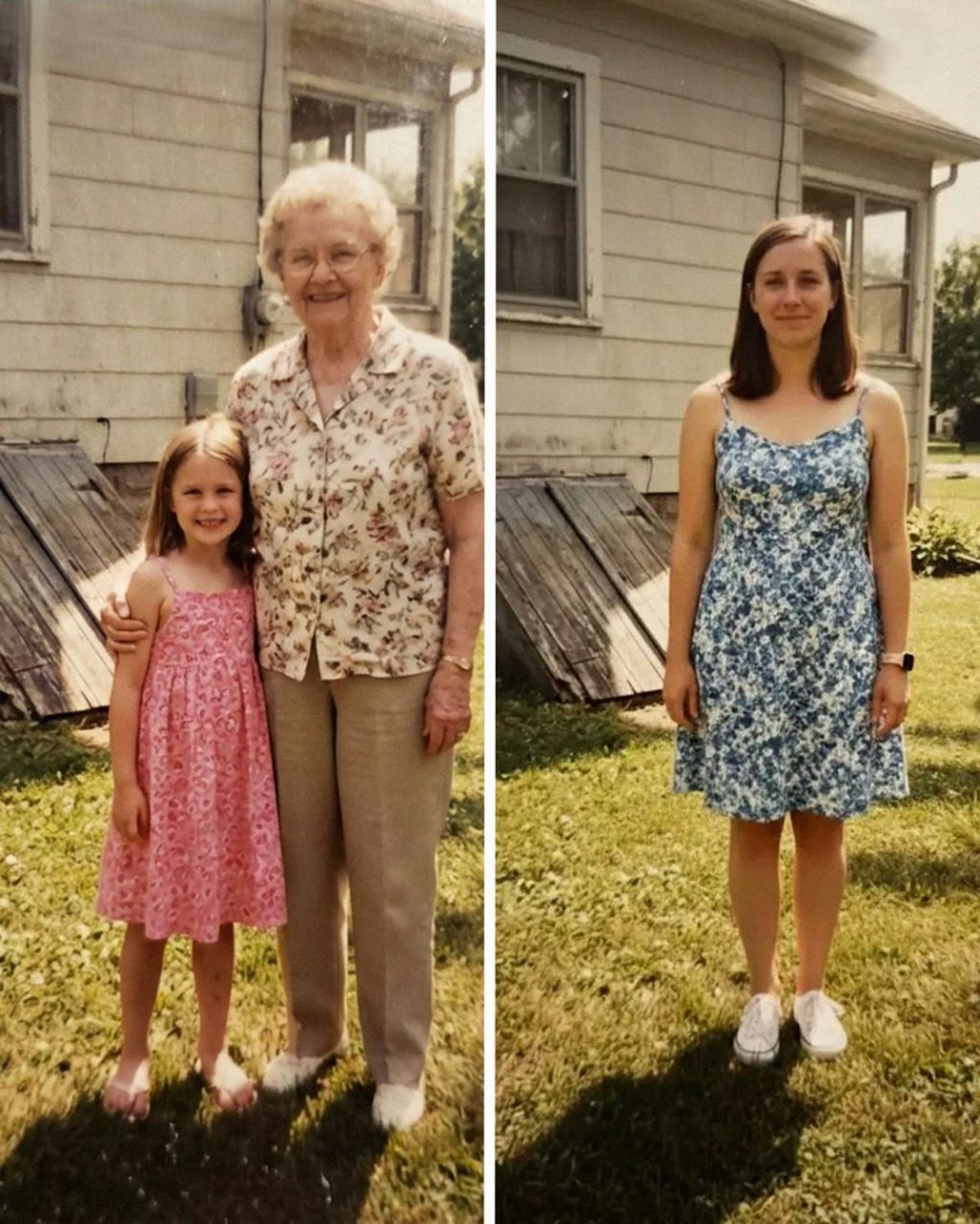
For as long as I can remember, my grandmother Evelyn was my entire world.
My father disappeared before I could even form a memory of him, and when I was twelve, my mother died in a car accident that shattered everything overnight. One moment I had a family, the next I had silence and unanswered questions.
My grandmother didn’t hesitate. She took me in, held me together, and somehow made room in her life—and her heart—for a grieving child who didn’t know how to ask for comfort.
Her little house on the edge of town became my safe place. I still remember the creak of the porch swing, the smell of cinnamon pies cooling on the counter, and the way she’d stay up late with me at the kitchen table, letting me talk until the ache in my chest eased enough to sleep.
Behind the house was her garden—neat rows of tomatoes and herbs she tended like they were old friends.
And behind that… the basement.
It was old, separate from the house, with heavy metal doors that looked more industrial than anything else on the property.
Those doors were always locked.
Always.
And I was never allowed anywhere near them.
It was the only rule she ever enforced without explanation.
When I was little, I once asked what was down there.
She crouched to my level, brushed my hair back gently, and said,
“Honey, there are dangerous old things in the basement that could hurt you. That’s why I keep the door locked.”
Her voice was calm. Final.
So I never questioned it.
Life went on. I grew up. I moved to the city with my fiancé, Noah. Built a life of my own. But no matter how busy things got, I visited my grandmother every weekend. Sometimes just for coffee. Sometimes to sit quietly while she crocheted and listened to old radio programs.
A few months ago, she got sick.
And then—quietly, almost gently—she was gone.
Losing her felt like losing the ground beneath my feet all over again.
After the funeral, Noah and I returned to her house to pack up her things. She’d lived there for over forty years. Every drawer, every shelf held pieces of her life—and mine.
Packing it all into boxes felt wrong. Like erasing something sacred.
We finished the bedrooms late in the afternoon. The sun was dipping low when I stopped near the back of the house.
The basement doors were still there.
Still locked.
And for the first time, it struck me: I had never once seen the key.
“Do you think…” I said slowly, turning to Noah, “there might be more of Grandma’s things down there? Stuff we need to pack?”
He hesitated. “If she wanted it opened, she would’ve opened it.”
I nodded. But something inside me wouldn’t let it go.
We tried every key we found. Nothing fit.
In the end, we had to break the lock.
It took effort. The metal groaned in protest before finally giving way.
The doors creaked open.
A wave of cold air rushed out, smelling faintly of dust and iron.
My heart started pounding.
I took the first step down carefully. The stairs were steep. Cobwebs clung to the corners. A single bare bulb hung from the ceiling, flickering when Noah flipped the switch.
And then I saw it.
I stopped breathing.
At the bottom of the stairs was a small room—cleaner than the rest of the basement—and inside it were shelves lined with boxes. Neatly labeled. Dates written in my grandmother’s handwriting.
But what froze me in place wasn’t the boxes.
It was the photographs.
Dozens of them. Old. Faded. Black-and-white and color, arranged carefully on a long table.
They were all of the same man.
And… children.
My voice came out shaky.
“Oh my God… Grandma hid this for forty years?”
I dropped to my knees, hands trembling as I picked up a photo.
The man looked young. Dark hair. Familiar eyes.
Then it hit me.
I’d seen that face before.
In the mirror.
“This is my father,” I whispered.
Noah crouched beside me, silent.
As I went through the boxes, the story unfolded piece by piece.
Letters. Legal documents. Newspaper clippings.
My father hadn’t disappeared.
He’d been dangerous.
Violent. Unstable. Wanted by the police for crimes tied to organized theft rings. My grandmother had discovered the truth shortly before my mother died. When my father tried to come back for me—to use me—she made a choice.
She hid everything.
She moved. Changed records. Locked away proof of his existence so I’d never be found, never dragged into the life he was running from.
One box was labeled “If She Ever Asks.”
Inside was a letter.
My hands shook as I opened it.
My sweet girl,
If you are reading this, it means I’m gone and you’ve opened the door I never could.
I didn’t lock the basement because of old things. I locked it to protect you.
Your father is not the man you deserved. And I refused to let his shadow touch your life.
I carried this alone so you could grow up free.
I cried harder than I had at the funeral.
Everything suddenly made sense. Her fear. Her rules. Her silence.
She wasn’t hiding something from me.
She was hiding me from something.
We turned the basement into light again—literally and figuratively. The boxes went to a lawyer. The documents were archived. The photos were packed away carefully.
And the doors?
I didn’t relock them.
Some doors need to stay closed.
Others only stay locked until you’re strong enough to open them.
That basement didn’t just hold secrets.
It held proof of a woman who loved me enough to guard my life with her own silence.
And now, every time I think of my grandmother Evelyn, I don’t remember the locked door.
I remember the open arms that made sure I never needed to fear what was behind it.