It started with a note on our windshield.
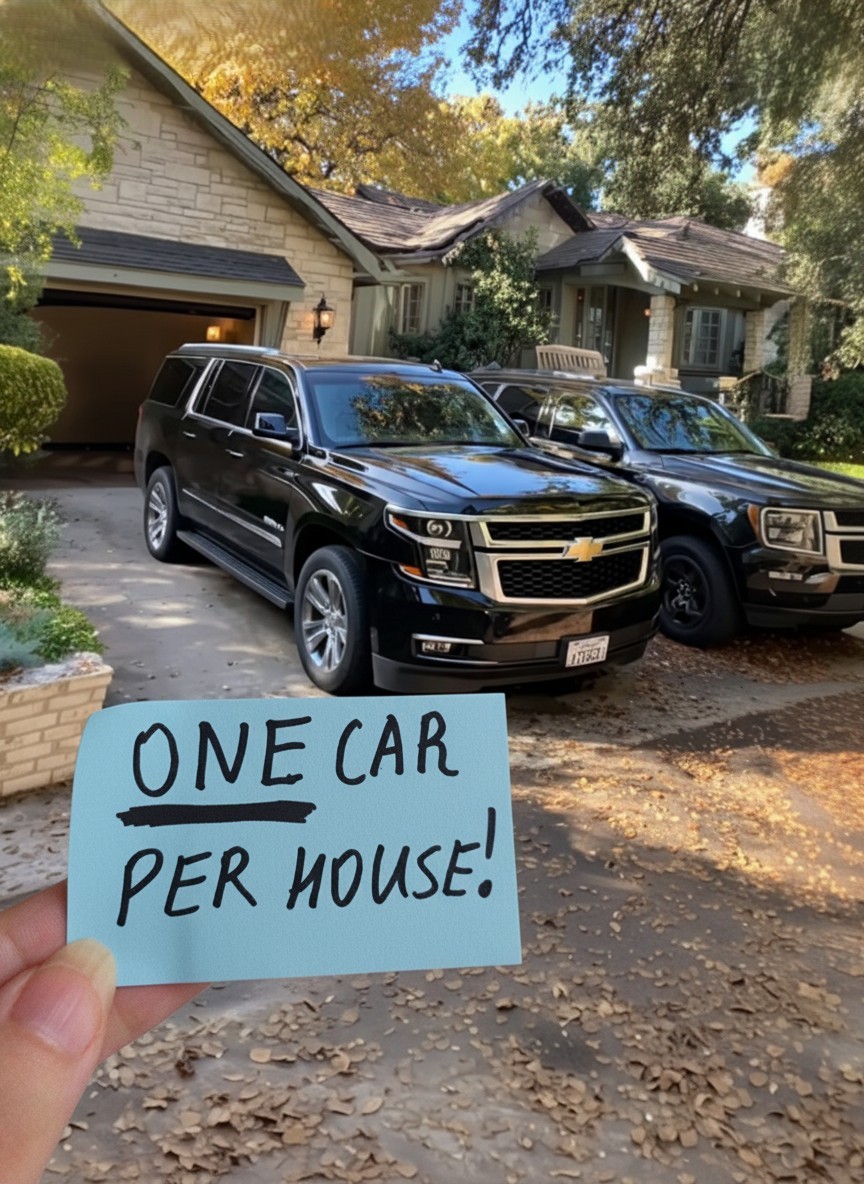
Bright white paper. Black marker. Big, confident letters.
ONE CAR PER HOUSE!
No name. No signature. Just a smiley face at the bottom, which somehow made it worse.
I stood in the driveway holding the note, rereading it like it might magically start making sense. My husband Jack came outside, coffee in hand, squinting at the paper.
“What’s that?” he asked.
“Apparently,” I said slowly, “we’re criminals for owning two cars.”
We both laughed it off—until later that afternoon, when our neighbor came over herself.
She knocked like she expected applause.
I opened the door to find her standing ramrod straight, dressed like she’d stepped out of a suburban lifestyle catalog: pastel pink cardigan, matching headband, white capri pants, and a smile that didn’t quite reach her eyes.
She didn’t bother with small talk.
“Our HOA—very friendly, but firm—has rules,” she said crisply. “Only one car per household in the driveway.”
I blinked. “One car?”
“Yes,” she replied, tightening her smile. “No exceptions. It keeps the neighborhood orderly.”
Jack stepped up beside me. “Both our cars fit in the driveway. We’re not blocking the sidewalk or parking on the street.”
She tilted her head, the way people do when they think they’re explaining something to a child. “Still not allowed. One house, one driveway, one car. The rule applies to everyone.”
Something about her tone made my jaw clench.
“Can you show us where that rule is written?” I asked.
She waved her hand dismissively. “I don’t need to. I’ve lived here longer than you. I know the rules.”
Then she turned on her heel and walked away like she’d just issued a royal decree.
Jack and I stood there for a moment.
“Is she serious?” he asked.
“She has to be bluffing,” I said. “That can’t possibly be a real rule.”
We checked the HOA handbook that night. Cover to cover.
There was no such rule.
Not even close.
So we did what any rational people would do.
We ignored her.
For three peaceful days, nothing happened. Both cars stayed in our driveway. Life went on. We figured she’d realized she was wrong and quietly backed off.
Then, on the fourth morning, I opened the front door and felt my stomach drop.
Our driveway was empty.
Both cars were gone.
I didn’t even have time to process it before I saw her—standing on her lawn, arms crossed, grinning like she’d just won a prize.
I stormed over. “Where are our cars?”
She didn’t miss a beat. “Towed. HOA rules,” she said sweetly. “I warned you.”
Jack came out behind me, already pulling out his phone. “You had no right to do that.”
“Oh, I absolutely did,” she replied. “I called it in myself.”
I laughed.
I couldn’t help it.
She frowned. “What’s so funny?”
“Nothing,” I said, wiping my eyes. “Just that you owe us twenty-five thousand dollars now.”
Her smile vanished.
“What?” she stammered. “That’s ridiculous.”
I pointed toward the empty driveway. “Did you notice the symbol on the license plate?”
Her face went blank.
Both of our cars had clearly marked diplomatic plates. Jack works for an international organization, and those plates aren’t just decorative. They come with very specific legal protections.
Towing them without authorization wasn’t just rude.
It was illegal.
Her mouth opened and closed. “I—I didn’t know.”
“That’s the problem,” Jack said calmly. “You didn’t check.”
The fallout was swift and brutal.
The towing company returned our cars within hours—apologetic, panicked, and eager to avoid further trouble. The HOA board called an emergency meeting. The neighbor was fined, removed from her informal “enforcer” role, and told she was personally responsible for damages, legal fees, and penalties.
That’s where the $25,000 came in.
She tried to backpedal. She cried. She claimed she was “just trying to help the neighborhood.”
But rules, real ones, don’t work on vibes and confidence alone.
A week later, she knocked on our door again.
No cardigan this time. No smile either.
“I think there’s been a misunderstanding,” she said quietly.
Jack raised an eyebrow. “Is there?”
She swallowed. “I’d like to apologize.”
I nodded. “That’s a good start.”
She left shortly after, and since then? She doesn’t look our way. Doesn’t wave. Doesn’t comment on anyone’s lawn, trash bins, or driveways anymore.
And our two cars?
They’re still parked exactly where they’ve always been.
Right in our driveway.
Because sometimes, the biggest lesson in a neighborhood isn’t about rules—it’s about knowing when you don’t actually have any power at all.