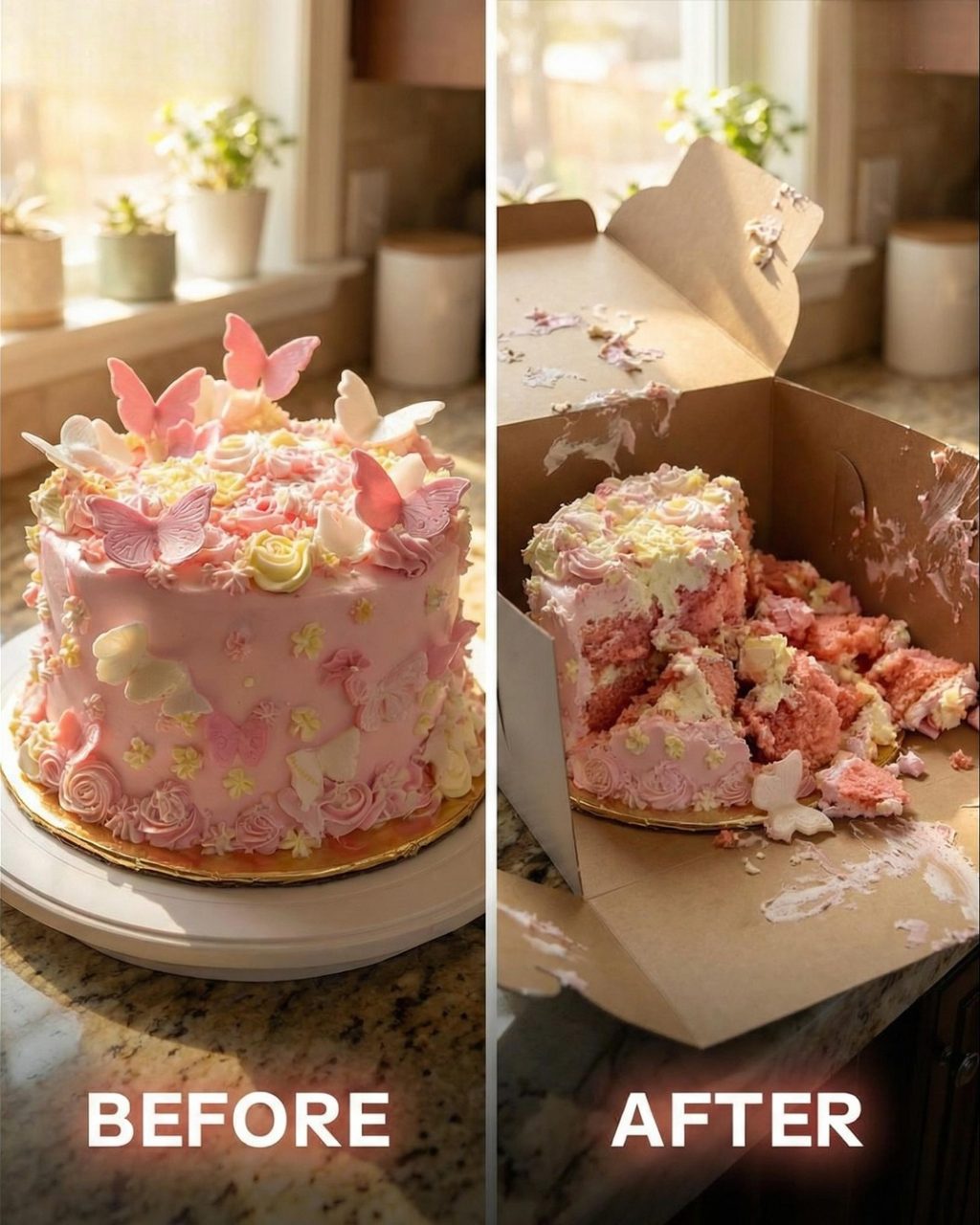
I baked a cake for my daughter’s ninth birthday—but on the morning of her party, she found it ruined.
I’m 35, and this is my second marriage. My husband, James, came into my life a few years after my first marriage ended, when my daughter Sophie was still small enough to fit neatly into the crook of my arm.
Sophie is nine now—bright, affectionate, and endlessly thoughtful in ways that catch me off guard. She slips handwritten “I love you, Mom” notes under my pillow. She saves the last piece of candy in her bag because “you might want it later.” She still reaches for my hand in public, even though some kids her age have already stopped.
When I remarried, I worried constantly about how she would feel. I’d read all the horror stories. The resentment. The distance. The quiet sadness kids carry when they feel replaced.
But James surprised me.
From the very beginning, he treated Sophie like she mattered. Not like a responsibility. Not like baggage. Like a person he genuinely enjoyed. He read her bedtime stories and used different voices for every character. He taught her how to ride a bike, jogging behind her with one hand on the seat until she shouted, “Dad—don’t let go yet!” He showed up.
Watching the two of them together healed parts of me I hadn’t realized were still sore.
So when Sophie started talking about her ninth birthday months in advance, I wanted everything to be perfect. Not Pinterest-perfect. Her-perfect.
She wanted balloons. Pink streamers. Music. Her friends from school. And most importantly—a cake.
Not a store-bought one.
“A real cake,” she said, eyes wide. “One you make.”
So I did.
The night before the party, I stayed up late in the kitchen. Three layers. Chocolate cake with strawberry filling. Pale pink frosting. Delicate flowers piped carefully around the edges. It wasn’t flawless, but it was made with patience and love.
When Sophie peeked around the corner and gasped, “Mom… is that for me?” I had to swallow hard.
I covered it carefully, slid it into the refrigerator, and went to bed exhausted but happy.
The next morning, the house was alive before the sun fully rose. Kids arrived early. Laughter bounced off the walls. James was hanging garlands crookedly while Sophie spun around in her party dress, unable to contain herself.
I bounced between rooms, refilling juice, answering questions, trying to soak it all in.
Then Sophie ran to the kitchen to grab some lemonade.
Seconds later, I heard a scream.
Not a playful squeal. Not excitement.
A sharp, broken sound.
I ran.
Sophie stood frozen in front of the refrigerator, her small hands shaking as she pointed.
The cake box was open.
The frosting was smeared. Finger marks gouged into the sides. One entire corner torn away, sponge exposed like a wound.
My stomach dropped.
This wasn’t an accident. This wasn’t a child sneaking a taste.
This was deliberate.
Sophie burst into tears. The kind that come from shock more than sadness.
“Mom,” she sobbed, “who would do this?”
I turned slowly, scanning the room. Parents chatting. Kids playing. Laughter still echoing, unaware.
Then I saw her.
James’s sister, Karen.
She was sitting on the couch, legs crossed, watching the chaos with a tight smile that didn’t reach her eyes. When our gazes met, she didn’t look away.
She smirked.
Something in me went cold.
Karen had never liked me. From the start, she’d made subtle comments. About “real family.” About how hard it must be for Sophie “not having her actual dad around.” About how blended families were “complicated.”
I’d ignored it. Smiled through it. Told myself I was being sensitive.
But in that moment, standing in front of my crying child and a destroyed cake, I knew.
I walked toward her.
“Karen,” I said calmly, though my hands were shaking. “Did you touch the cake?”
She raised her eyebrows. “Oh, relax. It was just a cake.”
Just a cake.
I felt something snap.
“That cake was for my daughter,” I said. “You didn’t ask. You didn’t apologize. You ruined it.”
She shrugged. “Kids need to learn that things don’t always go their way.”
James had come up behind me by then. He’d seen Sophie crying. He’d seen the cake.
“What happened?” he asked.
Karen opened her mouth, but James cut her off.
“I know what happened,” he said quietly.
The room went silent.
“She did this,” he said, pointing to his sister. “And she’s leaving.”
Karen laughed. “You’re choosing them over me?”
James didn’t hesitate. “I’m choosing my family.”
He took Sophie gently into his arms. She clung to him, still hiccupping through tears.
I expected the party to fall apart after that. I expected awkwardness. Whispers.
But something unexpected happened.
One of the other parents offered to run to the bakery down the street. Another brought out cupcakes they’d brought “just in case.” The kids didn’t care. They just wanted to celebrate.
Sophie smiled again.
Later that night, after the house was quiet, James sat beside me on the couch.
“I’m sorry,” he said. “I should have shut her down sooner.”
I leaned into him, exhausted but grateful.
That ruined cake taught me something.
Love isn’t about perfection. It’s about showing up. Protecting your child. Drawing lines—even when it’s uncomfortable.
Sophie didn’t remember the ruined frosting.
She remembered that her mom baked her a cake.
She remembered that her dad stood up for her.
And honestly?
That mattered more than anything I could’ve baked.