I still think about that day sometimes. Not because it was dramatic or glamorous, but because it was quiet, ordinary, and almost invisible — the kind of day that feels meaningless while you’re living it, yet somehow ends up reshaping everything.
Back then, I worked at a small neighborhood bakery. Nothing fancy. Just bread, pastries, and the comforting smell of sugar and yeast that clung to your clothes long after your shift ended. The pay was barely enough to get by, and my boss made sure we knew we were replaceable. Still, I showed up every morning, tied my apron, and did my job. I had no safety net. Missing even one paycheck felt terrifying.
That afternoon was slow. The lunch rush had come and gone, and I was wiping down the counter when the bell above the door rang.
A young woman stepped inside.
She couldn’t have been more than nineteen. Maybe younger. Her hair was pulled back in a messy knot, her hoodie stretched thin and faded from too many washes. In her arms, wrapped tightly in a blanket, was a baby who looked far too small.
She hesitated near the door, like she wasn’t sure she belonged there.
I smiled and asked, “Hi, how can I help you?”
Her eyes filled instantly.
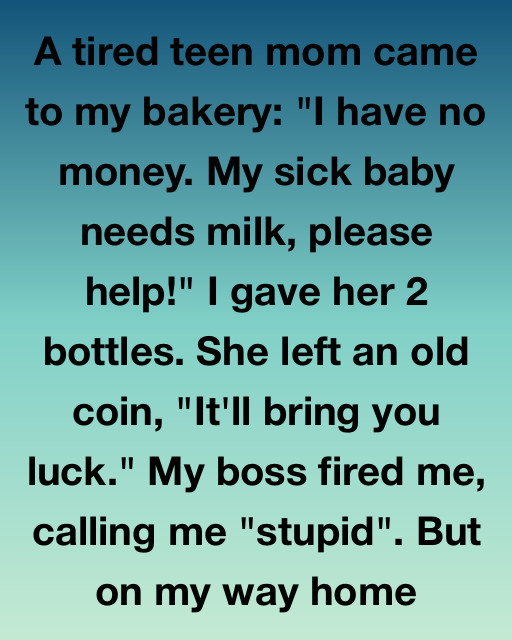
“I’m so sorry,” she said, her voice shaking. “I don’t have any money. My baby is sick and needs milk. Please… please help me.”
She tightened her grip on the blanket as the baby whimpered softly. The sound hit me right in the chest.
I glanced toward the back, instinctively checking if my boss was watching. He hated “problems.” Hated people who didn’t buy anything. Hated anything that slowed down business.
Technically, I wasn’t allowed to give food away. He’d made that very clear.
But standing there, looking at that exhausted girl and the tiny, pale face peeking out from the blanket, rules felt suddenly small and ridiculous.
Without saying a word, I reached for two bottles of baby milk from the shelf behind the counter. I slid them into a small bag and handed it to her.
“Here,” I said quietly. “Take these.”
Her mouth fell open.
“I—I can’t pay you,” she whispered.
“That’s okay,” I said. “Just go.”
Tears streamed down her face as she nodded again and again. “Thank you. You have no idea what this means.”
As she turned to leave, she paused. Then she reached into her pocket and pulled out something small.
It was an old coin. Worn smooth. Nothing fancy. She pressed it into my palm.
“It’s all I have,” she said softly. “My grandma gave it to me. She always said it brings luck.”
Before I could say anything, she was gone.
A few minutes later, my boss stormed out from the back.
“Did you just give away merchandise?” he snapped.
I tried to explain. I really did. I told him about the baby. About the milk. About how she had nothing.
He didn’t care.
“That was stupid,” he said flatly. “This isn’t a charity. You’re fired.”
Just like that.
I stood there, apron still on, my hands shaking. Fired over two bottles of milk. Over doing what felt like the most human thing I’d done all week.
I clocked out in silence, changed, and stepped outside with my box of personal things. The sky was gray, heavy, like it was pressing down on me.
On my way home, I kept rolling the coin between my fingers. I didn’t believe in luck. Not really. Life had taught me that pretty clearly.
Still, I slipped it into my pocket instead of throwing it away.
That night, I cried harder than I had in years. I didn’t know how I was going to pay rent. Or buy groceries. Or keep going.
The next morning, I started walking around, asking about jobs. No luck. Everywhere wanted experience I didn’t have or availability I couldn’t promise.
Tired and discouraged, I ducked into a small café to warm up. As I stood in line, the coin slipped from my pocket and rolled across the floor.
A man behind me picked it up.
“This is interesting,” he said, turning it over. “Do you know what this is?”
I shook my head.
“It’s an old commemorative coin,” he explained. “Rare. Worth a lot more than you’d think.”
I laughed bitterly. “That’s impossible. It was given to me by a girl who couldn’t even afford baby milk.”
He smiled. “Sometimes the most valuable things don’t look like much.”
We talked. Just casually. He asked what I did. I told him what had happened the day before.
Turns out, he owned several cafés and bakeries in the area.
By the end of that conversation, he offered me a job. Better pay. Flexible hours. A boss who believed kindness wasn’t weakness.
I walked home that day with a strange, unfamiliar feeling.
Hope.
Months later, I learned that the teen mom had found stable housing through a local program. Her baby recovered. Life didn’t magically become easy for her — but it became possible.
As for me, that single coin still sits on my dresser.
Not because of its value.
But because it reminds me of something I almost forgot that day — that doing the right thing can cost you everything in the moment, and still end up giving you more than you ever imagined.
Sometimes, destiny doesn’t arrive with fireworks.
Sometimes, it walks into your life wrapped in a blanket, asking for milk, and leaves behind a small, worn coin that quietly changes everything.