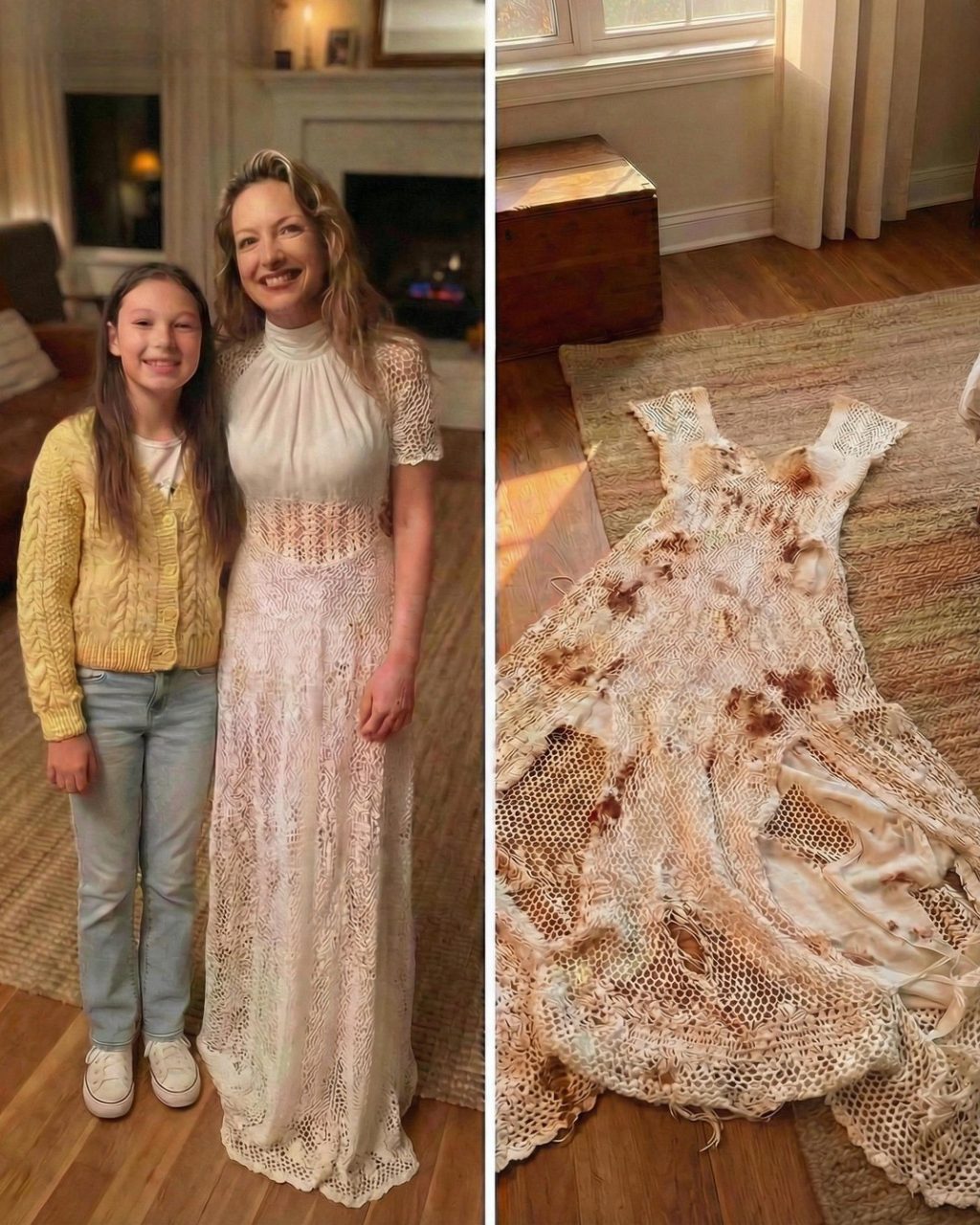
My 12-year-old daughter knitted my wedding dress.
Just hours before the ceremony, I opened the closet and found it destroyed.
I’m 38, and my daughter Lily is my entire world.
She always has been.
Lily learned how to knit when she was seven, curled up beside my mother on the couch, her little fingers clumsy at first, copying every movement with intense concentration. My mom would laugh gently when Lily dropped a stitch, then patiently guide her hands back into place.
What started as a simple pastime slowly became her thing.
Birthday scarves. Winter hats. Little handmade gifts for teachers and friends. Every piece slightly imperfect, every one filled with care. You could feel the love in them.
Five years ago, Lily’s father died suddenly.
There are no words for what that did to us.
In the months after his death, Lily barely spoke. She stopped sleeping through the night. She’d crawl into my bed, shaking, whispering that she didn’t want to forget his voice.
Knitting became her refuge.
When her hands were busy, her mind calmed. Stitch by stitch, she worked through her grief in a way words never could. I never rushed her. I just sat nearby, letting the quiet do its work.
After my husband’s death, I was sure that chapter of my life was closed. I wasn’t bitter—just certain. Lily needed stability. I didn’t have the energy to imagine love again.
Then, three years later, I met Daniel.
He wasn’t flashy. He didn’t sweep me off my feet with grand gestures. What he did instead was show up—consistently, patiently, quietly.
Most importantly, he never tried to replace Lily’s father.
He didn’t push affection. He didn’t demand closeness. He let Lily set the pace. He listened when she spoke. He respected her silences. Slowly, carefully, he earned her trust.
And that mattered more to me than anything else.
When Daniel proposed, I said yes—but I made it clear that Lily’s feelings came first. Daniel agreed without hesitation.
When we started planning the wedding, Lily hugged me tightly, her arms wrapped around my waist.
“Mom,” she said softly, “would you mind if I knit your wedding dress?”
I stared at her.
Then I burst into tears.
“Sweetheart,” I said, dropping to her level, “for me, that would be the most beautiful dress in the world.”
From that moment on, she took it seriously.
Every afternoon after school, she sat at the kitchen table, homework pushed aside, yarn spread out in neat piles. She watched tutorials. She counted stitches under her breath. Sometimes she’d rip out entire sections and start again, refusing to settle for “good enough.”
“I want it to be perfect,” she told me.
And it was.
The dress was simple. White. Handmade. Soft in a way store-bought fabric never is. When I finally tried it on, Lily covered her mouth and started crying. I cried too.
I had never felt more loved in my life.
I carefully hung the dress in the closet, zipped inside a garment bag, and made sure no one touched it.
The morning of the wedding arrived in a blur.
Relatives filled the house. Voices overlapped. Someone spilled coffee. Someone else couldn’t find their shoes. It was loud, chaotic, joyful.
A few hours before the ceremony, I slipped upstairs to get dressed.
I opened the closet.
And my heart dropped into my stomach.
The garment bag was unzipped.
The dress inside was ruined.
Dark stains bloomed across the front. Seams were ripped apart, deliberately torn. Yarn pulled and shredded like someone had attacked it in a fit of anger.
There was no accident here.
This was intentional.
I felt dizzy. My hands went numb.
Lily ran into the room behind me and froze.
“Mom… oh God…” she whispered, her voice breaking. “Who could do this?”
She started sobbing, collapsing against me, apologizing through tears as if it were her fault.
I held her tightly, my jaw clenched.
But I already knew.
Only one person had a reason.
Daniel’s mother.
From the moment we announced the engagement, she’d made her feelings clear. She’d scoffed at our small plans. Mocked the idea of a handmade dress. Made passive-aggressive comments about “real weddings” and “proper brides.”
I wiped Lily’s tears and kissed her forehead.
“Stay here,” I said gently. “I’ve got this.”
I took a deep breath and went downstairs.
Straight to her.
She was standing in the living room, sipping coffee, perfectly composed.
“I need to talk to you,” I said calmly.
She smiled thinly. “Now?”
“Yes. Now.”
I didn’t raise my voice. I didn’t accuse her loudly. I simply told her what I found.
Her face barely changed.
“That thing?” she said dismissively. “It was ridiculous anyway. You should be thanking me. I saved you from embarrassing yourself.”
That was it.
The moment something snapped.
I looked her straight in the eye and said, “You destroyed something my grieving child made with love. You don’t get to stay.”
She laughed. Until Daniel appeared behind her.
“What’s going on?” he asked.
I didn’t speak. I didn’t need to.
Lily came down the stairs, holding the ruined dress in her arms.
Daniel understood instantly.
He turned to his mother.
“You’re leaving,” he said. No hesitation. No negotiation.
She sputtered. “I’m your mother!”
“And that was my daughter’s gift,” he replied. “Get out.”
She left in a fury.
The house went quiet.
I thought the day was ruined.
Then Lily looked up at me, tears still drying on her cheeks, and said, “Mom… you don’t have to wear it. I just wanted you to feel loved.”
I knelt in front of her.
“I do,” I said. “More than you know.”
With help from friends, we repaired what we could. The dress wasn’t perfect anymore—but neither is life.
I walked down the aisle in that dress.
Loose stitches. Visible mends. Love in every thread.
And I’ve never worn anything more beautiful.