My daughter spent three straight days cooking for my mom’s birthday. Then, hours before the party, my dad sent a text that changed everything.
“We’ve decided to celebrate at a restaurant instead. It’s adults only.”
I didn’t argue. I didn’t make a scene.
But what I did next changed the way I see my parents forever.
My name is Rachel Morgan, and last weekend cracked something open in me that I don’t think will ever fully close again.
It all started with good intentions. That’s the part that still hurts the most.
My daughter Emily is seventeen—quiet, thoughtful, the kind of kid who listens more than she talks. She’s never been one to demand attention, but when she cooks, something in her comes alive. Cooking is how she loves people. It’s how she says what she doesn’t always have words for.
So when my mother’s seventieth birthday was approaching, Emily announced—calmly but firmly—that she wanted to cook the entire dinner herself.
“For everyone,” she said. “All twenty-three.”
I laughed at first, thinking she was joking. When I realized she wasn’t, I tried to talk her out of it. I told her it was too much work. Too stressful. Too big.
She smiled that gentle, stubborn smile of hers and said, “Mom, Grandma’s done so much for us. I want her to feel special.”
So I let her.
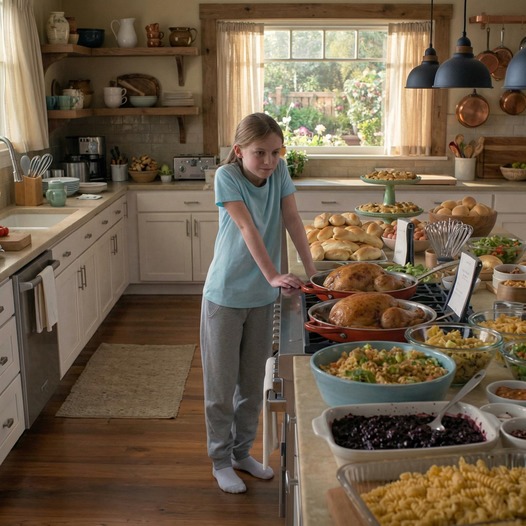
For three days, our kitchen turned into a full-scale catering operation. Homemade pasta dough rolled thin and perfect. Garlic bread stacked high. Roasted chicken seasoned with herbs she grew herself. Salads, sauces, appetizers, desserts. Blueberry crumble cooling on the counter like it belonged in a magazine.
She barely slept. She hummed while she chopped vegetables. She wrote recipe notes in careful handwriting and taped them to the cabinets.
She was exhausted.
And she was proud.
The party was scheduled for Saturday at 6 p.m.
At 4:12 p.m., while Emily was arranging the last trays, my phone buzzed.
It was my dad.
“We’ve decided to celebrate at a restaurant instead. It’s adults only.”
That was it. No apology. No explanation. No acknowledgment of the food. Or Emily.
I read the message twice, hoping I’d misunderstood. Adults only? After my daughter cooked for three days?
I walked into the kitchen slowly, my chest tight.
“Sweetheart,” I said gently, “plans changed.”
She looked up, confused. “What do you mean?”
I handed her my phone.
She read the message once. Then again.
She didn’t cry. She didn’t yell. Her shoulders just… sank. Her lips pressed into a thin line as her eyes flicked over the counters, the food, the work she’d poured herself into.
“Why would they do that?” she whispered.
I didn’t have an answer.
I wanted to scream. I wanted to call my parents and unload every ounce of anger in my body.
But instead, I wrapped my arms around my daughter and said, “We’re not wasting any of this.”
That evening, while my parents sat comfortably in a restaurant downtown, I posted in our local community group.
“Free homemade dinner available tonight. No questions asked. Families, seniors, anyone who could use a meal.”
Within an hour, people were lining up at our door.
Single parents with tired eyes. Elderly neighbors with walkers. A young couple who admitted they hadn’t had a proper meal in days.
Emily served every plate quietly, smiling shyly when people thanked her. One woman hugged her. Another cried. Someone called her an angel.
I watched my daughter stand a little taller with each “thank you.”
That night, she went to bed smiling.
The next morning, at 9:03 a.m., our front door started shaking.
Not knocking. Pounding.
Emily froze.
My stomach dropped.
I opened the door—and there stood my parents.
My mother’s face was tight with anger. My father looked flushed and humiliated.
“What the hell was that?” my mother snapped. “Why are people talking about us all over town?”
Apparently, someone from their restaurant had recognized Emily’s food online and mentioned it.
I took a breath.
“You canceled last minute,” I said calmly. “My daughter cooked for three days. We chose not to throw the food away.”
My mother scoffed. “You embarrassed us.”
My father crossed his arms. “We didn’t think she’d take it so personally.”
That’s when Emily stepped forward.
Her voice was quiet. Steady.
“I didn’t need you to come,” she said. “I just needed you not to dismiss me.”
The silence that followed was heavy.
For the first time in my life, my parents had nothing to say.
They left shortly after. No apology. No acknowledgment.
But something inside me shifted.
I realized that protecting my child mattered more than keeping the peace. That respect isn’t owed just because someone is family. And that sometimes, the people who teach us the most about love aren’t the ones who raised us—but the ones we’re raising.
Emily still cooks.
But now she cooks for people who show up.
And I make sure she never does it alone.