I’d pulled over around three in the morning to check something on my bike.
The road was quiet, the kind of quiet you only get in the early hours when even the night feels tired. I’d been riding for years—long enough to think I’d seen just about everything.
I was wrong.
That’s when I heard it.
A soft, broken whimper, barely louder than the wind moving under the bridge.
At first, I thought it was a trick of my mind. Then I heard it again.
I followed the sound and saw her.
A Golden Retriever, chained to the railing of the bridge.
She was lying on her side, her body too still, breathing shallow and uneven. She looked old—not ancient, but worn. Maybe eight, maybe nine. Her fur was matted around her belly, where a tumor the size of a softball stretched the skin tight and angry-looking.
Someone had left a bowl of water beside her. Empty now. And next to it, a stuffed duck—one of those cheap toys dogs destroy in a week.
This one was different.
The duck was faded. The stitching loose. It had been loved for years.
When I stepped closer, her tail moved. Just a little. She looked at me and wagged it again, like she was trying to be polite. Like she was saying, Oh. You’re here. Good.
I knelt down, my throat tight.
There was a note taped to her collar.
“I can’t afford to put her down. Please don’t let her suffer.”
That alone would’ve been enough to wreck me.
But there was another note tucked underneath.
Smaller. Folded unevenly. Written in crayon on a piece of notebook paper.
I unfolded it carefully.
“Please save Daisy. She’s all I have left. Daddy says she has to die but I know angels ride motorcycles. I prayed you’d find her. There’s $7.43 in her collar. It’s all my tooth fairy money. Please don’t let her die alone. Love, Madison, age 7.”
Inside the collar was a small plastic bag with coins and crumpled bills.
Exactly $7.43.
I sat there for a long time, just holding that paper.
And then I noticed something else written at the bottom, smaller, almost like an afterthought.
“I tried to stop him.”
That’s when the fear crept in.
Because suddenly, this wasn’t just about a sick dog.
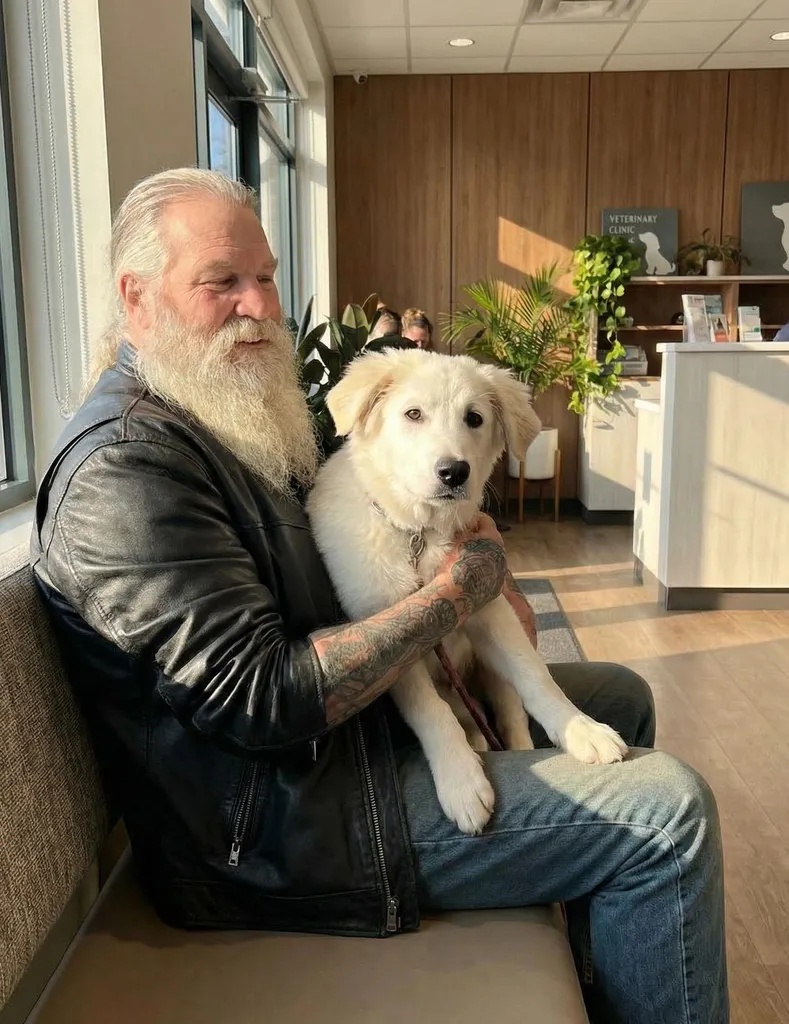
I called an emergency vet clinic. They told me to bring her in immediately. I wrapped Daisy in my jacket, unhooked the chain, and carried her to my bike. She was lighter than she should’ve been.
The whole ride, I kept talking to her. I don’t even remember what I said. Just nonsense. Promises. Apologies. Telling her she wasn’t alone anymore.
She didn’t cry. She just breathed.
At the clinic, they took her back right away. The vet came out a while later, her expression gentle but honest.
The tumor was malignant. Advanced. Surgery wouldn’t cure it. But Daisy wasn’t in as much pain as she looked. She was tired. Weak. But not suffering yet.
“She doesn’t need to die tonight,” the vet said. “And she doesn’t need to die alone.”
I asked how long she had.
“Days,” she said. “Maybe weeks. With comfort care after surgery to relieve pressure.”
I didn’t hesitate.
I paid for the surgery. I didn’t think about the cost. I didn’t think about anything except that a seven-year-old girl had prayed to strangers on motorcycles and somehow, I’d been dumb enough—or lucky enough—to answer.
Daisy made it through surgery.
She woke up groggy but calm. When she saw me, her tail thumped weakly against the blanket.
I stayed with her until visiting hours ended. Then I stayed longer.
Over the next few days, Daisy improved more than anyone expected. She ate. She wagged. She carried that old stuffed duck everywhere like it was sacred.
I asked the clinic staff to help me find Madison.
They contacted animal control. Then child services.
That’s when the truth came out.
Daisy hadn’t been abandoned because of money alone.
Madison’s father had been violent. Not just with the dog. With Madison’s mother, too. She’d left months earlier. Daisy was the only thing Madison had left that made her feel safe.
The night Daisy was chained to the bridge, Madison had begged her father to stop. He’d dragged the dog away anyway.
And then he’d left town.
Madison was found staying with a neighbor, clutching Daisy’s stuffed duck, crying herself to sleep every night.
When child services asked if Daisy could be reunited with Madison, the vet looked at me.
“She doesn’t have much time,” she said softly. “But we can make it good time.”
I said yes.
The reunion happened in a quiet room at the clinic.
Madison ran to Daisy and dropped to her knees, wrapping her arms around her neck like she was afraid she’d disappear.
“I told you angels ride motorcycles,” she whispered.
Daisy licked her face.
They spent two weeks together.
Two good weeks.
Walks in the grass. Sleeping side by side. Ice cream licked off fingers. Stories read out loud.
When Daisy passed, it was peaceful. Madison held her paw.
Afterward, Madison slipped something into my jacket pocket.
A drawing.
Me on my bike. Daisy in a sidecar. Wings on all of us.
I still ride that bridge sometimes.
I still think about how close we came to missing each other.
And I still believe this: sometimes the bravest prayers come from the smallest voices—and sometimes, if you’re lucky, you’re in the right place to answer them.