I’ve been a waiter for almost eight years.
You learn quickly not to expect much from certain tables—especially groups of teenagers. They laugh loud, order cheap, split checks, and usually leave a mess behind with little to show for it.
So when a group of four teens walked in that Friday night, dressed up and buzzing with excitement, I already braced myself.
They told me it was their homecoming night. First time out without parents. Big deal energy.
I smiled, took their order, made sure their waters stayed full, joked with them, even brought extra napkins when one of them spilled soda all over the table.
They stayed nearly two hours.
When they finally left, I cleaned the table and picked up the receipt.
$3.28.
That was the tip.
The Sting of It
I just stood there staring at the number.
Three dollars and twenty-eight cents—for two hours of work.
I didn’t yell. I didn’t chase them outside. I just felt tired. Invisible. Like my effort didn’t matter.
I crumpled the receipt, shoved it into my pocket, and told myself what I always do:
They’re kids. Let it go.
But that night, it stuck with me more than usual.
The Letter
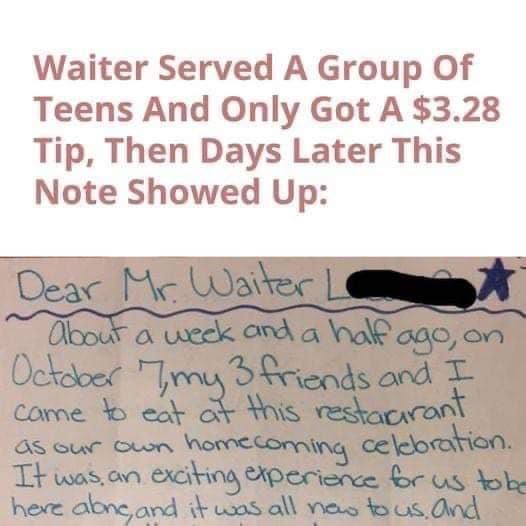
About a week and a half later, my manager called me over mid-shift.
“Hey,” he said, holding an envelope. “This came for you.”
It was handwritten.
No return address.
Inside was a folded piece of notebook paper, written carefully in blue ink.
The top line read:
“Dear Mr. Waiter,”
I frowned and started reading.
What the Letter Said
About a week and a half ago, on October 7, my three friends and I came to eat at this restaurant as our own homecoming celebration.
It was an exciting experience for us to be there alone, and everything felt new and grown-up.
We want you to know that you were very kind to us. You treated us with respect, joked with us, and made us feel welcome, even though we were just kids.
We didn’t realize until later that our tip was too small. We honestly thought we were doing the right thing. None of us had ever eaten out without our parents before.
When we got home and told them how much we tipped, they explained it to us—and we felt awful.
We hope you’ll forgive us. Please know that we never meant to disrespect you.
My throat tightened.
I kept reading.
The Part That Broke Me
Enclosed is the rest of the tip we should have given you, plus extra, because you taught us what kindness looks like.
We’ll never forget how you treated us, and we promise to do better in the future.
Taped to the bottom of the page was cash.
Not just a few bills.
Forty dollars.
I had to step into the back for a moment.
Seeing It Differently
All that anger I’d felt toward that table—the assumptions, the eye-rolls, the quiet resentment—it drained out of me at once.
They hadn’t been rude.
They hadn’t been cheap.
They had been ignorant, and then they had learned.
And instead of shrugging it off, they took responsibility.
Most adults don’t even do that.
What I Realized That Day
I realized how easy it is, especially in service jobs, to harden yourself.
To see people as “bad tippers,” “problem tables,” or “not worth the effort.”
But sometimes, people—especially young ones—are just figuring things out.
And how you treat them in that moment?
That sticks.
A Few Weeks Later
A few weeks after the letter, the same group came back.
I recognized them immediately.
This time, they looked nervous.
One of the girls smiled and said, “Hi… you were our waiter last time.”
“I remember,” I said.
They relaxed instantly.
We laughed. They ordered. They were polite and careful and clearly trying their best.
When they left, the tip was generous—but more than that, they wrote “Thank you” on the receipt and smiled on their way out.
The Lesson I Carry With Me
I still keep that letter in my locker.
Not because of the money.
But because it reminds me that kindness teaches.
That patience matters.
And that sometimes, what feels like disrespect is really just inexperience waiting for guidance.
That $3.28 tip upset me at first.
But the letter that came days later?
It restored my faith—in people, in learning, and in the quiet power of treating others well, even when you don’t think it’ll matter.
Because sometimes, it matters more than you’ll ever know.