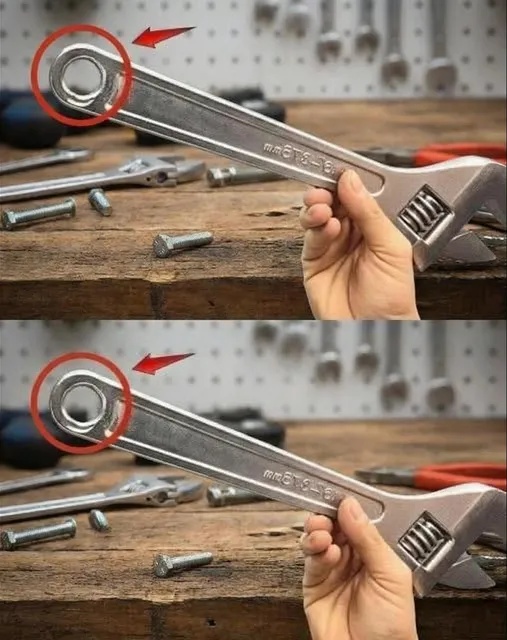
If you’ve ever picked up an adjustable wrench and noticed the small hole at the end of the handle, you’re not alone in wondering about it. It looks intentional… but also kind of mysterious. Most people assume it’s decorative, or just there to save metal.
It’s not.
That tiny hole actually has multiple practical purposes—and once you know them, you’ll never look at your tools the same way again.
1. It’s Meant for Hanging (and Staying Organized)
The most common reason is also the simplest: storage.
That hole allows the wrench to be hung on a pegboard, hook, or nail. In workshops where time matters, being able to see and grab the right tool instantly is a big deal. Hanging tools also:
- Keeps them off cluttered surfaces
- Prevents them from getting buried in drawers
- Reduces wear from tools banging into each other
If you’ve ever fished through a toolbox for five minutes just to find that one wrench, you already understand the value.
2. It Can Save Your Tool—and You—From a Fall
In construction, mechanical work, or jobs done at height, tools don’t just get lost—they can be dangerous.
That hole is often used to attach a lanyard or safety tether. When working on ladders, scaffolding, or rooftops, a tethered wrench won’t:
- Fall and injure someone below
- Damage surfaces or equipment
- Disappear into the void forever
Professionals use this feature all the time, even if it looks like a tiny detail.
3. Extra Leverage in a Pinch
Here’s a lesser-known trick.
In tight situations, that hole can be used to slide in:
- A screwdriver
- A metal rod
- Another wrench
This creates a longer lever, giving you extra torque when dealing with a stubborn bolt. It’s not something you should rely on constantly—but in emergencies, it can be a real knuckle-saver.
(Just be careful not to overdo it and damage the tool or fastener.)
4. A Measuring Shortcut (Yes, Really)
On some wrenches, the hole and handle length are standardized enough that experienced tradespeople use them as rough measuring references.
No, it’s not a ruler—but when you’ve been working with the same tools for years, you learn their dimensions instinctively. It’s one of those “old pro” habits that never makes it into manuals.
5. It’s a Small Detail That Signals Good Design
Tools are all about efficiency.
That hole may seem insignificant, but it reflects thoughtful engineering—adding function without adding bulk or cost. It doesn’t interfere with grip. It doesn’t weaken the wrench. And it adds versatility.
That’s good design doing its job quietly.
Why Most People Never Notice
Because for everyday home use, you don’t need the hole.
If your wrench lives in a drawer and comes out twice a year to tighten a loose pipe or bike seat, the feature never announces itself. But in professional or heavy-use environments, it earns its keep fast.
Final Thought
The next time you’re holding a wrench, take a second look at that little hole at the end of the handle. It’s not decoration. It’s not an accident.
It’s a reminder that even the simplest tools are full of smart ideas—designed by people who learned the hard way what actually matters on the job.
Sometimes, the smallest details do the most work.