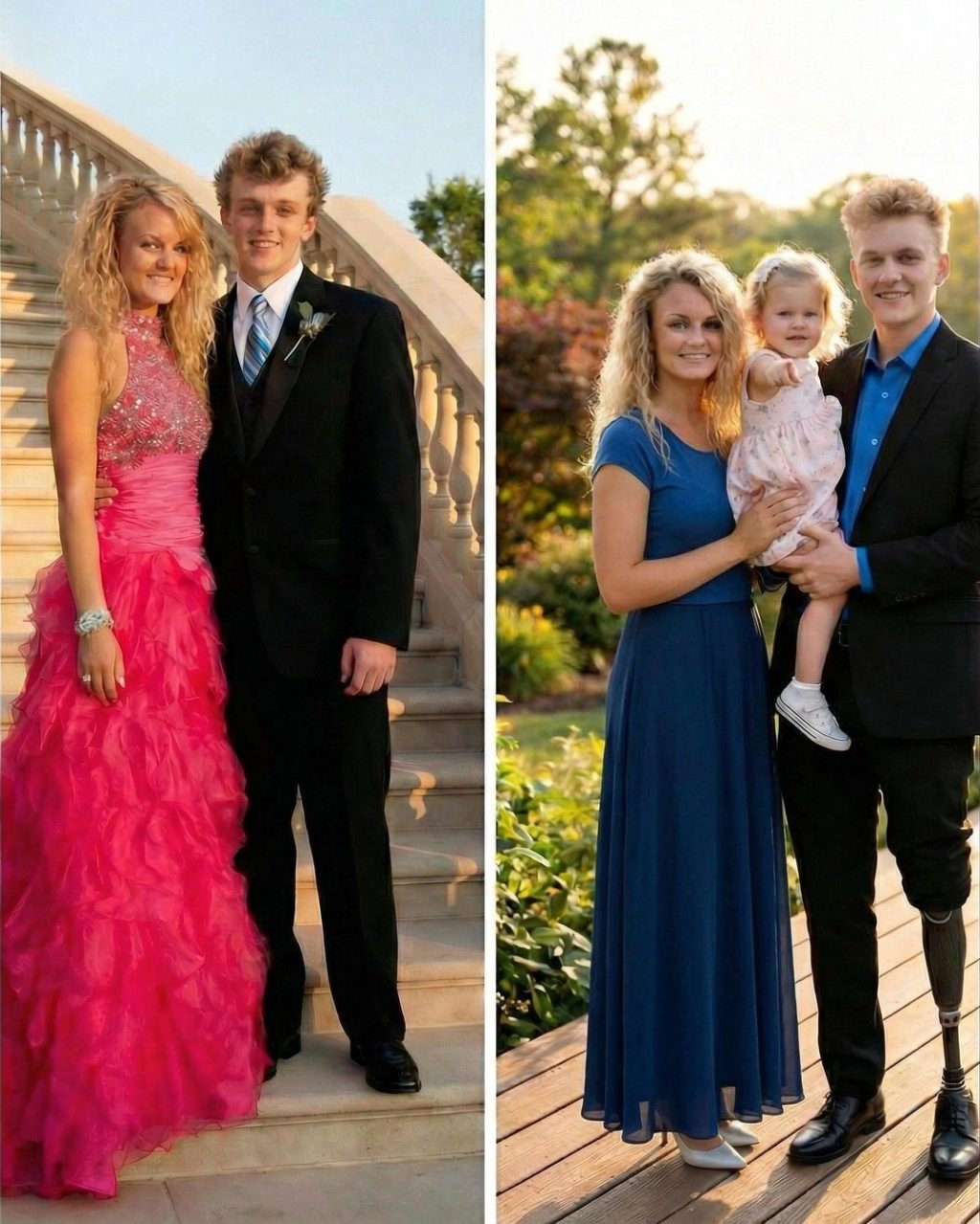
I was twenty-five when I lost my leg in the Army.
One second, you’re joking with the guys, thinking about nothing more than getting through the day. The next, there’s an explosion—and your entire life splits cleanly in two. Before and after. Who you were, and who you’re forced to become.
The IED took my leg, but it didn’t stop there. It took my sense of control. My confidence. My idea of what the future was supposed to look like.
Rehab was brutal. Anyone who tells you otherwise is lying. Learning to use a prosthetic isn’t heroic or inspiring—it’s humiliating. You fall. A lot. You sweat. You swear. You relearn things toddlers master without thinking. Walking across a room feels like climbing a mountain.
There were nights I lay awake wondering if I was still the man I used to be—or if I was someone entirely new that nobody had signed up for.
Then I came home.
A few months after my discharge, I proposed to my high school sweetheart, Jess. She had waited for me through deployments, long silences, and fear she never fully admitted out loud. When she saw me for the first time after the injury, she cried.
Not quietly.
She cried the kind of cry that scares you. The kind that shakes her whole body.
And then she wrapped her arms around me, pressed her forehead against mine, and said, “We’ll figure it out.”
She didn’t say you’ll figure it out.
She said we.
And she meant it.
Her parents weren’t so sure. They worried about what life would look like. About finances. About strain. About resentment. I overheard conversations I wasn’t meant to hear.
Jess shut them down every time.
She looked me straight in the eye once and said, “I love him. Not his body. Him.”
We got married.
We built a life. It wasn’t perfect. Money was tight. My temper wasn’t always great during the early years. Pain has a way of making you sharp around the edges. But Jess was steady. Patient. Fiercely loyal.
When our daughter was born, everything shifted again—but this time, in a good way.
She became our entire world.
Fast-forward to her third birthday.
Jess stayed home that afternoon to decorate a chocolate cake—our daughter’s favorite—while I went to the mall to buy the giant doll she’d been begging for. The one she’d pointed at every single time we walked past the toy aisle.
It took me almost two hours to get back.
Moving around with a prosthetic isn’t fast. It’s calculating. You plan routes. You take breaks. You ignore stares.
When I opened the front door, I knew immediately that something was wrong.
There was no music playing. No clinking dishes. No off-key humming—the thing Jess always did when she baked.
Just silence.
“Jess?” I called out.
Nothing.
The kitchen was spotless. The cake box sat unopened on the counter.
My chest tightened.
I checked the bedroom next.
That’s when my stomach dropped.
Her side of the closet was empty. Shoes gone. Clothes gone. The suitcase we only used for long trips was missing.
The panic hit so hard my vision blurred. For a second, I honestly thought I might collapse.
I rushed to the nursery.
Our daughter was asleep in her crib, thumb tucked under her chin, completely unaware that anything was wrong.
Behind her, taped carefully to the wall, was a folded note.
Jess’s handwriting.
My hands were shaking so badly I almost tore it in half.
It said:
I’m sorry. I can’t stay anymore. Take care of her. I made a promise to your mom. Ask her.
That was it.
No explanation.
No goodbye.
No “I love you.”
Just those words.
I didn’t stop to think. I strapped my daughter into her car seat and drove straight to my mother’s house.
I didn’t knock.
I kicked the door open so hard it slammed into the wall.
My mom was sitting calmly in the living room, hands folded in her lap, like she’d been waiting.
“Mom,” I demanded, my voice shaking, “what did you do to Jess?”
The color drained from her face.
“Oh no,” she whispered. “She did it.”
She looked at my daughter. Then back at me.
“Sit down,” she said quietly. “We’ve been hiding something from you all this time.”
My legs felt weak as I lowered myself into a chair.
She took a deep breath.
“When you were injured,” she said slowly, “the doctors told us things you were never supposed to hear. Complications. Chronic pain. Mobility issues. The possibility that stress could shorten your life.”
I stared at her, stunned.
“Why didn’t you tell me?” I asked.
“Because you had just lost your leg,” she said, tears welling up. “And you were already fighting to survive.”
She told me that one night, while I was still in rehab, she had sat with Jess at the hospital. Jess had been exhausted, scared, barely holding herself together.
“I told her,” my mom continued, “that loving someone means knowing when to step back. I asked her to promise me something.”
My chest tightened.
“I asked her to promise that if she ever felt like she was becoming more of a caregiver than a partner—if she started losing herself—she would leave. Quietly. Without a fight. For your sake and for hers.”
I stood up so fast the chair tipped.
“You told my wife to leave me?” I shouted.
My mom shook her head. “No. I told her to protect all of you.”
The room spun.
Jess had carried that promise for years. Through my pain. Through my anger. Through nights she cried in the bathroom so I wouldn’t hear. Through the weight of being strong for everyone.
And when she finally felt herself breaking, she kept the promise she made—to my mother.
Not because she didn’t love me.
But because she did.
It took weeks to find her.
She was staying with a friend two towns over. When I finally saw her, she looked thinner. Tired. But relieved.
“I didn’t leave because you’re broken,” she said quietly. “I left because I was.”
We talked for hours. Cried. Argued. Told truths we’d both been afraid to say.
In the end, we chose counseling. Not as a last resort—but as a reset.
She came home.
Not because she felt obligated.
But because this time, the choice was hers.
We’re still figuring it out.
But I’ve learned something important: love isn’t proven by how much pain you can endure in silence. Sometimes, love means telling the truth before resentment does it for you.
I lost my leg at twenty-five.
But the hardest thing I ever faced wasn’t learning how to walk again.
It was learning how to listen—to the people who stayed, the ones who almost left, and the truths we hid from each other out of fear.