I’m 18 years old, and I walked into prom with the only family I have left—my grandmother.
My mom died giving birth to me. I never knew my father. By the time I was old enough to understand what the word family really meant, it was already just the two of us. Me and Grandma Doris against the world.
She raised me when most people her age were slowing down. Her hands were always tired. Her knees ached. Some mornings she moved so carefully it hurt to watch—but she never complained. Not once. Not about the pain. Not about the sacrifices. Not about how unfair life had been.
She read me adventure stories at night even when her eyes could barely stay open. She made pancakes every Saturday morning, even when the fridge was almost empty. She came to every school event—concerts, assemblies, parent nights—always sitting quietly in the back row, clapping louder than anyone else.
To keep a roof over our heads, she worked as a janitor.
At my school.
That’s when the jokes started.
“Future mop boy.”
“Careful, he smells like bleach.”
“Hey, tell your grandma to clean aisle three.”
I heard it all. Every laugh in the hallway. Every whisper behind my back. Every sideways look when kids saw her pushing that yellow cart down the corridor. I learned how to keep my face blank, how to swallow the hurt and act like it didn’t matter.
I never told her.
I didn’t want her to feel ashamed of honest work. And I didn’t want her to think, even for a second, that she was the reason kids treated me differently.
Prom season came around fast.
Everyone talked about dates, dresses, limos, and after-parties. Guys argued over who had the hottest date. Girls stressed over shoes and hair appointments. Teachers reminded us it was “a night we’d never forget.”
They were right. Just not in the way they expected.
I already knew who I wanted to take.
When I asked my grandma, she laughed at first. Thought I was joking. Then she realized I wasn’t—and immediately tried to talk me out of it. She said she didn’t belong there. Said I deserved a “real date.” Said people would stare.
I told her I didn’t care.
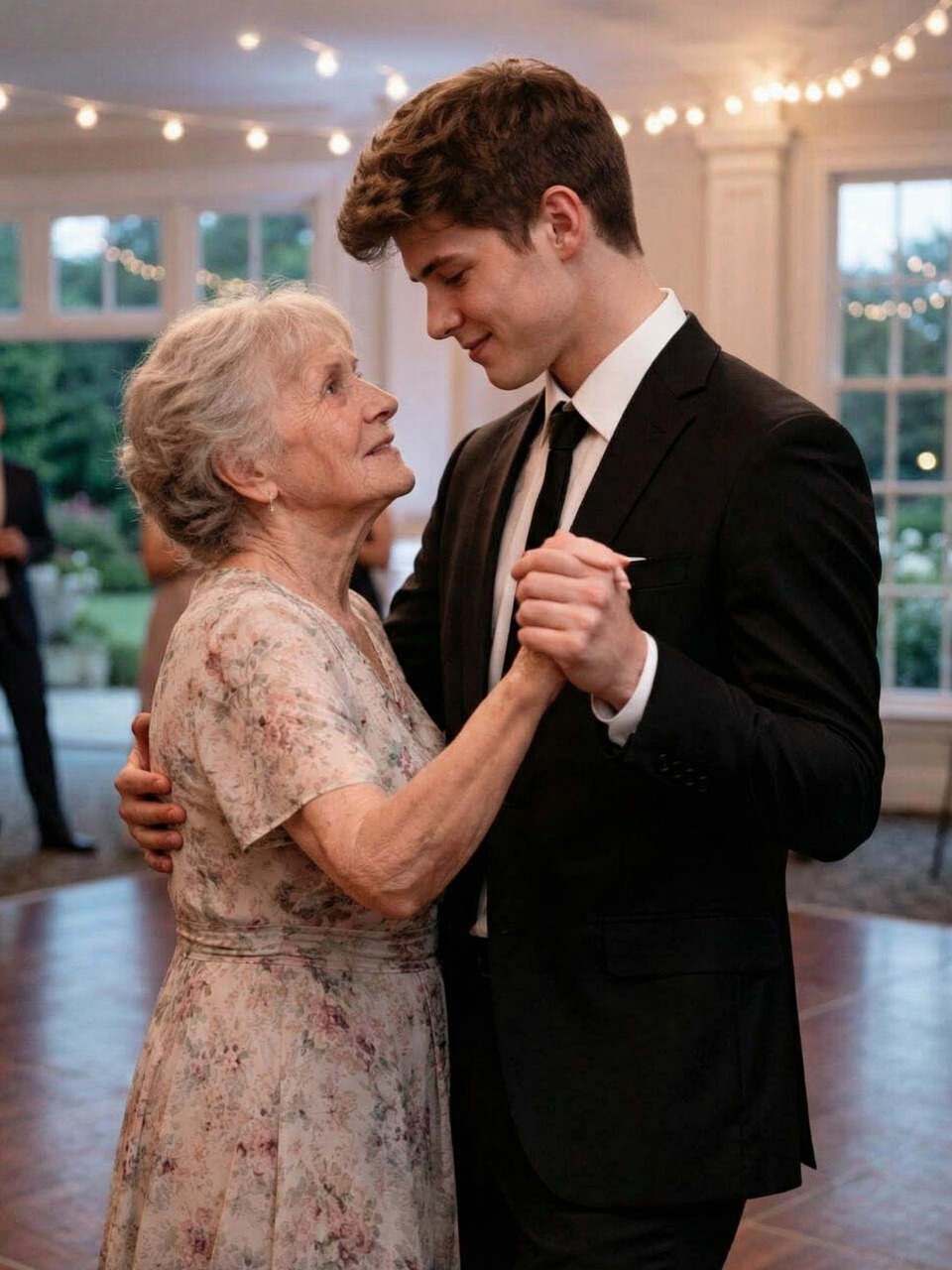
Prom night came, and she stood in her room staring at the mirror like she was fifteen again. She wore an old floral dress she’d kept tucked away for years. She kept smoothing the fabric, apologizing over and over for not having something “nicer.”
To me, she looked perfect.
When we walked into the gym, the lights were dim, music thumping, decorations everywhere. Heads turned. Whispers started almost instantly. I could feel the stares crawling up my back.
I ignored them.
When the first slow song played, boys rushed to the dance floor to claim their dates. I didn’t move. I walked straight to my grandma and held out my hand.
“May I have this dance?”
She froze.
Then the laughter exploded.
“DON’T YOU HAVE A GIRL YOUR AGE?”
“IS THAT HIS GRANDMA?”
“HE BROUGHT THE JANITOR!”
I heard it all. Loud. Sharp. Cruel.
Her hand shook in mine. I felt it. She tried to smile, but her eyes filled with tears. She leaned in and whispered that maybe she should go home. That she didn’t want to ruin my night.
That’s when something inside me snapped.
Not anger. Not embarrassment.
Something deeper.
I walked her to a chair, told her to wait just a second. Then I did something no one expected.
I walked straight to the DJ.
And I turned off the music.
The room dropped into complete silence.
Hundreds of people froze mid-laugh, mid-conversation. Every head turned as I grabbed the microphone. My heart was pounding so hard I thought it might break my ribs—but my voice came out steady.
“My name is Alex,” I said. “And the woman you’re laughing at… is the reason I’m standing here today.”
The room stayed silent.
“I never met my mom. She died the day I was born. I don’t know who my father is. This woman raised me by herself. She worked two jobs. She skipped meals so I could eat. She cleaned your classrooms so I could graduate in one.”
I looked straight at the crowd.
“She worked here as a janitor, and some of you laughed at that. But while you were sleeping, she was scrubbing floors. While you were worrying about outfits, she was worrying about keeping the lights on.”
I turned toward her. She was crying now, hands over her mouth.
“This is my prom date because she’s my hero. And if that’s funny to you… then you don’t understand what love is.”
You could’ve heard a pin drop.
Then I walked back to her, took her hand again, and nodded at the DJ.
The music came back on.
Slowly.
No one laughed this time.
Some people clapped. A few wiped their eyes. Teachers stood frozen. My grandma stood up, still shaking, and we danced. Just the two of us. Right there in the middle of the floor.
Halfway through the song, other couples joined in. Not because it was trendy. Because the room had changed.
After that night, something else changed too.
The kids who used to whisper apologized. A few admitted they’d never thought about the people who cleaned their school. Teachers hugged my grandma. One even said, “We should’ve said something sooner.”
When prom ended, my grandma squeezed my hand and said it was the best night of her life.
Mine too.
Years from now, I won’t remember the decorations. I won’t remember who wore what. I won’t remember the music.
But I’ll remember the moment the laughter stopped—and love filled the room instead.