My wife was the first one to notice it.
A tiny blinking light on the smoke detector in our Airbnb bedroom. At first, we both brushed it off. Low battery, maybe. Or some newer model feature we weren’t familiar with. The place was clean, well-reviewed, and supposedly “family-friendly.” Nothing about it screamed danger.
But the blinking didn’t stop.
It was subtle—easy to ignore if you weren’t paying attention. My wife was paying attention. She has that instinct. The kind that nags quietly until you finally listen.
“That light isn’t normal,” she said.
I laughed it off. “It’s a smoke detector.”
“Still,” she replied. “Why would it blink like that?”
Later that night, after the lights were off and the room was quiet, the blinking felt louder. Brighter. Wrong. That’s when she got up on the bed, twisted the detector, and unscrewed it from the ceiling.
What fell into her hand wasn’t just a smoke detector.
It was a camera.
A small one. Hidden. Tucked neatly inside the housing, pointed directly at the bed.
For a second, neither of us spoke.
Then everything happened at once.
My stomach dropped. My chest tightened. My wife’s face went pale. It felt like the room suddenly wasn’t ours anymore—like the walls had ears, like someone was still watching even though we’d found it.
We didn’t argue. We didn’t debate. We didn’t even finish packing properly.
We grabbed our bags, threw our things inside, and left. No shower. No sleep. No looking back.
In the car, my hands were shaking as I started the engine.
That’s when the anger kicked in.
Once we were somewhere safe, I opened the Airbnb app and wrote a review. I didn’t exaggerate. I didn’t rant. I simply told the truth. There was a hidden camera inside the smoke detector. We found it. We left immediately. People needed to know.
I hit “post.”
A few minutes later, my phone buzzed.
It was a reply.
Not from Airbnb support.
From the host.
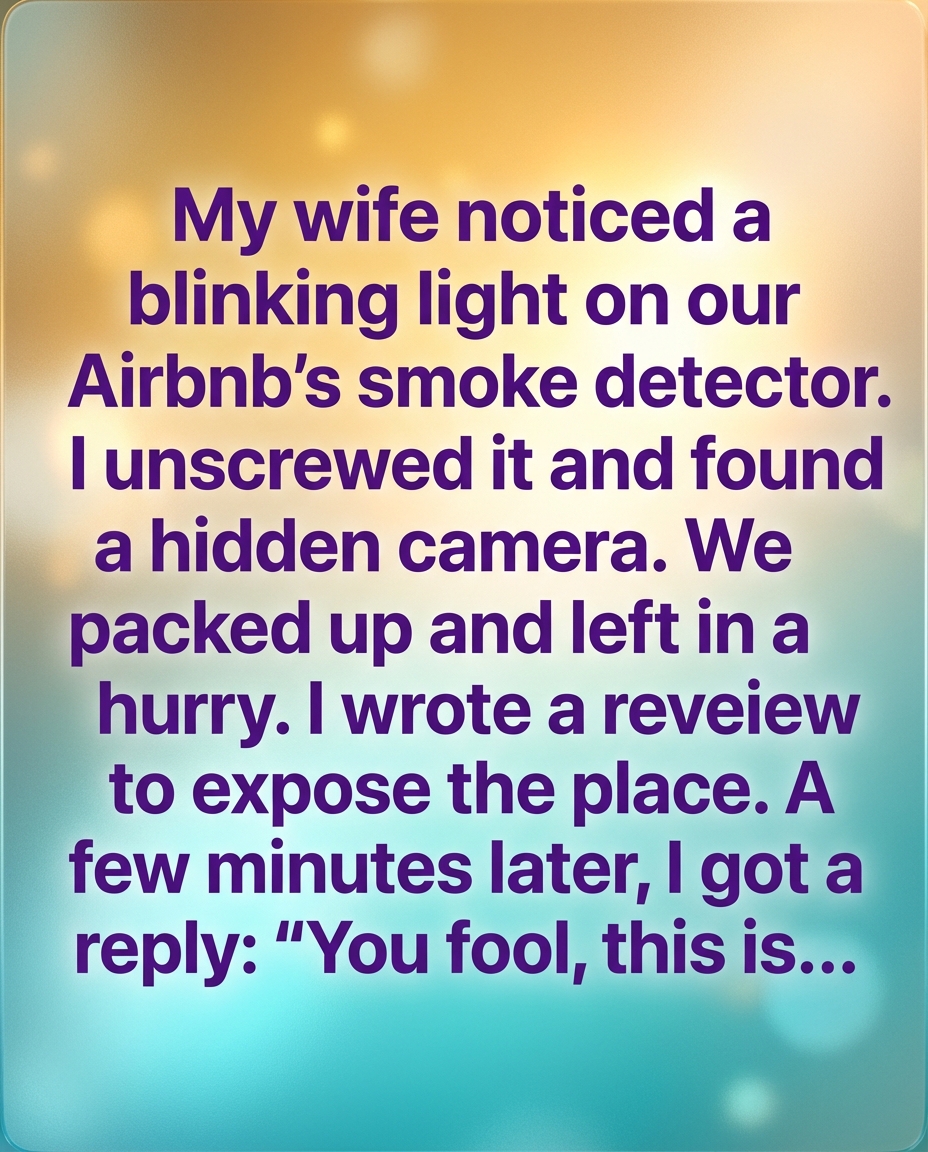
“You fool,” it started. “This is…”
And that’s when my blood went cold.
He claimed it wasn’t a camera. He said it was a “security sensor.” A “monitoring device.” Something installed to “protect the property.”
Protect it from what? Guests sleeping?
The message went on—condescending, defensive, almost mocking. He said I was overreacting. That I’d misunderstood. That I was damaging his reputation over nothing.
Nothing.
I took screenshots. Every word. Every timestamp.
Then I reported everything—through the app, through customer support, and finally to local authorities. Airbnb escalated the case. The listing disappeared within hours. My review vanished too, but by then, it didn’t matter. The paper trail existed.
The next day, Airbnb confirmed what we already knew.
The device violated policy. Cameras inside private spaces are strictly prohibited. The host was banned.
But here’s the part that still haunts me.
That listing had hundreds of reviews.
Families. Couples. Solo travelers.
How many people never noticed the blinking light?
How many people were recorded without ever knowing?
I still think about that.
What scares me most isn’t that we found the camera.
It’s how close we were to not finding it.
If my wife hadn’t trusted her gut.
If we’d assumed the light was normal.
If we’d stayed one more night.
We tell ourselves these things only happen to other people. In sketchy places. In bad neighborhoods. Not in highly rated rentals with professional photos and glowing reviews.
But they do happen.
And sometimes, the only warning you get is a tiny blinking light you almost ignore.
So if you ever notice something that feels off—listen to it.
If something doesn’t make sense—question it.
And if your instinct says leave—don’t second-guess it.
Your privacy isn’t paranoia.
Your safety isn’t an overreaction.
And no vacation is worth ignoring that quiet voice telling you something isn’t right.