When I was sixteen, our house caught fire in the middle of the night.
One moment I was asleep, wrapped in the ordinary comfort of being a kid who believed tomorrow was guaranteed. The next, I was coughing, half-blind from smoke, my dad shaking me awake and dragging me toward the front door.
I remember the heat. The noise. The way everything felt unreal, like I was watching my life from the outside.
My dad pushed me out onto the lawn in my bare feet. I turned around just in time to see him run back inside.
He was going for my mom.
And my grandpa.
They never came back out.
The fire took all three of them in less than ten minutes.
After that, I wasn’t really living. I was drifting.
The fire didn’t just take my family. It took our house, our savings, every photo we’d ever owned, my clothes, my school notebooks—everything that proved we had once existed as a whole family.
Everything except me.
For a while, I stayed wherever the system put me. Eventually, a local volunteer service helped me get a room in a community dorm-style shelter. It wasn’t home, but it was safe. Clean. Warm. A shared kitchen. Two bathrooms per floor. A bed that didn’t smell like smoke.
I was grateful.
Especially because my only living relative—my mom’s sister—refused to take me in.
“I don’t have the space,” she said flatly. “And I’m not giving up my reading nook for a teenager.”
What she did take, though, was half the insurance payout that came to me after the fire.
“I lost my sister,” she said, like that made it fair.
I didn’t argue.
I’d already lost the thing that mattered most. Money felt meaningless by comparison.
During the day, I focused on surviving the future. I studied obsessively, determined to get into college. I applied for every job that would look at a sixteen-year-old with no parents and a permanent smell of smoke clinging to their memory.
At night, when most people in the shelter gathered around the TV in the common room, I went to the kitchen.
That’s where I started baking.
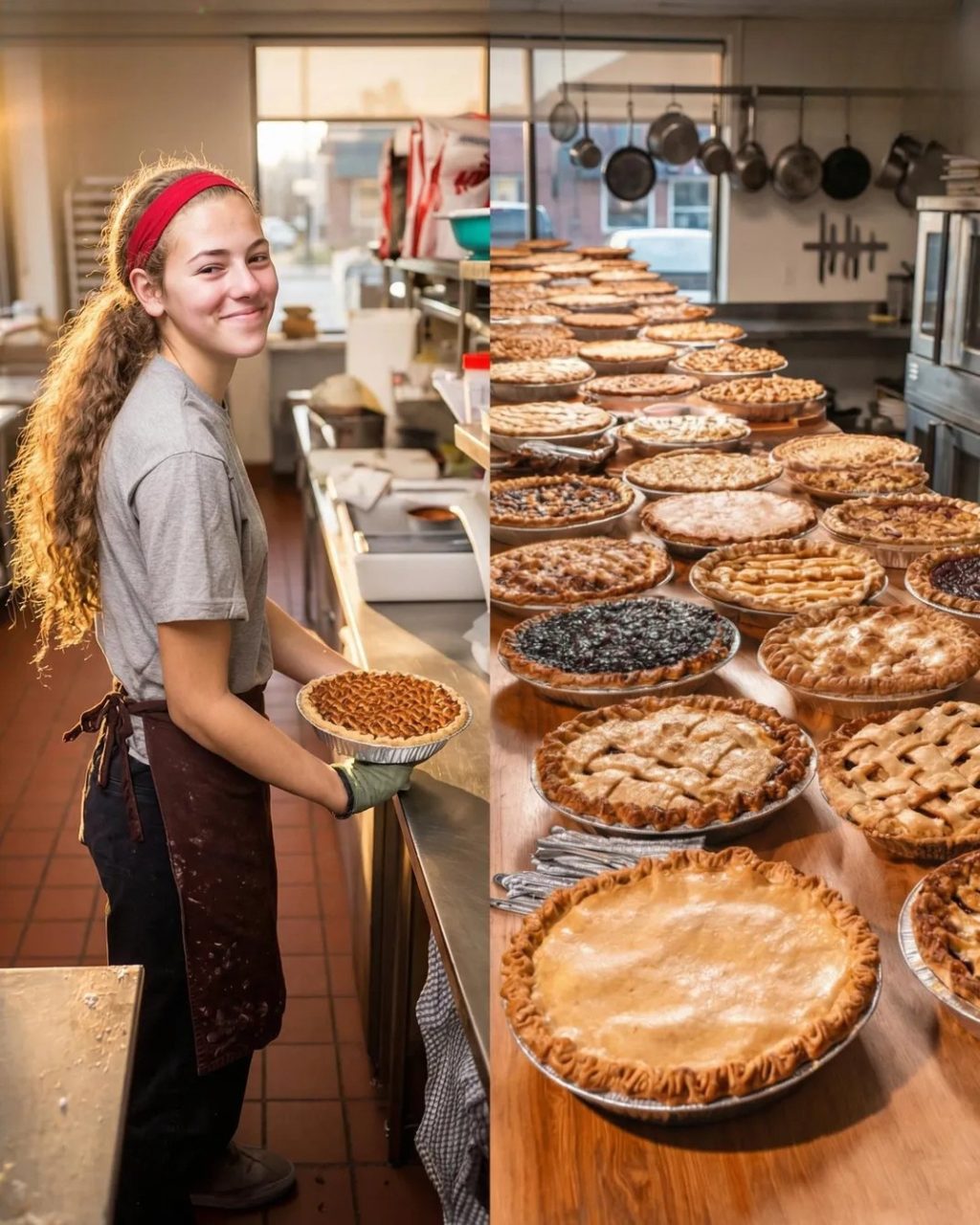
It wasn’t planned. One night, I found an old recipe card in a donated cookbook—apple pie, written in looping handwriting that reminded me of my mom’s. I bought flour, apples, and butter with part of my monthly aid and made it quietly, after midnight.
Something about the rhythm calmed me. Measuring. Mixing. Rolling dough until my hands remembered what to do even when my heart didn’t.
Soon, one pie became two. Then five. Then ten.
I baked pies for the local hospice and the homeless shelter downtown. Apple. Peach. Strawberry rhubarb when I could afford it. Once, when a volunteer gave me extra fruit, I made twenty in one night, my arms aching and my eyes burning from exhaustion.
I saved for ingredients the way other people saved for clothes or phones. Flour. Sugar. Butter. Whatever I could afford.
I dropped the pies off anonymously, handing them to nurses or volunteers and leaving before anyone could ask questions. I never met the people who ate them. That was too much for me. I wasn’t ready to hear their stories when I was still drowning in my own.
My aunt thought I was ridiculous.
“You’re wasting money,” she snapped when she found out. “You should be sending that money to me. I lost my sister.”
I didn’t explain that baking was the only thing that made me feel useful. The only thing that reminded me I could still put something good into the world, even if everything else had burned away.
So I kept baking.
It gave my days shape. It gave my nights meaning.
Two weeks after my eighteenth birthday, a small brown box showed up at the front desk of the shelter.
My name was written on it in neat, careful cursive.
No return address.
Inside was a pecan pie.
Perfectly golden. A braided crust so precise it looked like art. Lightly dusted with powdered sugar. The smell alone made my knees weak.
I stood there staring at it, confused. No one I knew baked. No one knew me well enough to send something like this.
I brought it to the kitchen, my hands shaking as I cut into it.
That’s when I saw what was hidden inside.
Folded carefully between layers of filling, wrapped in wax paper, was a note.
And underneath it—cash.
Not loose bills. Not change.
Neatly stacked money.
Enough to make my chest hurt.
I unfolded the note with trembling fingers.
You fed my husband during his last months when he had nothing left to offer anyone. He talked about your pies like they were miracles. He said a kid who had lost everything still found a way to give. Please let us give back.
I had to sit down.
The note was signed by his wife. At the bottom was an address. A real one. A house.
I cried harder than I had since the fire.
Not because of the money—though it changed everything—but because someone had seen me. Someone had felt what I was doing. Someone had remembered.
That pie wasn’t just dessert.
It was proof that kindness doesn’t disappear when you give it away. It multiplies. It finds its way back, even when you’re not looking.
I went to college. I worked two jobs. I kept baking.
Years later, I opened a small bakery. On the wall behind the counter, framed and yellowing with age, is that note.
And every time I make a pecan pie, I braid the crust just like the one that saved me.
Because sometimes, the thing that brings you back to life isn’t rescue.
It’s being reminded that you mattered to someone—even when you thought you didn’t.