The trauma center was already chaos before the night crossed into something no one was prepared for.
Monitors were beeping out of rhythm, voices overlapped in clipped commands, and the smell of antiseptic hung thick in the air. It was the kind of shift veteran ER staff recognized instantly—the kind that left you wrung out before midnight even hit.
Then the doors burst open.
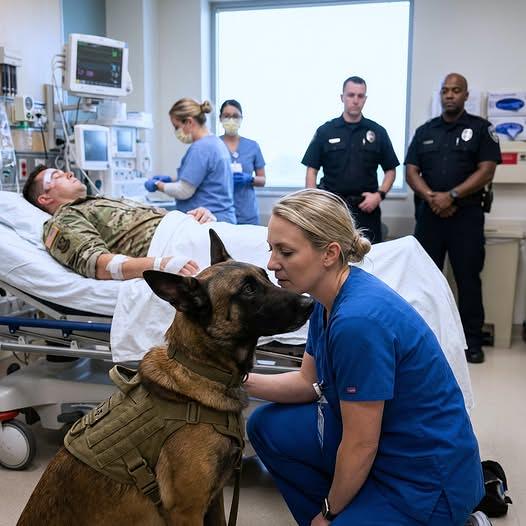
On the stretcher lay a Navy SEAL. A man built for endurance and war, now ghost-pale and unconscious, his uniform torn and soaked with blood. Shrapnel wounds riddled his torso and leg. His vitals were dropping fast.
Normally, the trauma team would’ve moved like a single organism—cutting gear, applying pressure, shouting measurements. But no one touched him.
Because no one could.
A massive Belgian Malinois had launched itself onto the stretcher the second it stopped moving. The dog wasn’t frantic. It wasn’t confused. It was locked in, focused, every muscle coiled tight.
This wasn’t a scared animal.
This was a trained protector doing exactly what it had been taught to do.
The dog planted itself over the soldier’s chest, ears flat, teeth bared, a low growl vibrating through the room. Every time a hand came closer than three feet, the growl deepened. A warning. A promise.
Security rushed in. One guard instinctively reached for his weapon. Another hesitated.
“Animal control, now!” the lead trauma surgeon shouted.
Someone yelled back, “They’re twenty minutes out!”
Twenty minutes the soldier didn’t have.
Blood pressure dropped again. A monitor alarm screamed.
To save the man, they had to reach him.
To reach him, they had to move the dog.
And to move the dog… someone might have to shoot it.
The room locked into a terrible stillness.
No one wanted to be the one who made that call.
That’s when Ava stepped forward.
Most people barely noticed her at first. She was new—barely a month into the ER. Quiet. Efficient. The kind of nurse who stocked supplies without being asked and stayed out of the way during high-intensity moments.
Not the kind of person anyone expected to step into the center of a standoff.
“Ava, stop,” someone hissed as she crossed the invisible line everyone else had avoided.
She didn’t.
A guard shouted, “Ma’am, get back!”
She kept walking.
Ava lowered herself to one knee, slow and deliberate, until she was eye-level with the dog. Close enough to see the flecks of blood on its muzzle. Close enough that one wrong move could end her career—or her life.
The dog snapped once. Loud. Sharp.
Ava didn’t flinch.
She didn’t raise her voice. Didn’t reach out. Didn’t try to assert control.
She simply looked into the dog’s eyes and spoke softly.
The words weren’t English. They weren’t German. They weren’t commands anyone in the room recognized.
They came out slow and rhythmic, almost like a lullaby—but precise. Measured.
A code.
The dog froze.
The growl faded into silence.
Its ears shifted. Its posture changed—not relaxed, but uncertain. Conflicted.
Ava kept talking, her voice steady even as the room held its breath.
Then something unbelievable happened.
The dog slowly stepped off the stretcher.
Not all the way. Just enough.
Enough for the trauma team to move in.
“Go!” the surgeon snapped.
Hands flew. Scissors cut. Gauze pressed. IVs inserted. The room exploded back into motion.
The dog sat beside the stretcher, trembling now, eyes never leaving the soldier’s face.
The operation that followed was brutal and fast. Blood transfusions. Emergency surgery. A race measured in heartbeats.
The dog never moved.
When the soldier was finally stabilized and wheeled toward surgery, the Malinois followed—stopping only when a handler from the base arrived and gently clipped on a leash.
Only then did the staff exhale.
Later, in the break room, the questions came.
“What did you say to that dog?”
“How did you know that would work?”
“Where did you learn that?”
Ava hesitated.
Then she said, “My brother was K-9 unit. Army. He trained dogs before… before he didn’t come home.”
She explained that years earlier, during one visit to the base, she’d listened while handlers talked about a rarely used verbal code—a fallback sequence meant for extreme situations. A phrase designed to tell a combat dog that its handler was safe for now and that medical intervention was not an enemy.
Most people never learned it.
Most dogs never needed it.
She never thought she would either.
“But I recognized the dog’s stance,” Ava said quietly. “That wasn’t aggression. That was loyalty.”
The soldier survived.
Weeks later, he returned to the hospital on crutches, scars fresh and eyes clear. His dog walked beside him, calm and alert.
He asked for Ava by name.
When she entered the room, he struggled to stand. She waved him back down.
“I heard what you did,” he said. His voice broke before he could stop it. “You saved my life. And you saved him.”
The dog sat at Ava’s feet and leaned into her leg.
For a moment, no one spoke.
That night changed how people looked at the quiet rookie nurse. But more than that, it changed how the staff talked about protocol.
Because sometimes, the rulebook doesn’t save lives.
Sometimes it’s empathy. Memory. A single voice that knows how to speak when everything else is noise.
And sometimes, the difference between tragedy and survival…
is knowing exactly what to whisper at the right moment.