Elliot Row was standing at the stove when the phone rang.
Butter sizzled softly in the pan, garlic filling the kitchen with that warm, familiar smell that usually meant comfort. He wiped his hands on a dish towel and glanced at his phone, already annoyed. Unknown number.
He hesitated, then answered.
“Hello?”
“Mr. Row, this is your family notary. I’ll need you to come into my office tomorrow morning. There’s an inheritance matter that requires your signature.”
Elliot frowned, eyes still on the omelet.
“Inheritance?” he repeated. “I think you’ve got the wrong person.”
“No mistake,” the man said calmly. “Please come in. It’s… unusual. But legitimate.”
Before Elliot could ask anything else, the call ended.
He stood there for a moment, spatula frozen in his hand. His parents were alive. Healthy. Ordinary. There were no rich relatives lurking in the background of his life. No mysterious benefactors. Nothing like this.
Still, curiosity has a way of prying open doors logic tries to keep shut.
The next morning was gray and heavy with fog. Elliot drove across town, irritation slowly replacing confusion. The notary was already waiting outside the office, coat buttoned, expression serious.
“Elliot,” he said, ushering him inside. “I know this sounds strange. But if it weren’t important, I wouldn’t have pulled you in on your day off.”
The office was eerily quiet. No ringing phones, no assistants rushing past. Just the sound of their footsteps on old wooden floors.
Elliot sat across from the desk, arms folded.
“This concerns your uncle,” the notary began. “Walter Jonas.”
“I don’t have an uncle named Walter,” Elliot said immediately.
“You do,” the man replied, unfazed. “Or rather, you did. He passed away last month.”
He laid three items on the desk: an old iron key, a yellowed hand-drawn map, and a single sheet of paper with an address written in careful handwriting.
“A property,” the notary continued. “Left entirely to you.”
Elliot stared at the items. “What kind of property?”
“A house,” the man said. “In the middle of Lake Connamah.”
Elliot laughed once, sharply. “You’re joking.”
“I’m not.”
The notary slid the map closer. “Central Connecticut. It’s been in your uncle’s possession for decades. And now it’s yours.”
Something stirred in Elliot’s chest. Not excitement exactly. More like… recognition. As if a long-forgotten word had just been spoken aloud.
He picked up the key. It was heavier than he expected, the metal worn smooth by time.
Within an hour, he’d packed a small backpack and was on the road.
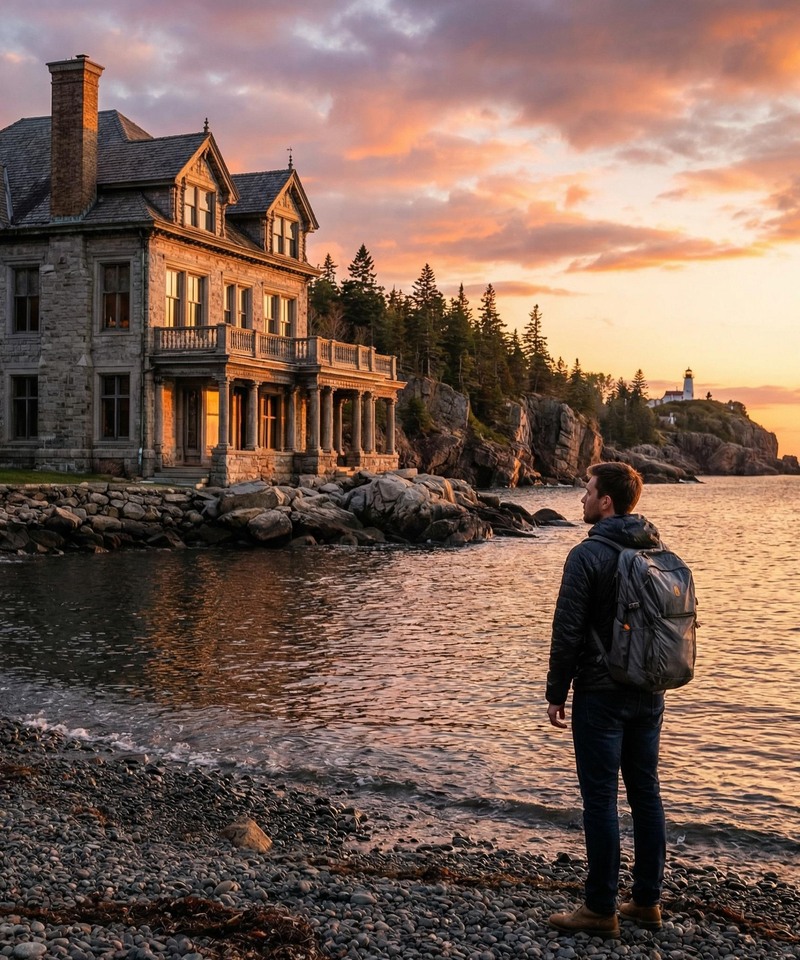
Lake Connamah appeared suddenly, the trees thinning until water stretched out before him like a sheet of dark glass. The lake was unnaturally still. And there, at its center, stood the house.
It was massive. Old. Dark. As though it had risen straight from the water rather than been built upon it.
At a small café near the dock, a few elderly men sat nursing their coffee. Elliot approached them.
“Excuse me,” he said. “That house out there—do you know who lived in it?”
One man slowly set his cup down.
“We don’t talk about that place.”
“Why?”
“Because it shouldn’t still be there,” another muttered. “And neither should the man who lived in it.”
Elliot swallowed. “Someone lived there recently. I inherited it.”
The men exchanged looks.
“At night,” the first said quietly, “we hear boats. Supplies get taken out. But we never see anyone come or go. And we don’t ask.”
That should have been his sign to turn back.
It wasn’t.
The woman at the boat dock introduced herself as June. Her eyes flicked to the key in Elliot’s hand, then back to his face.
“No one goes there,” she said flatly.
“I need to,” Elliot replied. “It’s mine.”
June sighed, long and weary. “I’ll take you. But I’m not waiting. I’ll be back tomorrow morning.”
The house loomed larger as they approached, its reflection rippling across the water. The dock creaked beneath Elliot’s feet as he stepped off the boat.
June didn’t linger.
“Good luck,” she called, already pulling away. “Hope you’re still standing here tomorrow.”
The fog swallowed her boat within seconds.
Elliot was alone.
The door opened easily.
Inside, the air smelled old but clean. Dust and something else—polished wood, perhaps. Tall windows lined the walls. Portraits hung everywhere.
One stopped him cold.
A man stood by the lake, the house behind him. Stern eyes. Familiar eyes.
Walter Jonas, 1964.
The library was filled with books covered in handwritten notes. In the study, a telescope faced the lake. Neat stacks of journals lay beside it. The most recent entry was dated last month.
In the bedroom, dozens of clocks stood frozen at different times.
On the dresser lay a locket.
Inside: a baby photo.
On the back, one word.
Row.
Elliot’s hands began to shake.
In the attic, boxes of newspaper clippings were stacked neatly. One headline was circled in red.
“Boy Missing from Middletown — Found Days Later, Unharmed.”
Elliot felt the blood drain from his face.
That was him.
Sleep came fitfully.
Sometime after midnight, a loud metallic clang echoed through the house.
Elliot bolted upright. His phone showed no signal.
Another sound followed. Heavy. Deliberate.
A door opening below.
Heart pounding, he grabbed a flashlight and stepped into the hallway.
The beam cut through the darkness, landing on something that hadn’t been there before.
A door at the end of the corridor—solid steel, inset into the wall.
The key in his pocket grew warm.
With trembling hands, Elliot unlocked it.
The room beyond was small. Windowless. And filled with photographs.
Hundreds of them.
Photos of him.
At school. At home. At the park. Growing up.
All taken from a distance.
At the center of the room sat a final journal, open to the last page.
You were never meant to disappear, it read.
I watched so you could live.
I kept the time that was stolen.
A memory slammed into Elliot with brutal clarity.
Cold water.
Strong arms pulling him out.
A voice whispering, You’re safe now.
Walter Jonas hadn’t been a stranger.
He’d been a guardian.
And as Elliot stood there, the clocks upstairs began to tick—one by one—coming back to life.
The house wasn’t finished with him yet.
And neither was the truth.