On a bright afternoon in early July, the boardwalk in Puerto Vallarta was alive with noise and color. Children darted between vendors, laughter floated above the music of a nearby mariachi band, and the Pacific shimmered under the sun. Tourists snapped photos. Locals called out to one another. Life moved forward, loud and careless.
For Elena Morales, that place would always feel frozen in time.
Eight years earlier, right there on that same stretch of sand, she had lost her only daughter.
Sofía was ten years old then—small for her age, with long braided hair and a shy smile that only fully bloomed when she laughed. That day, Elena remembered, Sofía had worn a yellow huipil dress embroidered with tiny flowers. She had twirled in it, proud of how it spun.
They had gone to the beach as a family. A simple day. A happy one.
Elena turned away for just a moment—to search through her bag for her hat, she would later replay again and again in her mind. When she looked back, Sofía was gone.
At first, Elena wasn’t afraid. Children wander. She called her name lightly, scanning the sand, expecting her daughter to pop out from behind someone’s legs.
“Sofía?”
Nothing.
Minutes passed. Then more.
Panic crept in slowly, like cold water seeping into her chest. She asked nearby families. Vendors. Lifeguards. No one had seen a little girl in a yellow dress.
The beach administration was alerted. Loudspeakers crackled to life, announcing her description again and again. Rescue teams searched the shoreline. Police combed the area.
They found nothing.
No sandal. No towel. Not even the small María cloth doll Sofía had carried everywhere.
It was as if she had dissolved into the humid coastal air.
Theories flooded in. Some said a wave must have pulled her under, though the sea had been calm that afternoon. Others whispered about kidnapping, about trafficking rings rumored to operate along tourist routes. Security footage offered no answers.
After weeks of searching, the family returned to Mexico City carrying a grief that had no shape, no ending.
Elena refused to stop looking.
She printed flyers—Sofía’s smiling face beside an image of the Virgin of Guadalupe. She joined search groups. Traveled to neighboring states following tips that led nowhere. Each false lead hurt worse than the last.
Her husband, Javier, grew quiet. Then sick. Three years later, he died, worn down by grief Elena could see had hollowed him from the inside out.
Neighbors in Roma Norte said Elena was strong. They admired how she kept her small panadería running, waking before dawn to bake conchas and sweet bread, greeting customers with tired kindness.
But strength wasn’t what kept her going.
Hope did.
For Elena, Sofía had never died. As long as there was no proof, there was still a chance.
Eight years passed.
On a heavy April morning, Elena sat in the doorway of her bakery, sipping cold water, watching the street wake up. An old pickup truck rattled to a stop nearby. A group of young men stepped out, laughing, wiping sweat from their brows as they came in to buy bottled water and pastries.
Elena barely looked up.
Until she did.
One of the men rolled up his sleeve, and her breath caught in her throat.
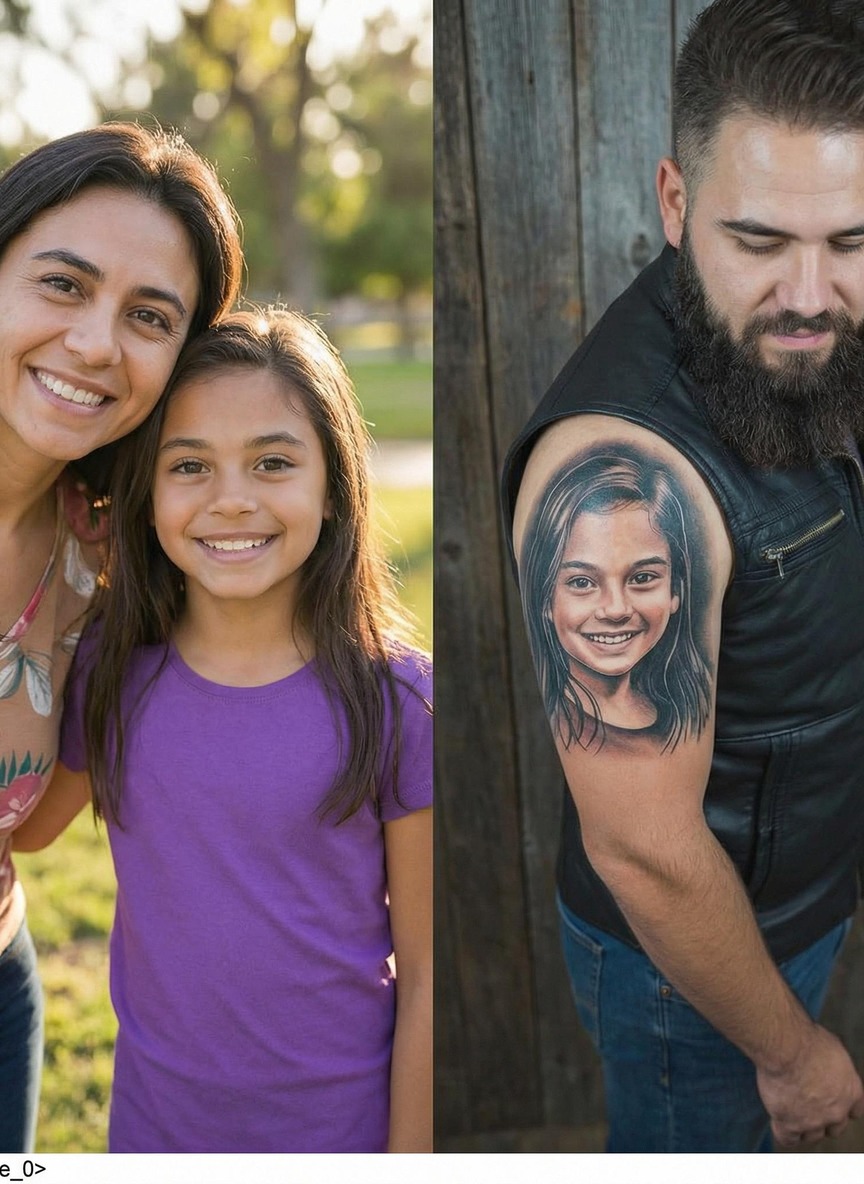
On his right arm was a tattoo.
A girl’s face.
It wasn’t elaborate—just a simple portrait. Round cheeks. Bright eyes. Braided hair.
Elena’s heart slammed so hard she thought she might faint.
She knew that face.
Her hands began to shake. The glass slipped in her fingers, clinking softly against the counter. Tears blurred her vision.
It was Sofía.
Older, perhaps, but unmistakable.
Before fear could stop her, Elena spoke.
“My son,” she said softly, her voice trembling. “That tattoo… who is it?”
The young man froze.
He looked at her, then down at his arm. The laughter drained from his face.
For a moment, he didn’t answer.
Then he swallowed.
“She’s… my sister,” he said quietly.
Elena felt the world tilt.
“How old is she?” she asked, barely able to breathe.
The man hesitated. “Eighteen. Maybe nineteen.”
Elena’s knees nearly gave out.
“My daughter disappeared eight years ago,” she whispered. “She was ten.”
The shop went silent.
The man’s friends shifted uncomfortably, exchanging looks. One muttered that they should leave.
But the man stayed.
“She doesn’t remember much,” he said slowly. “She was found years ago. Near the coast. No documents. No memory of her family. Just her name.”
Elena’s heart shattered and rebuilt itself in the same second.
“Sofía,” she breathed. “Her name is Sofía.”
The man nodded. “She told us that once. We thought it was just… something she imagined.”
Tears streamed down Elena’s face as she reached across the counter and gripped his arm—not the tattoo, but the living warmth beneath it.
“Please,” she said. “Take me to her.”
Two hours later, Elena stood outside a modest apartment on the edge of the city, her chest tight with terror and hope. The door opened.
A young woman stood there.
Her hair was braided.
Her eyes—those eyes—were Sofía’s.
They stared at each other in silence.
Then the girl’s lips trembled.
“Mamá?” she whispered.
Elena collapsed into her arms.
Eight years of waiting ended in that single word.
And though the truth behind Sofía’s disappearance would take time to unravel—years stolen, memories fractured, wounds still raw—one thing was certain:
Love had survived.
And sometimes, even after unimaginable loss, it finds its way back—etched into skin, waiting to be seen.