Freedom didn’t feel the way I’d imagined it would.
It smelled like diesel fumes, burnt coffee, and cold metal—the sharp, empty scent of a bus station just before sunrise. After three years in prison, I stepped outside carrying a thin plastic bag with everything I owned. A change of clothes. Some paperwork. Nothing else.
But my mind wasn’t on any of that.
It was on my father.
Every night behind bars, I pictured him the same way. Sitting in his old leather chair by the window, porch light casting a warm yellow glow across his face. In my head, he never aged. Never got sick. Never stopped waiting for me.
That image was the only thing that got me through.
So I went straight home.
Or at least, to what I thought was home.
The street was familiar enough, but as I walked closer, something felt off. The porch railing wasn’t the chipped white I remembered—it was freshly painted slate blue. The wild flower beds my dad never bothered with were neatly trimmed, filled with plants I didn’t recognize. Two unfamiliar cars sat in the driveway.
I slowed down, my stomach tightening, but I kept walking.
The front door was charcoal gray now. Not the dull navy my father had chosen years ago. The crooked welcome mat he used to joke about was gone, replaced with a clean, polished one that read HOME SWEET HOME.
I knocked.
Hard.
Like someone who had counted every one of the 1,095 days he’d been gone.
The door opened.
No familiar smells. No warmth. No rush of relief.
Linda stood there.
My stepmother.
Her hair was perfect. Her silk blouse crisp. Her eyes sharp and measuring, like she was assessing damage.
For a split second, I expected surprise. Maybe awkwardness. Even guilt.
Instead, her face stayed flat.
“You’re out,” she said.
“Where’s my dad?” My voice came out rough, like I’d forgotten how to use it.
Her lips pressed together. Then she said it, calm and emotionless.
“Your father was buried a year ago.”
The words didn’t land right. Buried. A year ago. I waited for her to correct herself. To smirk. To reveal it as some cruel joke.
She didn’t blink.
“We live here now,” she added. “You should go.”
My mouth went dry. “Why didn’t anyone tell me?”
She tilted her head slightly. Almost amused. “You were in prison, Eli. What did you expect? A sympathy card?”
Behind her, the house looked wrong. New furniture. New photos. None of my father anywhere. It was like he’d never existed.
And Linda was the one who erased him.
“I need to see his room,” I said, my chest tight.
“There’s nothing left,” she replied, already closing the door. Not slamming it. Just shutting it—slow, deliberate, final.
The lock clicked.
A year.
My father had been gone for a year.
And I found out like a trespasser.
I don’t remember leaving the porch. Only walking. One block, then another, until my legs carried me to the cemetery on autopilot.
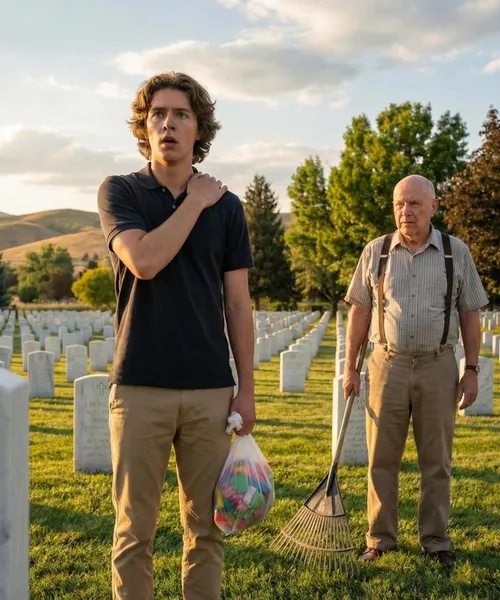
An older man was raking leaves near the entrance.
“Looking for someone?” he asked.
“My father,” I said. “Thomas Vance.”
He studied my face for a long moment, then shook his head.
“Don’t bother,” he said quietly.
My stomach dropped. “What do you mean?”
“He’s not here.”
“What?” I whispered. “I was told—”
“That man never went into the ground,” he said. “No service. No headstone. Just paperwork.”
I felt dizzy. “Then where is he?”
The man hesitated, then lowered his voice. “You should check the county storage records.”
That night, I slept on a bench near the bus station. Sometime before dawn, I felt something hard press against my side.
I reached into my jacket pocket.
A folded piece of paper.
I froze.
I was sure it hadn’t been there before.
My name was written across the front in familiar handwriting.
My father’s.
Inside was a short note.
Eli, if you’re reading this, they didn’t tell you the truth. I’m sorry I couldn’t protect you sooner. Go to Unit 317. Locker C. Use the key taped to this letter. Watch everything. Then decide what to do next. Love you. Always.
A small key fell into my hand.
My hands shook as I stared at it.
By noon, I was standing in front of a storage facility on the edge of town.
Unit 317.
Locker C.
The door rolled up with a metallic scream.
Inside sat a single folding chair, a dusty old camcorder on a tripod, and a sealed envelope.
I pressed play.
My father appeared on the screen, thinner than I remembered, but unmistakably him. He took a breath before speaking.
“Eli, if you’re watching this, I’m already gone,” he said. “And if Linda is still walking free, then you deserve to know the truth.”
He explained everything.
The forged financial records. The manipulated witness. The pressure she’d put on people behind the scenes.
“She framed you,” he said plainly. “I tried to stop it. I was too late.”
My chest felt like it was caving in.
“She thought prison would break you. And when it didn’t… she made sure I couldn’t finish fixing it.”
The video ended.
I sat there for a long time, staring at the blank screen.
She thought she’d won.
She thought I was done.
But my father didn’t leave me just a key or a letter.
He left me the truth.
And this time, I wasn’t going to let it be buried.