I’ve worked in hospitality long enough to know that long-term guests come in all types.
Some treat the hotel like a temporary home. Others treat it like a storage unit with a bed. And then there are the rare ones—the guests you actually remember long after they’ve checked out.
That’s what I thought these two women were.
They arrived together on a quiet Monday afternoon. Polite, well-dressed, always smiling. One was a bit taller with silver-streaked hair pulled neatly into a bun. The other was shorter, lively, with expressive hands and a laugh that carried down the hallway.
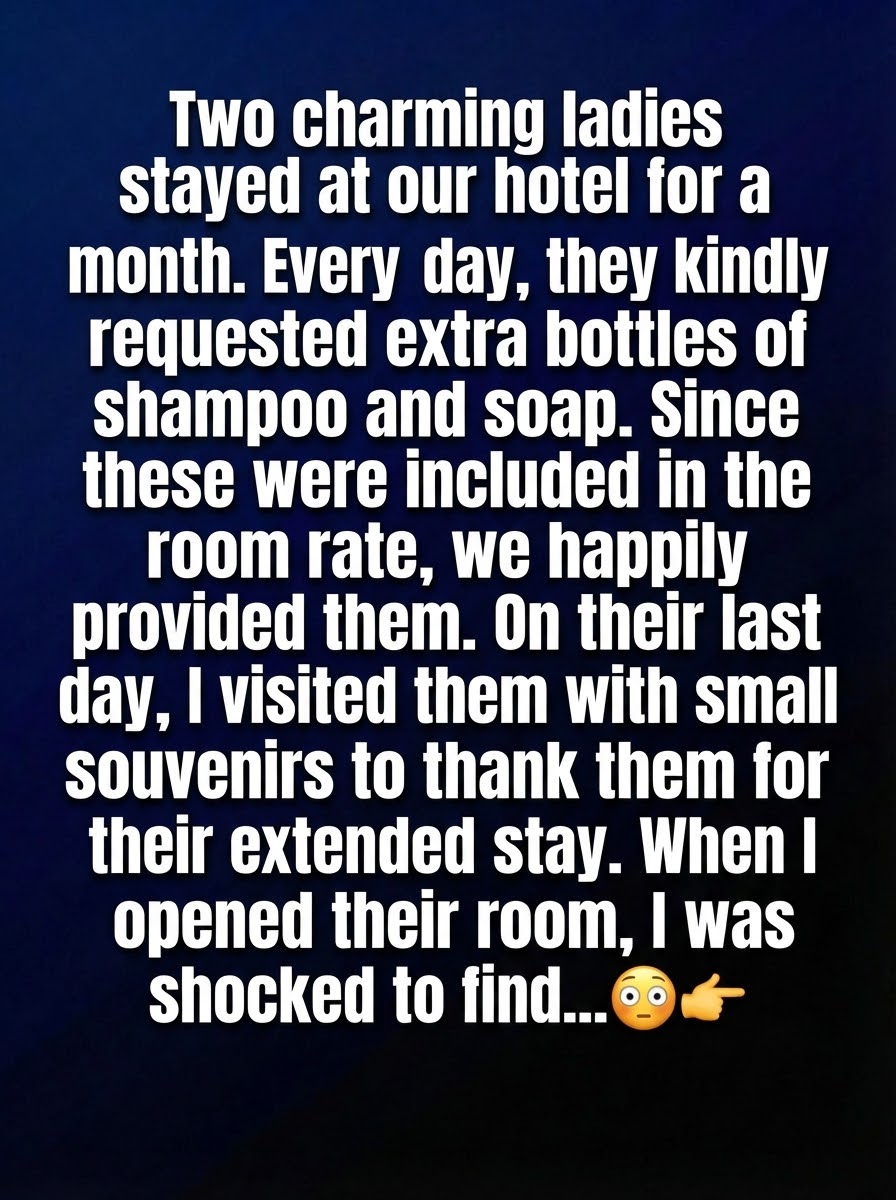
They booked a month-long stay.
From the start, they were easy guests. Friendly with the front desk, patient with housekeeping delays, always thanking staff by name. Every morning, they’d stop by the desk on their way out.
“Could we please have a couple of extra bottles of shampoo and soap today?” one of them would ask gently.
They never demanded. Never complained.
Since those items were included in the room rate, we happily provided them. No issue at all.
At first, I assumed they just preferred extra-long showers. Or maybe sensitive skin. It wasn’t my place to ask.
But as the days went on, the requests became… consistent.
Every single day.
Two shampoos. Two soaps. Sometimes lotion. Occasionally conditioner.
Housekeeping mentioned it casually one afternoon.
“They’re very sweet,” one of the housekeepers said, “but they don’t seem to use the room much. Beds barely touched. Towels barely damp.”
That struck me as odd—but again, nothing suspicious.
By week three, the staff had grown fond of them. They tipped modestly but sincerely. They remembered birthdays. They left handwritten thank-you notes for the cleaning crew.
So when their last day arrived, I decided to do something small but thoughtful.
I picked out a couple of modest souvenirs from the hotel shop—locally made keychains, a handwritten card thanking them for choosing us for their extended stay. Just a simple gesture.
I knocked on their door that afternoon, assuming they’d still be packing.
No answer.
I tried again. Still nothing.
Front desk confirmed they were checking out later that evening, but housekeeping said the room was still occupied.
I used my master key, expecting to find suitcases open on the bed or clothes laid out.
Instead, I opened the door—and froze.
The room was spotless.
Too spotless.
No luggage. No clothes. No personal items. The beds were perfectly made, untouched. Towels neatly folded. Curtains open. The air smelled faintly of soap.
And lining the desk, the dresser, the nightstand—even the windowsill—were dozens upon dozens of hotel toiletries.
Shampoo. Soap. Conditioner. Lotion.
All neatly arranged. Categorized. Counted.
At first, my stomach dropped.
Had they been stealing?
But then I noticed something else.
On the desk was a folded piece of paper, weighted down with a bar of soap.
My name was written on the front.
With shaking hands, I picked it up and opened it.
Thank you for your kindness.
We hope you won’t be angry when you understand.
Everything we took was given freely—and everything is going where it’s needed most.
Confused, I looked closer.
Behind the toiletries were cardboard boxes, already packed and labeled.
One read: “Women’s Shelter – East Side.”
Another: “Senior Care Home.”
Another: “Community Outreach – Hygiene Kits.”
That’s when it hit me.
They weren’t hoarding.
They were collecting.
Carefully. Intentionally. Respectfully.
I stood there for a long moment, trying to process what I was seeing.
Then I noticed a second envelope.
Inside were copies of donation receipts, volunteer IDs, and a short explanation written in careful handwriting.
They traveled from city to city, staying in hotels for extended periods, quietly building hygiene kits for shelters that struggled to keep basic supplies stocked. Hotels already factored toiletries into room costs—and instead of letting them go unused, they made sure they reached people who desperately needed them.
They never resold anything. Never wasted anything.
They just… redirected abundance.
At the bottom of the note was one final line:
Thank you for treating us with dignity. We promise we passed it on.
When they came to the front desk later that evening, I didn’t confront them.
I didn’t accuse them.
I thanked them.
And for the first time in weeks, I saw something shift in their expressions—not guilt, not fear—just relief.
One of them squeezed my hand gently and said,
“Kindness compounds when you don’t keep it to yourself.”
After they left, we changed a policy.
Unused toiletries are now donated monthly to local shelters.
Staff volunteer days are encouraged.
And every time someone asks for “extra shampoo,” I don’t assume anything anymore.
Because sometimes, generosity doesn’t look dramatic.
Sometimes it looks like two women, a quiet smile, and a room full of soap—waiting to change someone else’s life.