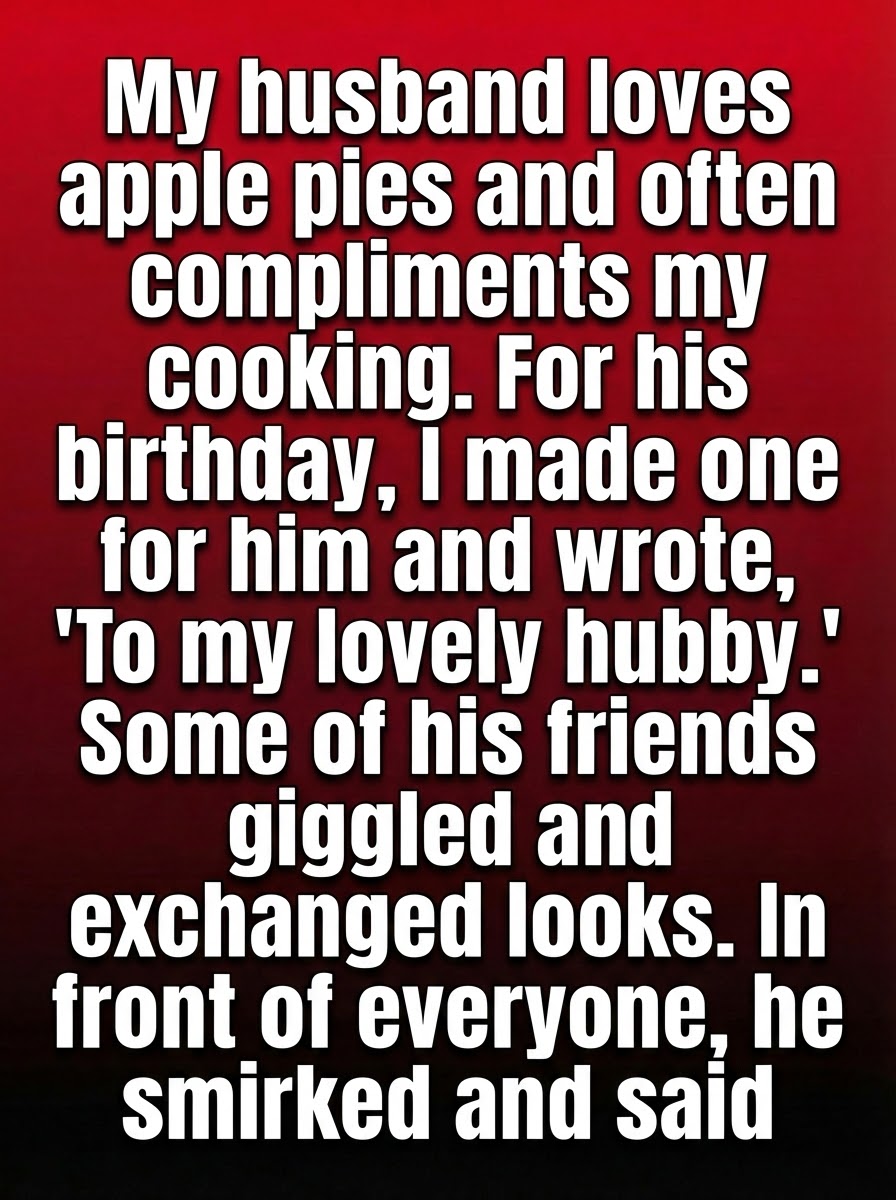
My husband has always loved apple pie. It’s his comfort food, his weakness, the one dessert he never turns down. And to his credit, he’s usually quick to praise my cooking. He’ll take a second slice, lean back in his chair, and say things like, “You really nailed this,” or “I don’t know how you do it.”
So when his birthday rolled around, I wanted to do something sweet and personal.
I baked him his favorite apple pie from scratch. Real apples, cinnamon, flaky crust, the whole thing. Before putting it out, I carefully wrote a little message on top with dough letters: “To my lovely hubby.”
It wasn’t meant to be clever. It was meant to be loving.
We had a small gathering that evening. A few friends, some family, laughter filling the house. When I brought out the pie, everyone clapped. My husband smiled, leaned forward to read the message… and then something shifted.
A couple of his friends snorted. One of them elbowed another. There were looks exchanged. Quiet giggles.
I felt my face warm, confused but still smiling.
Then my husband smirked.
Right there, in front of everyone, he said, “Well… I guess that explains why the pie’s so soft.”
The room went quiet for half a second. Then laughter. Loud, awkward laughter.
Someone said, “Ohhh man.”
Another added, “Brave guy.”
I laughed too. At least, I think I did. That automatic laugh you give when you’re embarrassed but don’t want to seem uptight. But inside, something dropped.
He kissed my cheek like it was all a joke, like I should be in on it. “Relax,” he whispered. “I’m kidding.”
But the moment passed strangely. The pie got cut. Compliments were handed out. Life moved on.
Except it didn’t, not really.
Later that night, after everyone left and the dishes were stacked in the sink, I brought it up. Not angrily. Just honestly.
“Hey,” I said, “that comment earlier kind of hurt.”
He sighed like I’d asked him to solve a math problem at midnight. “Come on. It was a joke. Everyone laughed.”
“Yeah,” I said quietly. “They did.”
He shrugged. “You’re being sensitive.”
That word stuck with me.
Over the next few weeks, little things started standing out more than they used to. The jokes at my expense. The comments disguised as humor. The way he’d laugh a bit too hard when someone teased me, instead of shutting it down.
None of it was cruel enough to explode over. But it piled up.
And then came the dinner party.
We were hosting again, and I cooked all afternoon. A full spread. Everyone praised the food, and someone said, “You’re lucky. She really takes care of you.”
Before I could even respond, my husband chuckled. “Yeah, well… someone has to make up for her other shortcomings.”
More laughter.
I didn’t laugh this time.
I just smiled, excused myself, and went into the kitchen under the pretense of checking the oven. I stood there longer than necessary, staring at nothing, realizing something uncomfortable: I felt smaller in my own home.
That night, I couldn’t sleep.
I replayed moments from the past few years. How often I brushed things off. How often I swallowed my feelings to keep the peace. How often “just joking” became a shield for disrespect.
The next morning, I made a decision.
A week later, I baked another apple pie.
Same recipe. Same care. Same flaky crust.
When I brought it to the table, I smiled and said, “I made your favorite.”
He grinned, already reaching for a knife. “You’re spoiling me.”
I nodded. “I know.”
Then I added, calmly, “This one’s just for you.”
He laughed. “What’s the occasion?”
I met his eyes. “No occasion. Just appreciation.”
As he cut into it, he noticed the writing on top.
This time it said: “Made with love. Served with boundaries.”
The room went silent.
“What’s that supposed to mean?” he asked, half-laughing.
“It means,” I said evenly, “I love doing things for you. I love cooking. I love being thoughtful. But I don’t love being the punchline.”
No yelling. No drama. Just the truth.
His friends shifted uncomfortably. Someone cleared their throat.
I continued, still calm. “Jokes are funny when everyone’s laughing. When one person’s smiling just to survive the moment, that’s not humor.”
He stared at the pie. Then at me.
Later that night, he apologized. Not a quick one. A real one. He admitted he’d crossed lines. That he’d gotten too comfortable. That he hadn’t realized how often he’d done it.
We talked for hours.
Things didn’t magically fix themselves overnight. But something changed. The jokes stopped. The respect came back. And when it didn’t, I spoke up.
As for the apple pie?
He still loves it.
But now, when he compliments my cooking, he does it without smirks, without side comments, without turning love into entertainment.
And that little message I wrote on his birthday?
I don’t regret it at all.
Because it taught me something important: kindness should never require swallowing your dignity. And love should never come at the cost of your voice.