My name is Harper. I’m thirty-six years old, and six months ago, my life split cleanly down the middle.
Before and after.
Before was my son, Luke. His laugh. His tiny sneakers by the door. The way he said “Mama” like it was the safest word in the world.
After was the phone call.
A car accident. No warning. No goodbye. Just a silence so loud it swallowed everything else.
My husband, Ryan, stayed for a little while. Long enough to try. Long enough to realize he couldn’t stand watching me fall apart. One night, he said quietly, “I don’t know how to help you anymore,” and left.
I didn’t fight him.
I barely noticed.
Grief hollowed me out. I stopped answering messages. Avoided friends with children. Crossed the street if I heard a baby cry because the sound felt like a blade to my chest.
The holidays came and went in a blur of empty rooms and untouched decorations.
By January, I was surviving—but only just.
That Tuesday, I went to the grocery store because my fridge was empty and my body still needed fuel, even if my heart didn’t care.
I stood in line, coat pulled tight around me, staring at nothing, when I noticed the woman ahead of me.
She couldn’t have been older than twenty-five.
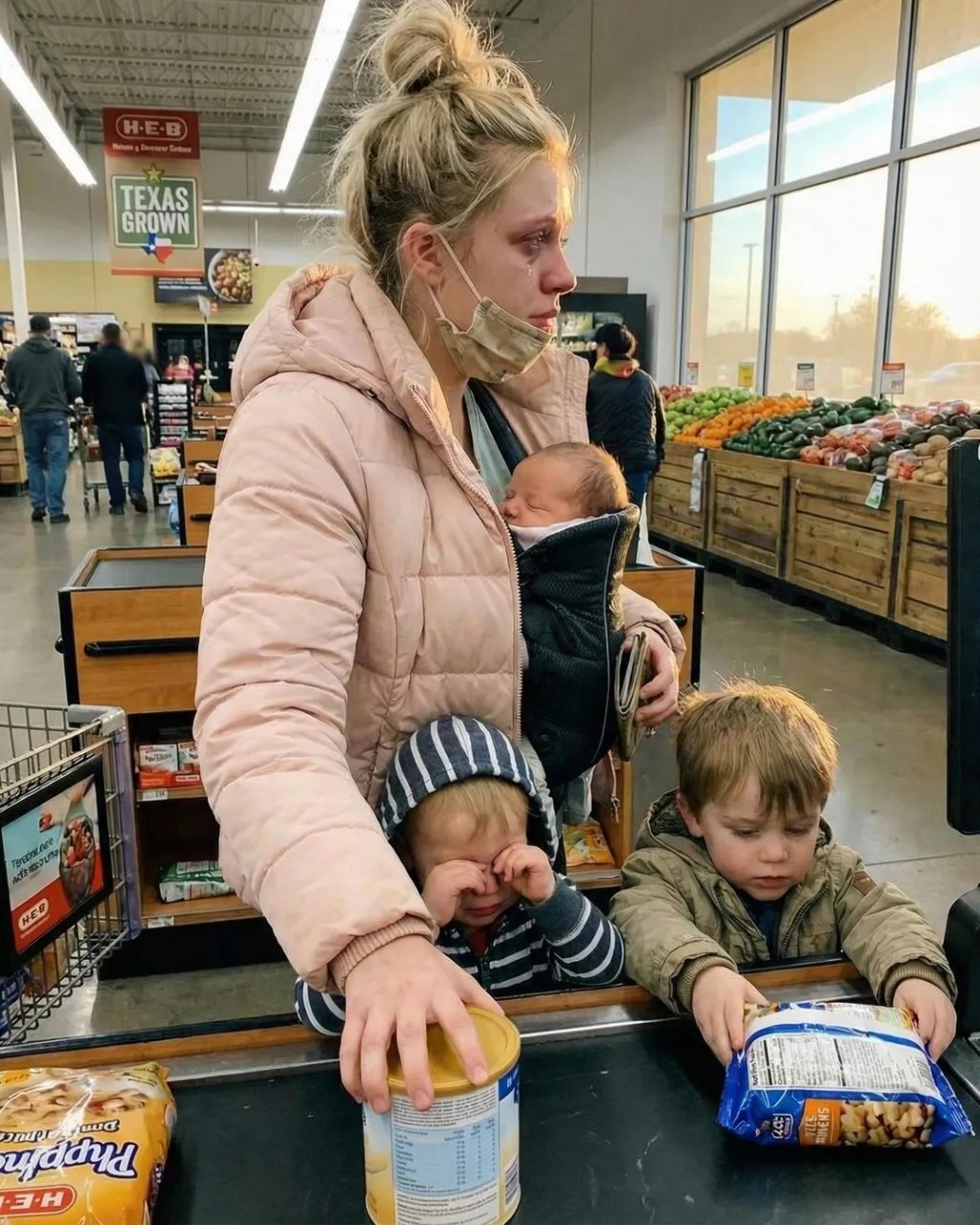
Three kids clung to her—one on her hip, one tugging at her sleeve, another standing too quietly at her side. She looked exhausted in a way sleep alone doesn’t fix.
The cashier rang up her items.
She nodded, then hesitated, digging into her purse.
Coins clinked onto the counter. Pennies. Nickels. A few crumpled bills.
Her hands shook as she counted.
The total flashed red.
She stared at it, then at the can of baby formula sitting there like an accusation.
That’s when the murmurs started.
“Are you serious?” a woman behind me hissed. “Three kids and you can’t even pay for formula?”
“Count faster,” someone snapped. “Some of us actually have jobs.”
A man leaned forward, voice sharp and cruel. “How do you even afford three? Didn’t you think this through?”
The young woman flinched like she’d been struck. She hugged the can closer.
“I just… I’m short,” she whispered. “I didn’t realize—”
“Just what?” someone barked. “You expect sympathy?”
“Step aside if you can’t pay!”
My stomach twisted. My throat burned.
I couldn’t hear another word.
“I’ll pay for it,” I said suddenly, my voice trembling but loud enough.
The line went quiet.
The woman turned, eyes wide, disbelief written across her face. “You… really?”
I nodded, already handing my card to the cashier.
“It’s okay,” I said softly. “I’ve got it.”
She covered her mouth, tears spilling over. “Thank you. I—thank you.”
People behind us sighed and rolled their eyes, annoyed at the delay.
I didn’t care.
I watched her shoulders sag with relief as the transaction went through, as if someone had finally loosened a weight crushing her chest.
Before she left, she whispered, “You have no idea what this means.”
I didn’t answer.
Because I did.
That night, I couldn’t sleep.
I kept seeing her face—her fear, her humiliation, the way she’d braced herself for cruelty and been shocked by kindness instead.
I thought about how close grief and desperation live to each other.
How easily anyone can fall.
The next afternoon, there was a knock at my door.
I almost didn’t answer.
When I opened it, a man in military uniform stood on my porch.
He was tall, composed, his posture unmistakable—but his eyes were gentle.
“Harper?” he asked.
“Yes?”
“Were you at the grocery store yesterday?”
My heart started pounding. A thousand possibilities raced through my mind.
“Yes,” I said cautiously.
He exhaled slowly, then nodded. “May I come in for a moment?”
He introduced himself as Captain Daniel Morales.
“I’m Allison’s husband,” he said.
The name hit me instantly.
“She told me what you did,” he continued. “I’m currently stationed overseas. I came home early this morning.”
He swallowed, jaw tightening.
“She’s been holding everything together while I’ve been gone. Three kids. No help. Too proud to ask.”
He looked down at his hands.
“She didn’t tell me how bad it had gotten.”
My eyes stung.
“She didn’t do anything wrong,” I said quietly.
“I know,” he replied. “That’s why I’m here.”
He reached into his jacket and pulled out a small envelope.
“I don’t want your money back,” he said quickly, seeing my expression. “I want to thank you.”
Inside was a handwritten letter.
From Allison.
She wrote about the shame she’d felt standing in that line. About how close she’d been to breaking. About how one stranger’s kindness reminded her she wasn’t invisible.
At the bottom, she wrote:
You saved more than a purchase. You saved my dignity.
I couldn’t hold the tears back.
Daniel stood, straightening his uniform. “You didn’t just help my wife,” he said softly. “You helped my family. And I wanted you to know that mattered.”
As he turned to leave, he hesitated.
“Allison would like to bring the kids by sometime. If you’re open to it.”
I surprised myself by saying yes.
They came the following Sunday.
The kids filled my quiet house with noise and movement and life. The baby gurgled. The older two played on the floor.
For the first time in months, the sound didn’t shatter me.
It hurt—but it healed too.
Later, Allison squeezed my hand and said, “You didn’t know it, but you helped me survive that day.”
I smiled through tears. “You helped me too.”
Grief doesn’t disappear.
But sometimes, when you show up for someone else, it loosens its grip—just enough to let light back in.
And sometimes, kindness circles back in ways you never expect.
All it takes is one moment.
One choice.
One open heart in a grocery store line.