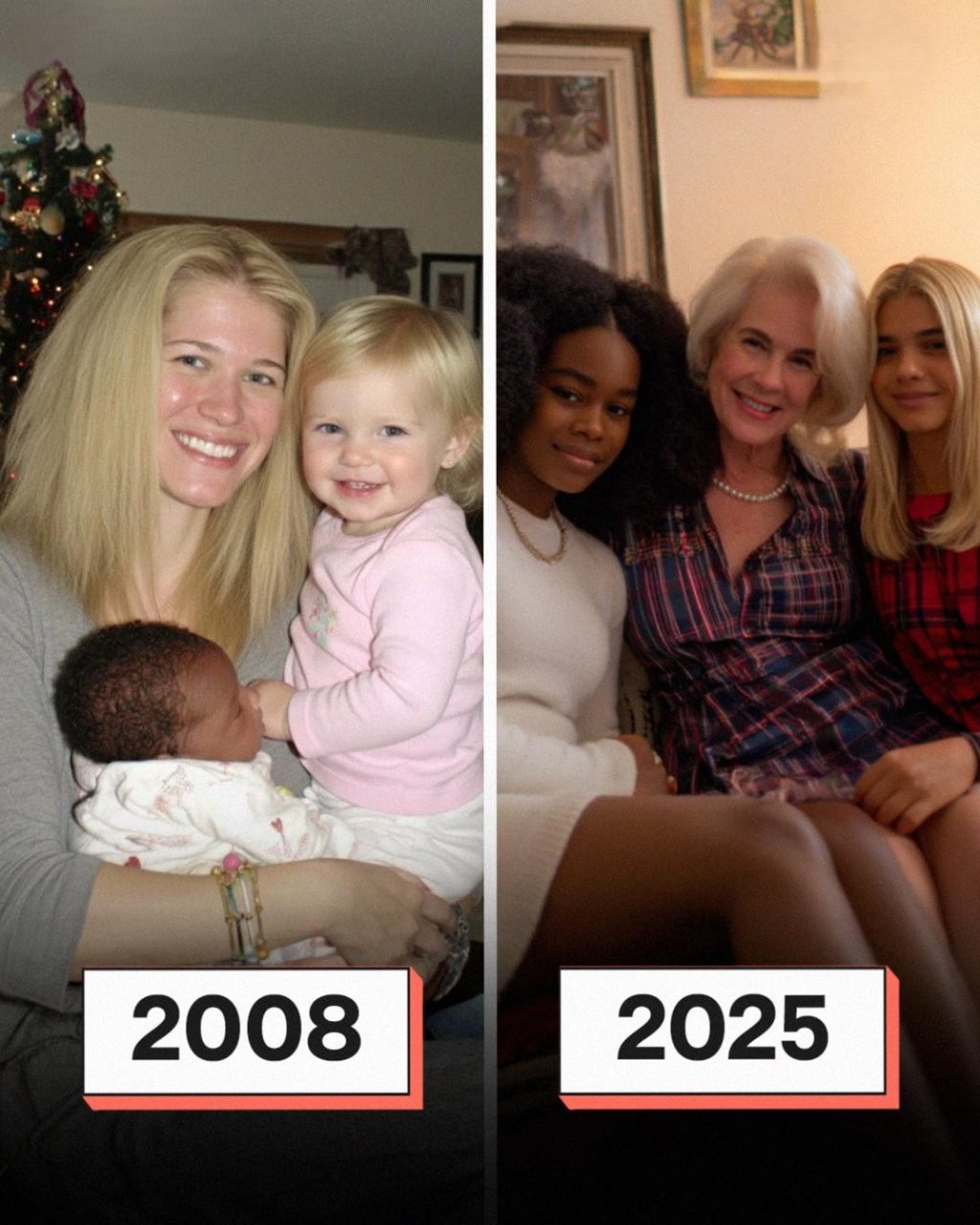
I wanted to become a mother more than anything.
My husband and I tried for years.
Doctors. Tests. Treatments. Thousands of dollars. Hundreds of pills.
And still—only miscarriages.
My husband was kind and patient, but I could see the quiet fear in his eyes every time I said, “Maybe next time.”
The hope was hurting him, too.
One night, after my fifth miscarriage, I sat on the cold bathroom floor, my back against the tub, my hands shaking.
And for the first time in my life, I prayed out loud.
“Dear God,” I whispered, my voice breaking, “if You give me a child… I promise I’ll save one too. If I become a mom, I will give a home to a child who has none.”
Ten months later, I was holding my newborn daughter.
Stephanie.
She was perfect. Pink. Loud. Alive.
I cried harder than I ever had in my life—not from pain, but from gratitude.
And I never forgot my promise.
On Stephanie’s first birthday, while balloons floated against the ceiling and cake frosting smeared her tiny hands, my husband and I signed the final adoption papers.
We adopted a baby girl named Ruth.
She had been abandoned on Christmas Eve—left near the city’s main Christmas tree, wrapped in a thin blanket, with no note. No name. No explanation.
From that day on, I had two daughters.
Stephanie grew into a bold, confident child. She spoke her mind early and loudly, never afraid to take up space.
Ruth was quiet, observant, deeply sensitive. She watched the world carefully before stepping into it.
They were different in every way—but my love for them never was.
I packed the same lunches.
I kissed the same scraped knees.
I sat through the same school plays, the same late-night talks, the same heartbreaks and triumphs.
When people asked who was adopted, I never answered—because it didn’t matter.
They were both mine.
Years passed.
Seventeen of them.
And I thought—foolishly—that love had protected us from everything.
The night before Ruth’s prom, I stood in the doorway of her room, holding my phone, ready to take pictures. She looked beautiful in her dress, standing stiffly in front of the mirror.
She didn’t look at me.
“MOM,” she said quietly, “you are not coming to my prom.”
I smiled, confused.
“What? Of course I am.”
She finally turned toward me. Her eyes were red. Her jaw was tight.
“No,” she said. “You’re not. And after prom… I’m leaving.”
My heart stopped.
“Leaving?” I asked. “Why?”
She swallowed hard.
“Stephanie told me the truth about you.”
The room went cold.
“What truth?” I whispered.
Ruth’s voice trembled, but her words landed like knives.
“She said I’m not your real daughter. That you only adopted me because you felt guilty. That I was some kind of charity project.”
My knees weakened.
“She said you promised God you’d ‘save one’—and I was just the payment,” Ruth continued. “That Stephanie is the miracle, and I’m… the obligation.”
I felt like I couldn’t breathe.
“That’s not—” I started, stepping forward.
“DON’T,” she snapped, tears finally spilling. “Don’t lie to me. I heard her. I heard how she talks about me when you’re not around.”
I sank onto the edge of her bed.
“She said you never would’ve chosen me if you hadn’t already gotten what you wanted.”
Silence filled the room, heavy and suffocating.
I didn’t defend myself right away.
Instead, I asked softly, “Ruth… do you remember when you were seven and got sick at school?”
She frowned, confused. “Yes.”
“I left work in the middle of a meeting. I drove forty minutes in traffic to sit with you until you fell asleep. Do you remember what you said?”
She hesitated. “I… asked if you’d stay.”
“And what did I say?”
She whispered, “You said you’d always stay.”
I nodded, tears streaming.
“Ruth, I didn’t adopt you to keep a promise to God,” I said. “I kept the promise because of you.”
She shook her head, unsure.
“I didn’t know who you would be when I prayed on that bathroom floor,” I continued. “But when I met you—when I held you—I knew my heart had been waiting for you, specifically.”
She broke down then, sobbing into her hands.
The next morning, I called Stephanie into the kitchen.
She tried to brush past me.
“No,” I said firmly. “Sit.”
She rolled her eyes. “What?”
I took a deep breath.
“You do not get to rewrite this family.”
Her face hardened. “I just told the truth.”
“No,” I said calmly. “You told a version that made you feel bigger by making your sister feel smaller.”
Her mouth opened, then closed.
“You’ve always known Ruth was adopted,” I continued. “But you were never more loved. Never more chosen.”
“She gets all the attention,” Stephanie muttered. “You’re always worried about her.”
I looked her straight in the eyes.
“Because she’s quieter. Because she needs reassurance. Not because she’s less.”
She looked away.
“If you can’t respect your sister,” I said, “you will not live here as an adult.”
The words shocked her into silence.
Ruth went to prom that night.
I didn’t attend—but not because she didn’t want me there.
She asked me to stay home because she needed space. And I respected that.
At 2 a.m., she came home, kicked off her heels, and crawled into my lap like she used to when she was little.
“I’m not leaving,” she whispered.
I held her all night.
Years later, Ruth would stand at her own wedding and say in her vows:
“I was chosen. Twice. Once by chance… and once by love.”
And Stephanie?
She apologized. Slowly. Imperfectly. But sincerely.
Because love doesn’t mean we never hurt each other.
It means we stay—and do the work to heal.
And I stayed.
For both of my daughters.