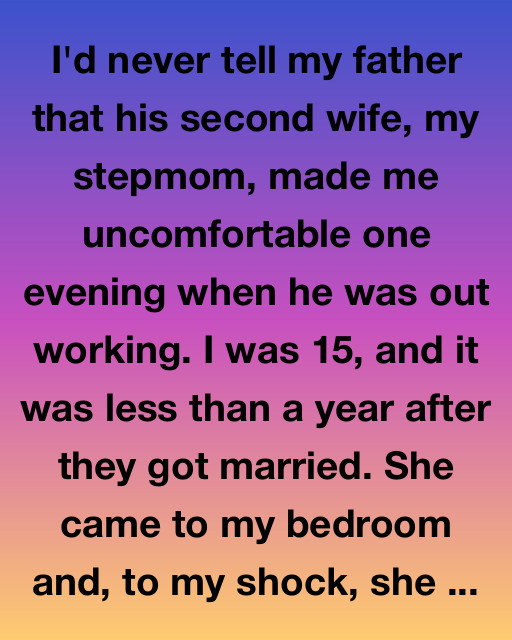
I never told my father that his second wife—my stepmom—made me uncomfortable one evening while he was working late.
I was fifteen.
It had been less than a year since they got married, and everything in our house still felt unfamiliar, like furniture that hadn’t found its place yet. I was still grieving my mom in quiet ways I didn’t know how to explain, and suddenly there was this new woman trying to fit into a role no one had prepared me for.
I kept my head down. I stayed polite. I told myself that if I just didn’t cause trouble, things would eventually feel normal.
They didn’t.
The Night That Changed Everything
That night, my dad had picked up an extra shift. He kissed me on the forehead before leaving and reminded me to lock the doors.
I was in my room doing homework when I heard my stepmom knock.
“Can I come in?” she asked.
I hesitated—but said yes.
She sat on the edge of my bed, too close for comfort, asking questions that felt… off. Not inappropriate in words, but in tone. In how long she stayed. In how she watched me instead of listening to my answers.
I remember the way my stomach tightened.
The way my body told me something wasn’t right before my brain could explain it.
Then she said something that crossed a line—not loudly, not aggressively—but enough to make my heart race and my throat go dry.
I froze.
She laughed it off when she saw my reaction, stood up, and said, “Relax. I didn’t mean anything by it.”
But I knew better.
Why I Stayed Silent
I didn’t tell my father.
Not that night. Not the next day. Not even the week after.
I was scared of being misunderstood. Scared of being blamed. Scared that I’d somehow ruin his happiness after everything he’d been through.
So I did what a lot of kids do.
I swallowed it.
I started locking my door at night. I avoided being alone with her. I memorized my dad’s schedule and planned my day around it.
On the outside, I was a normal teenager.
On the inside, I was always on edge.
The Pattern I Couldn’t Ignore
Over the next few months, it happened again—not the same way, but enough to confirm my fear.
Lingering touches on my shoulder.
Comments that made my skin crawl.
Moments where she invaded my space and then brushed it off as “affection.”
Each time, I felt smaller.
Each time, I told myself I was overreacting.
Until one day, I overheard her on the phone.
Laughing.
Talking about me like I was a problem she needed to “manage.”
That’s when something in me snapped—not in anger, but in clarity.
I realized staying silent wasn’t protecting my father.
It was protecting her.
The Truth Finally Comes Out
I told my school counselor.
My voice shook the entire time, but she listened. Really listened.
She didn’t question me. She didn’t minimize it. She didn’t tell me I’d misunderstood.
She took it seriously.
Within days, my father was called in.
I still remember sitting in that office, staring at the floor, terrified to look up.
When my dad finally spoke, his voice cracked.
“Why didn’t you tell me?”
I whispered the truth.
“Because I was scared you wouldn’t believe me.”
He cried.
Not loud sobs—just quiet, broken tears that told me everything I needed to know.
What My Father Did Next
He confronted her that same night.
She denied it, of course. Said I was confused. Said I was “imagining things.”
But my father didn’t waver.
He chose me.
She was gone within a week.
No shouting. No drama. Just consequences.
He apologized over and over—not for her actions, but for not seeing sooner. For bringing someone into our lives who made me feel unsafe.
Healing Takes Time
I didn’t bounce back overnight.
Trust doesn’t repair itself just because the danger is gone.
But my father showed up. Every day.
He asked how I felt. He listened. He learned.
We went to therapy—together.
Slowly, the house felt like home again.
What I Understand Now
Years later, I know something I didn’t at fifteen:
Discomfort is not something you have to justify.
If something feels wrong, it deserves to be heard.
Silence doesn’t protect peace—it protects harm.
And the people who truly love you will always want the truth, even when it’s hard to hear.
If You’re Reading This and Relate
You’re not weak.
You’re not dramatic.
And you’re not alone.
Your voice matters.
And it always has.