It started as a little habit.
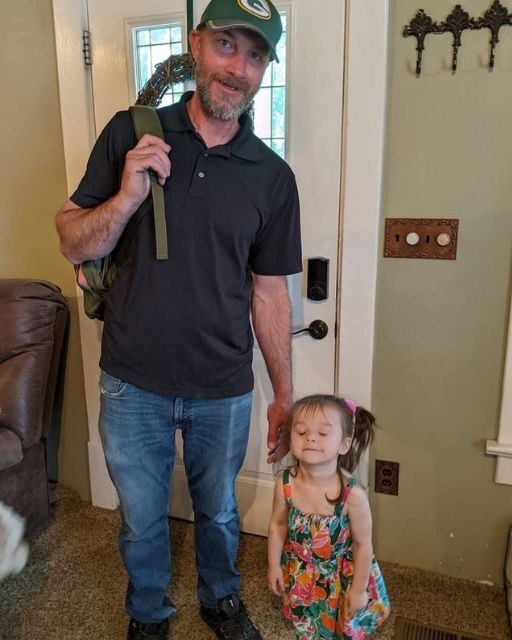
She’d finish her snack, wipe her hands on that same flowery dress, and wander over to the door as if it were part of her daily routine. No TV, no toys—just the door. Sometimes she’d sit cross-legged on the mat, sometimes she’d stand with her nose pressed to the glass, whispering little updates like, “Daddy, it rained today,” or “I saved you the blue jellybean.”
At first, we thought it was cute. Then it became a ritual. Rain or shine, weekday or weekend, she was there. Waiting.
And he always made it worth it. Every single time, the second that door opened, she lit up like it was Christmas morning. He’d scoop her up, kiss her forehead, and say, “Thanks for keeping the house safe, Lieutenant.”
Today, though… today was different.
He was late.
Not just a few minutes late—over an hour. Her face stayed glued to the window while her little fingers tapped a restless rhythm on the glass.
“Maybe he got more traffic, sweetheart,” I murmured, trying to keep my voice light.
She nodded, but her eyes didn’t move from the driveway.
Five more minutes passed. Then fifteen. Then thirty.
“I think he’ll be here any minute,” she whispered, but her voice trembled like she didn’t believe it. “He always comes back.”
My chest tightened. She had too much faith for someone so small.
Finally, after nearly two hours, she turned to me with wide, glistening eyes. “Mommy… did Daddy forget me?”
That question nearly broke me in half.
“No, baby,” I whispered, pulling her close. “Daddy didn’t forget you.”
But the truth was… I didn’t know.
I had tried calling him—twice. No answer.
I texted—no response.
And the last message he sent me that morning, the one I’d brushed off as stress, suddenly felt colder than I wanted to admit:
We need to talk tonight.
Another hour passed before the sound finally came—the crunch of tires on gravel.
Her head shot up. Her entire body froze.
“He’s here!” she cried, scrambling toward the door.
She yanked it open before he even reached the steps.
But instead of being scooped into his arms, she halted.
He didn’t smile.
He didn’t open his arms.
He didn’t look like her hero.
His eyes were red-rimmed, his jaw tight, his shoulders slumped like he was carrying something too heavy to hold. And in that moment, I knew—whatever he’d meant when he said we needed to talk, it wasn’t going to be good.
“Daddy?” she whispered.
He forced a smile then. A weak, strained one. He crouched to her level, hugged her tighter than usual, and whispered, “I missed you, Lieutenant.”
But even she felt it—something wasn’t right.
She didn’t light up. She didn’t giggle. She just clung to him with silent worry.
I stood in the doorway with my arms wrapped around myself, waiting for the blow I knew was coming.
He put her to bed early that night. Earlier than usual.
He read two stories instead of one.
He sang her the silly song he usually “didn’t have the energy for.”
He held her hand until she fell asleep.
And the whole time, I stood in the hall, watching him through the crack in the door.
When he finally stepped out, he closed her door gently and leaned his forehead against the frame.
“She deserves better than me,” he whispered.
My stomach dropped. “What is going on?”
He didn’t look up. “I almost didn’t come home today.”
“What do you mean?”
He took a deep breath—the kind that tries to hold back a storm.
“I had chest pain at work. Bad pain. It dropped me to my knees.”
My heart stopped.
“What? Why didn’t you call me?!”
“Because I didn’t want you to panic. I didn’t want her to see me like that.” He dragged a trembling hand through his hair. “They rushed me to the hospital. The doctor said… it was a warning. A serious warning.”
My knees went weak. “A heart attack?”
“A prelude to one,” he said quietly. “They said if I don’t change everything—stress, work, habits—I might not have much time.”
I pressed a hand to my mouth, swallowing a sob.
He continued, voice cracking, “And when I was lying there, all I could think about was her waiting by the door. How one day she might sit there and I might never walk through it again.”
I felt tears spill down my cheeks. “Why didn’t you tell me sooner? Why did you make her wait like that today?”
He shook his head. “I wasn’t sure I’d walk out of that hospital. I wasn’t sure—” His voice broke entirely. “I wasn’t sure she’d ever see me again.”
We sat on the couch together for nearly an hour. Sometimes talking. Mostly crying.
But then something happened neither of us expected.
Little footsteps.
Her bedroom door creaked, and our daughter padded down the hall, clutching her teddy.
“Daddy?” she said softly.
He wiped his face quickly, forcing a smile. “Hey, Lieutenant. What are you doing awake?”
She climbed onto his lap, placed both hands on his cheeks, and whispered, “You’re sad.”
He swallowed hard. “I’m okay, sweetheart.”
“No,” she said simply. “You’re sad. But I’m here.”
And something in him shattered.
He held her to his chest and cried into her hair—quietly, but more honestly than I’d ever seen.
She hugged him tighter than I thought her tiny arms could manage.
When he finally calmed down, she looked up at him and whispered in the most matter-of-fact tone:
“Don’t go away again. It makes Mommy cry.”
We both froze.
“I saw her,” she added softly. “She hid in the bathroom.”
My eyes widened. I didn’t realize she’d seen that.
He pulled both of us close—one arm around her, one arm around me.
“I’m not going anywhere,” he whispered. “Not if I can help it.”
The next morning, everything changed.
He called in sick—a sentence I’d never heard him say in the decade I’d known him. Not once.
He made oatmeal instead of grabbing a coffee and donut.
He walked our daughter to school instead of rushing to beat traffic.
He came home and sat with me at the table, holding my hand like he was afraid to let go.
Then he showed me the papers from the hospital.
And the pamphlets.
And the emergency instructions.
The doctor’s handwritten note at the bottom read:
This is your chance. Don’t waste it.
That afternoon, he took our daughter to the park. He didn’t sit on the bench like usual—he joined her. He climbed the slide with her. He chased her in the grass. He laughed with a freedom I hadn’t seen in years.
And when she looked at him with those wide, adoring eyes, something clicked for both of us.
She didn’t wait by the door because it was a ritual.
She waited by the door because he was her world.
And he finally understood what it meant to protect that world.
Weeks passed.
He changed his diet.
He quit smoking.
He cut his work hours in half.
He went to every doctor’s appointment, every follow-up, every recommended therapy session.
He started walking every evening. Not once alone—our daughter insisted on coming.
She liked to hold his hand and match her tiny steps to his.
Every night, they’d stop at the big oak tree near the end of the street, and she’d say the same thing:
“This is your heart-healthy tree, Daddy. It keeps you alive.”
He always laughed, but he always hugged her too.
And then one night, something happened I’ll never forget.
They returned from their walk, and instead of heading straight inside, he lifted her up and said:
“Do you want to help me with something important?”
Her eyes lit up. “Yes!”
He turned to me with a nervous smile. “You too.”
We followed him into the living room, where he kneeled down and looked at our daughter with all the seriousness in the world.
“I used to think being a good dad meant working hard,” he said softly. “But now I know… it means coming home. It means listening. It means being here.”
She placed her little hand on his cheek again. “You’re here.”
He nodded. “I’m here. And I promise”—his voice wavered—“I’ll do everything I can to stay here. For you and Mommy.”
She threw her arms around him, burying her face in his shoulder.
And in that moment, as he held her close, I felt something inside me shift too.
We were not the same broken family from a few weeks ago.
We were healing.
Together.
Now, every afternoon, she still waits by the door.
But not with anxious whispers.
Not with fear.
Not with a breaking heart.
She waits with a drawing in her hand, eager to show her daddy what she made.
The door opens.
She beams.
He lifts her up.
And instead of thanking her for “keeping the house safe,” he says something new:
“Thanks for keeping my heart going, Lieutenant.”
Because she did.
She saved him in ways none of us saw coming.
And he’s finally walking through that door again—not as the tired, overworked man he used to be…
…but as the father she always believed he could become.