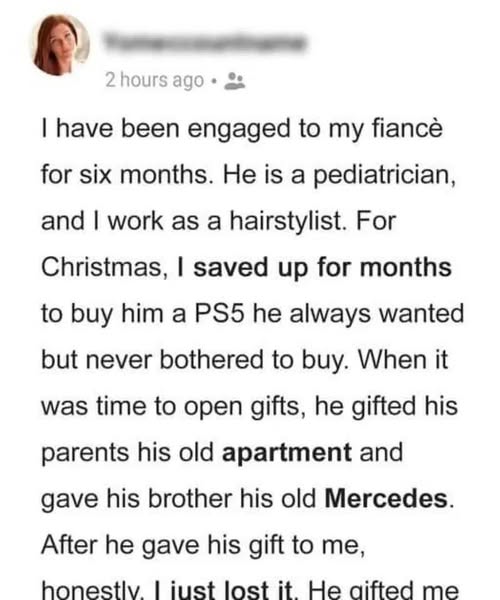
I have been engaged to my fiancé for six months. He is a pediatrician, and I work as a hairstylist.
For Christmas, I saved up for months to buy him a PS5 — something he had always wanted but never bothered to get for himself. It wasn’t easy. I took extra shifts, skipped little comforts, and budgeted carefully just to afford it. But I wanted to show him how much I cared.
When Christmas morning finally arrived, I was excited to give him the gift. But before I could hand him mine, we started exchanging presents with his family.
That’s when everything shifted.
He gifted his parents his old apartment — fully paid off — and gave his brother his old Mercedes. Everyone cheered, hugged him, and praised him for his generosity.
Then he turned to me.
After giving gifts worth tens of thousands of dollars to his family, he handed me a neatly wrapped box, smiling like he had done something wonderful.
Inside was… a keychain.
A small, cheap keychain with our initials on it.
My heart dropped.
I tried to smile, but I couldn’t. Not after spending months scraping together money for a PS5 while he had given away assets that could have changed my entire life.
After the gathering, he noticed my silence.
“What’s wrong?” he asked, confused.
And that was the moment I broke.
I told him everything — how hard I had worked to afford his gift, how much thought I had put into it, and how receiving a keychain after his extravagant generosity to others made me feel invisible.
He frowned.
“So you’re upset because I didn’t give you something expensive?”
His tone wasn’t angry… it was dismissive.
And somehow, that hurt even more.
“No,” I replied. “I’m upset because you didn’t think about me at all. You didn’t consider what I might need, or like, or value. You didn’t match the effort. Not even close.”
He crossed his arms.
“I can give my family whatever I want. They’ve done more for me than you have.”
That sentence cut deeper than any cheap gift ever could.
I felt small — smaller than I had ever felt in my life.
And for the first time, I realized something I had been ignoring for months:
Whenever his family needed something, he was there.
Whenever I needed something, he was… busy.
The truth had been in front of me the whole time.
The Turning Point
The next day, his mother stopped by to drop off leftovers from Christmas dinner. She noticed my red eyes and asked what was wrong.
I didn’t plan to tell her — but the words spilled out anyway.
Her expression changed. She sighed and placed a hand on my shoulder.
“I know my son,” she said softly. “He means well, but he takes people for granted. Especially women. His last girlfriend left him for that reason.”
My breath caught.
I had never heard a single word about this.
“She wanted a partner,” his mother continued. “But he wanted someone who would adjust to him, not someone he needed to adjust for.”
And finally, everything clicked.
I wasn’t his partner.
I was an accessory — someone who made his life convenient.
The PS5 wrapped under the tree suddenly felt symbolic.
I had poured everything into our relationship, while he had given me whatever scraps of attention he had left.
The Confrontation
That evening, he texted me asking why I hadn’t apologized yet.
Apologized.
For feeling unappreciated.
I stared at the screen, numb, and asked him a simple question:
“What did you think I wanted for Christmas?”
He replied instantly:
“I don’t know. Girls like small thoughtful gifts. I figured the keychain was cute.”
Cute.
Meanwhile, I was struggling with bills. Working double shifts.
Trying to build a future he assumed he didn’t need to invest in.
I realized then that our definitions of love were worlds apart.
His love was effortless — because he made no effort.
Mine was exhausting — because I gave until it hurt.
The Choice
The next morning, I visited him with the PS5.
I placed it gently on his counter.
“What’s this?” he asked.
“It’s your Christmas gift,” I said. “But I won’t be here when you open it.”
He laughed awkwardly.
“Stop being dramatic.”
“I’m not,” I replied. “I want someone who invests in me the way I invest in them. Someone who doesn’t measure my worth by what I give, but by who I am.”
He opened his mouth to argue, but for the first time, I didn’t let him finish.
“I deserve a partner. Not a project. Not a man who thinks my love is cheap.”
His face fell.
“Are you breaking up with me over a keychain?”
“No,” I said firmly. “I’m breaking up with you because the keychain represents exactly how little you see me.”
I walked out.
And for the first time in months, I felt light.
The Letter That Changed Everything
A week later, his mother came to my salon. She handed me an envelope.
“I found this in his room,” she said. “It’s something you should see.”
Inside was a list — a list of financial goals he wanted to achieve before marriage.
One of them said:
“Don’t spend too much on her. She needs to know I’m careful with my money.”
Another said:
“Once we’re married, she’ll have to stop working so much. I need her available.”
My stomach turned.
I hadn’t lost a fiancé.
I had escaped a future that would have drained me dry.
His mother hugged me before she left.
“You did the right thing,” she whispered.
And I believed her.
Healing and Moving Forward
The breakup hurt, but the healing that followed changed everything.
I started investing in myself — taking courses to grow my salon business, buying things I had always denied myself, and surrounding myself with people who valued me.
A few months later, one of my clients — a woman I had done hair for many times — said something that made me tear up.
“You glow different now,” she told me. “Like someone who finally remembers her worth.”
And she was right.
I had spent years shrinking myself for someone who never once tried to grow for me.
Now?
I take up space unapologetically.
The Lesson
Sometimes life gives you a small moment — a cheap keychain, a disappointing holiday, a careless word — that reveals a much bigger truth:
Love without effort is just convenience.
And you deserve more than being convenient.