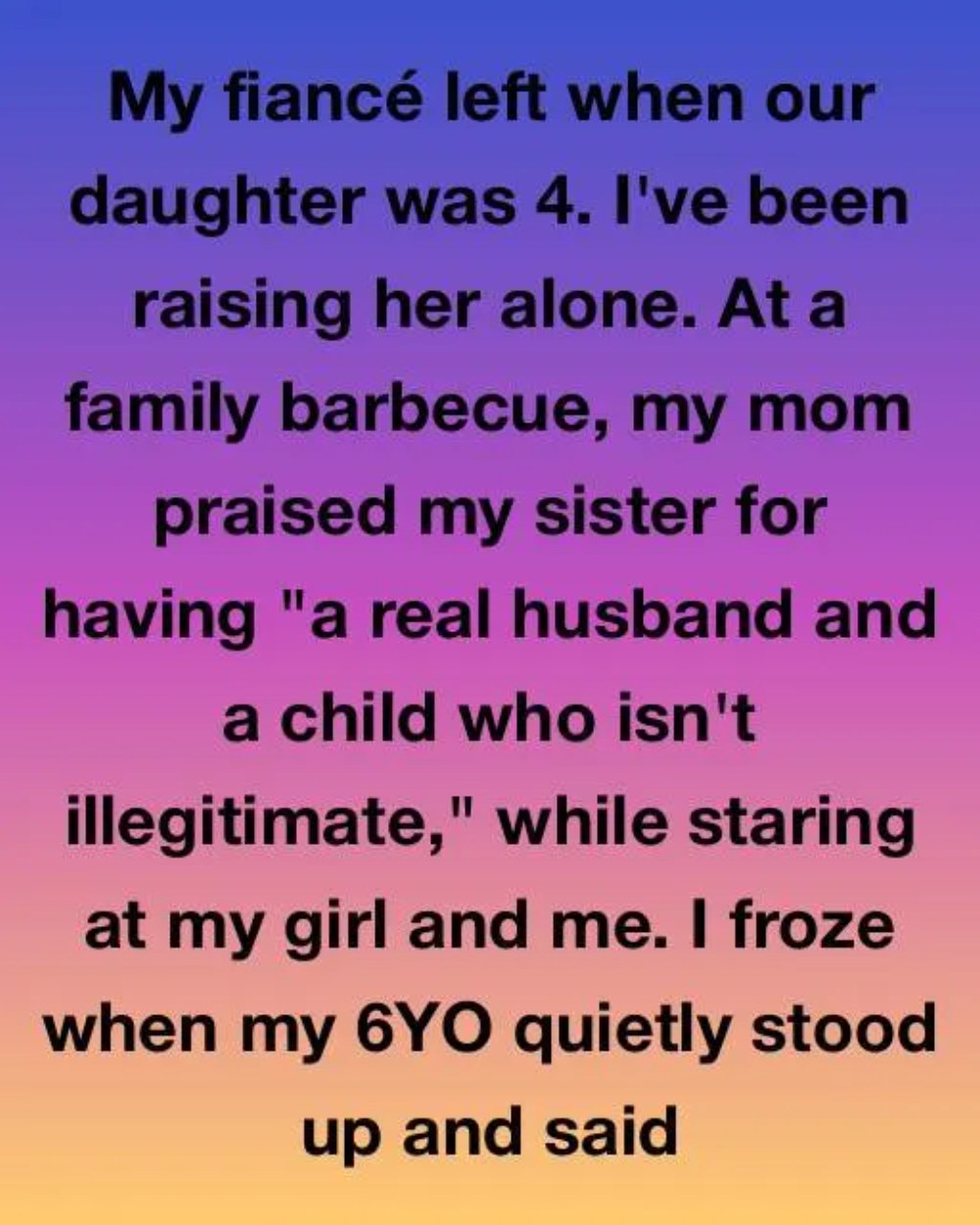
My fiancé left when our daughter was four.
Since then, I’ve been raising her alone—every scraped knee, every bedtime, every hard question that shouldn’t fall on a single parent’s shoulders.
Still, she grew into the brightest little soul I’d ever known.
Last weekend, my family hosted a barbecue. Smoke from the grill curled through the warm evening air, kids ran in the yard, and the adults circled together talking about “real families” and “traditional homes.”
I already felt out of place. My mother’s tone all day had been sharp, judgmental… pointed.
Then it happened.
My mom raised her glass and loudly praised my sister for having “a real husband and a child who isn’t illegitimate,” all while staring directly at my daughter and me.
The entire yard went quiet.
Her words hit me like a slap. I felt my stomach twist, shame and rage colliding.
I opened my mouth to defend us—but before I could say a single word, my six-year-old stood up.
Slowly. Calmly. With a seriousness that did not belong on such a tiny face.
She looked straight at my mother and said:
“Grandma, I’m not illegitimate. I’m loved. And Mommy is stronger than anyone here.”
The yard froze.
Even the birds seemed to stop singing.
My mother’s smile faltered—just a flicker, but enough to reveal the guilt beneath.
But my daughter wasn’t done.
She stepped closer, voice rising with a bravery that made my eyes burn.
“Daddy left because he didn’t know how to be a dad. Mommy didn’t leave. She stayed. So she’s the real parent.”
My sister’s mouth dropped open.
My uncle choked on his beer.
My mother’s face turned pale.
I felt tears slip down my cheeks—quiet, unstoppable—because I had never said those words out loud. Not once. I never wanted her to feel abandoned or different.
But she knew. Children always know more than we think.
And in that moment, she chose me.
When my daughter finished speaking, she slipped her small hand into mine. Her fingers trembled, though her voice had not. She had been braver than any adult there.
My mother tried to laugh the moment off, waving her hand.
“Oh come on, it was just a joke. You’ve all gotten so sensitive.”
But no one laughed.
My aunt crossed her arms and stepped forward. “It wasn’t a joke, Linda. You’ve said things like that for years.”
My mother’s jaw tightened. “I’m just being honest! A child deserves two married parents—”
I cut her off.
“Stop.”
It came out steadier than I felt.
“For six years, you’ve acted like my daughter is some stain on the family. You’ve talked down to me. Criticized me. Whispered behind my back. But insulting her? No. That ends today.”
My mother scoffed. “I’m trying to help you! You need to find a man and give that child a proper home.”
I stared at her, stunned at how easily the words rolled off her tongue.
“A proper home?” I repeated softly. “She has one. She has me. And that’s enough.”
My daughter squeezed my hand again.
Across the yard, my sister stepped forward, her face softening. “Mom… she’s right. And you were out of line.”
My mother turned toward her, betrayed. “I can’t believe you’re siding with her.”
“I’m siding with what’s right,” my sister said.
For the first time in my life, she stood up for me.
The tension cracked through the yard like lightning. People shifted uncomfortably, staring at the ground, pretending to refill drinks.
My mother folded her arms, doubling down. “I will NOT be attacked in my own backyard.”
“You attacked us,” I replied quietly. “And you’ve been doing it for years. I just never wanted to cause a scene.”
My daughter looked up at me, small voice trembling. “Mommy… can we go home?”
That did it.
I picked her up, kissed her cheek, and turned toward the gate.
Behind me, the murmurs grew louder. Someone muttered, “She’s right.” Someone else added, “I can’t believe Linda said that.”
Just before I stepped out, my mother called after me.
“Wait!”
I paused, but didn’t turn around.
Her voice cracked. “Don’t take her away from me.”
I slowly turned to face her. For the first time, she looked scared. Not angry. Not judgmental. Just… scared.
“Why shouldn’t I?” I asked.
My mother swallowed hard. “Because she’s my granddaughter.”
“Then treat her like one,” I said softly. “Treat me like your daughter. Because we deserve better than this.”
She opened her mouth to argue—but nothing came out.
I walked away.
A WEEK LATER
I didn’t expect her to call.
But she did.
Her voice was shaky. “Can I come over? I… I want to apologize. To both of you.”
Part of me wanted to reject her. To let her feel the sting of being pushed away.
But then I looked at my daughter sitting on the floor, drawing us holding hands. Her joy. Her innocence. Her heart far too big.
And I knew what to do.
“Come over,” I said. “But this time… things will change.”
When my mother arrived, she knelt in front of my daughter, tears in her eyes.
“I’m sorry,” she whispered. “You’re perfect. And your mother… she’s stronger than I ever gave her credit for.”
My daughter hugged her without hesitation.
And for the first time in a very long time, I felt something soften inside me.
Maybe forgiveness wasn’t weakness.
Maybe it was healing.