“Never leave appliances like toasters or coffee makers plugged in when not in use,” my electrician told me one afternoon while fixing a light fixture in my kitchen.
At first, I laughed. It sounded like one of those overly cautious things people say—like “don’t run with scissors” or “don’t open the fridge during a thunderstorm.”
But the look on his face told me he wasn’t joking.
He unplugged my toaster, pointed to the outlet, and said quietly,
“You’d be surprised how many fires start from these little guys. Even when they’re turned off.”
I didn’t think much of it at first… until I saw what he showed me next.
The Warning That Hit Home
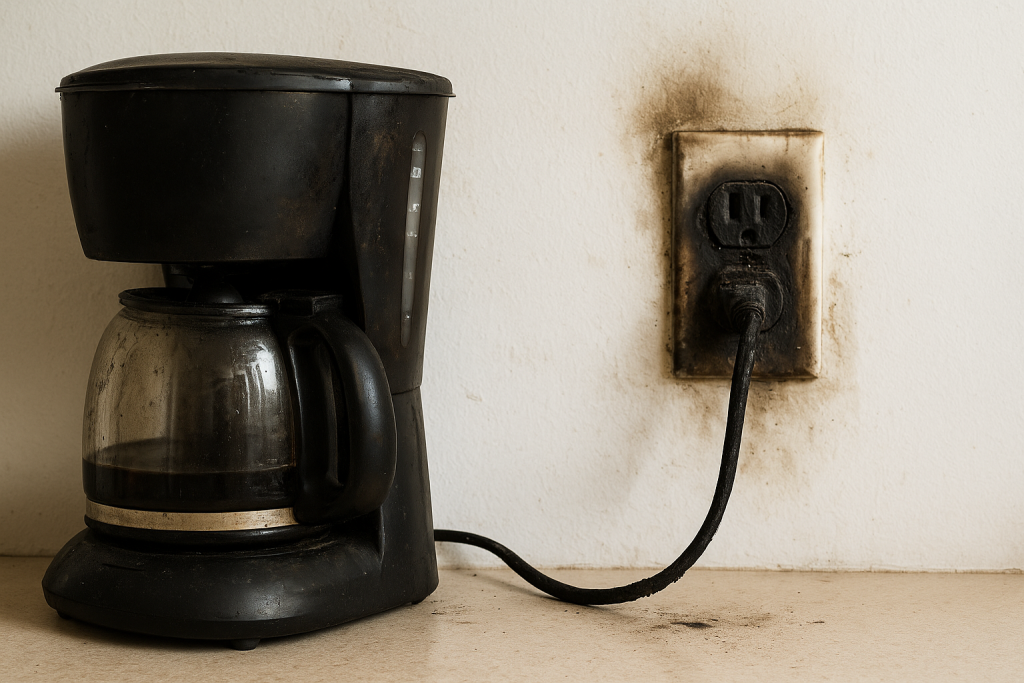
He reached into his toolbox and pulled out a melted outlet plate—charred black around the edges.
“This,” he said, “was from a coffee maker. It was off, but still plugged in. Internal wiring faulted overnight. The family woke up to a kitchen full of smoke.”
I froze.
I’d left my coffee maker plugged in for years. Every single day. Same with the air fryer, toaster, and blender—everything stayed ready to go.
The idea that something could ignite while I was asleep made my stomach twist.
He went on, explaining that small kitchen appliances, especially older ones or those with heating elements, draw what’s called phantom energy—a trickle of electricity that keeps them on standby. But if there’s even a slight wiring defect or dust buildup inside, that current can spark a fire.
“Doesn’t happen often,” he said, “but when it does—it’s bad.”
The Night Everything Clicked
A week later, his words came back to me in the worst way.
It was a quiet Sunday night. I’d just finished cleaning the kitchen and was heading to bed when I noticed a faint smell—burnt plastic.
At first, I thought it was coming from outside. Then I realized the smell was stronger near the counter. My heart dropped.
The toaster.
It wasn’t on. The switch was in the off position. But the metal casing felt warm. Not hot—but warm enough to scare me.
I yanked the plug from the socket, and the faintest crackle sounded as I did.
That was all I needed to never ignore that advice again.
The Truth Behind Plugged-In Dangers
The next morning, I called my electrician back. He explained what probably happened:
Tiny particles of bread crumbs had built up inside the toaster over time, creating a short circuit when moisture in the air interacted with the heating coil.
“Most people don’t realize,” he said, “those crumbs don’t just burn when the toaster’s on. Sometimes, they smolder when it’s off—if it’s still connected to power.”
He told me he’d seen enough melted cords and half-burned countertops to fill a gallery of kitchen horror stories.
Apparently, toasters, coffee makers, and even slow cookers can overheat from residual current if left plugged in for long periods.
And here’s the kicker—insurance companies often don’t cover damages caused by appliances left plugged in but turned off, because it’s classified as “preventable negligence.
I Started Unplugging Everything
That same day, I went out and bought a set of surge-protecting power strips with individual switches.
Now, after every use, I unplug or switch off every appliance in my kitchen.
Toaster. Coffee maker. Air fryer. Microwave. Even the phone charger on the counter.
It only takes a few seconds, but it gives me peace of mind that I’ll never wake up to smoke or worse.
And when I shared what happened with my friends and neighbors, the reactions were the same: surprise, disbelief, and then a kind of nervous laughter—until they heard the story of that melted outlet plate.
What the Fire Department Confirmed
A few weeks later, I happened to bring it up at a community safety talk hosted by our local fire department.
The fire chief nodded immediately.
He said they respond to dozens of small kitchen fires every year caused by unattended or plugged-in appliances.
According to him, the top culprits are:
- Toasters – Crumbs and residual heat build-up.
- Coffee makers – Thermostats or timers malfunctioning.
- Air fryers & slow cookers – Overheated cords or stuck relays.
- Electric kettles – Burnout from mineral deposits.
He said something that really stuck with me:
“People think it’s about leaving the stove on. It’s not. It’s the silent electricity that starts most fires.”
The Picture That Proved It
A few months later, I shared a post online with the same warning: “Never leave appliances plugged in when not in use.”
Someone commented, skeptical, saying, “What’s the worst that could happen?”
So, I posted a photo (the one my electrician showed me)—a half-melted coffee maker, its cord fused to a blackened outlet.
That image said more than words ever could.
A Small Habit That Saves Lives
Now it’s automatic for me. I finish breakfast, unplug everything, and walk away knowing the kitchen is truly safe.
And every time I do, I remember that faint smell of burnt plastic and the sound of that tiny crackle when I pulled the toaster plug.
Because that could’ve been the start of something far worse.
It’s such a small change—barely an inconvenience—but it’s one that could save your home, or even your life.
So if you’re reading this, take this story as your sign:
Before you leave the house tonight, or go to bed, look around your kitchen.
Unplug that toaster. That coffee maker. That air fryer.
You’ll sleep easier knowing you did.